By Md Abdur Rouf Mia | Updated 19 October 2026 | Google guidance checked 19 October 2026
AI content EEAT guidelines come down to one test that Google repeats in several documents: did a person add real value to this page, and did a person check every claim before it went live? AI-assisted writing is allowed. Mass-produced pages with little added value are what earn a “Lowest” quality rating and, at scale, run into Google’s spam policies.
Two recent changes mean most guides on this topic are already out of date. On 1 October 2026 Google edited two Search Central pages, adding a firm instruction to manually fact-check all AI-generated content. And since 15 May 2026, Google’s spam policies explicitly cover content shown in AI Overviews and AI Mode.
This guide explains the current AI content EEAT guidelines in plain English, separates a quality “rating” from a “penalty” (a distinction most headlines blur), and gives you a free 12-point checklist you can download and use on every article.
The short version:
- Under the AI content EEAT guidelines, using AI does not by itself lower a page’s quality rating. Adding little or no value does.
- A rater’s score does not change how your page appears. Spam enforcement is a separate system, and that is where demotion happens.
- Since 1 October 2026 Google says to manually fact-check all AI content, including titles, meta descriptions, structured data and image alt text.
- What protects you is boring and specific: firsthand material, a named accountable person, checked sources, honest limits and no scaling tricks.
- Download the free 12-point AI Content EEAT Checklist (PDF, 2 pages).
AI Content EEAT Guidelines in 2026: What Google Actually Says
People say “Google penalises AI content” as if it were one rule. It is three separate things, and mixing them up leads to bad decisions.
| Layer | What it is | Can it hurt your site? |
|---|---|---|
| Search Quality Rater Guidelines | The manual for roughly 16,000 contract raters who score search results. Their scores help Google test and train its systems | Indirectly. The guidelines say no single rating changes how a page appears. They are not a ranking checklist |
| Ranking systems | Automated systems that reward helpful, reliable, people-first content | Yes, gradually. Unhelpful pages tend to lose ground, with no notice and no label |
| Spam policies and manual actions | Published rules, including scaled content abuse, enforced by automated systems and human reviewers | Yes, directly. This is where pages and sites get demoted or removed |
So under the AI content EEAT guidelines, a “Lowest” rating is a warning about how Google’s own evaluators would judge your page, not a penalty notice. The real exposure is the combination: a page a rater would call Lowest is usually also a page the ranking systems rank poorly, and at volume it can look like scaled content abuse.
The four letters in E-E-A-T come from the rater guidelines: Experience, Expertise, Authoritativeness and Trust, with trust at the centre. They are a framework raters use to judge quality, not a score sitting on your page. Experience was added in December 2022 to capture something a model cannot supply: whether the author has actually done the thing they describe.
Google AI Content Quality Guidelines 2026: What Changed and What Did Not
Here is the timeline that matters for the AI content EEAT guidelines, with the sources I used.
| Date | What changed | Why it matters |
|---|---|---|
| 23 Jan 2025 | Rater guidelines grow from 170 to 181 pages, with Google’s first definition of generative AI and sections on scaled content abuse, expired domain abuse and site reputation abuse | Main content made with automated tools and little added value can be rated Lowest |
| 11 Sep 2025 | 182-page edition adds examples for rating AI Overviews | Still the edition Google hosts as of October 2026, according to PPC Land |
| 15 May 2026 | Google says its spam policies apply to content in AI Overviews and AI Mode | Manipulating AI answers counts as spam |
| 24 Mar, 24 Jun, 18 Aug 2026 | Three spam updates, each rolling out in a few days or less | Google did not publish a new policy with them. Case studies of the August update point at scaled, thin pages, some AI-assisted |
| 1 Oct 2026 | Google updates its generative AI guide and its helpful-content page | Manual fact-checking of all AI content is called critical, and effort and oversight are spelled out |
The 1 October change is the one to act on in the AI content EEAT guidelines. Google’s guide now says it is “critical to manually factcheck and review all AI-generated content” before publishing, and explains why: generative models predict likely words instead of retrieving facts, so their output can contain hallucinations. Coverage of the update notes the review extends to titles, meta descriptions, structured data and image alt text.
The same day, Google added a passage to its people-first content guidance. As practitioners summarised it, generating pages from feeds or producing large amounts of AI text without manual oversight or curation counts as little to no effort. Those summaries are secondary, so read the page itself before you quote it.
What did not change. Google still does not say AI-generated content is penalised because it is AI-generated. It still says AI can help with research and structure. And it has published no rule that ranks pages by an AI-detector score. If you read that a 2026 rater-guidelines update changed this, check the document: PPC Land reports that the hosted edition is still the September 2025 one.
Avoid Google Lowest Quality Rating AI: What Actually Triggers It
The rater guidelines assess main content on effort, originality, talent or skill, and accuracy. The AI content EEAT guidelines add a specific warning: if most of a page’s main content is automated or AI-generated and nobody added original value, the page should be rated Lowest. The patterns that point that way include:
- Filler at scale. Many pages that restate the same facts with little effort, originality or curation.
- Paraphrase without contribution. Rewriting other sources with nothing new added, even if credit is given.
- AI residue. Telltale leftovers, such as phrases like “as an AI language model”, which Search Engine Land reported raters are told to look for.
- Deception about who is behind the page. The guidelines treat deceptive information about a site or its creator as a strong reason for the lowest rating.
- Significant inaccuracies. Factual errors undermine trust, and trust sits at the centre of E-E-A-T.
Notice what is missing from that list of AI content EEAT guidelines triggers: the words “written by AI”. The Lowest rating is triggered by missing value, missing effort and missing honesty. Google’s own spam policy on scaled content abuse says the same thing from the enforcement side: it covers many pages produced mainly to manipulate rankings, whether a person, a model or both made them.
For a deeper look at why generic machine-written text is losing reader trust as well as rankings, see The AI Slop Backlash Is Real.
The Four E-E-A-T Pillars and What AI Can and Cannot Supply
| Pillar | What AI alone can do | What you must add |
|---|---|---|
| Experience | Summarise a spec sheet or a review | Something you did: a test, screenshot, measurement, worked example |
| Expertise | Sound knowledgeable | A named author with relevant background, and expert review on high-stakes topics |
| Authoritativeness | Nothing. It is earned over time | Consistent, accurate coverage that other credible sources recognise |
| Trust | Produce confident text, including confident errors | Verified facts, transparency about who is behind the page and how it was made |
Under the AI content EEAT guidelines, not every page needs deep expertise. Google’s people-first guidance says plainly that not all content requires specialised credentials. A recipe or a product-setup walkthrough is judged differently from medical or financial advice, which the guidelines call Your Money or Your Life topics and examine most closely.
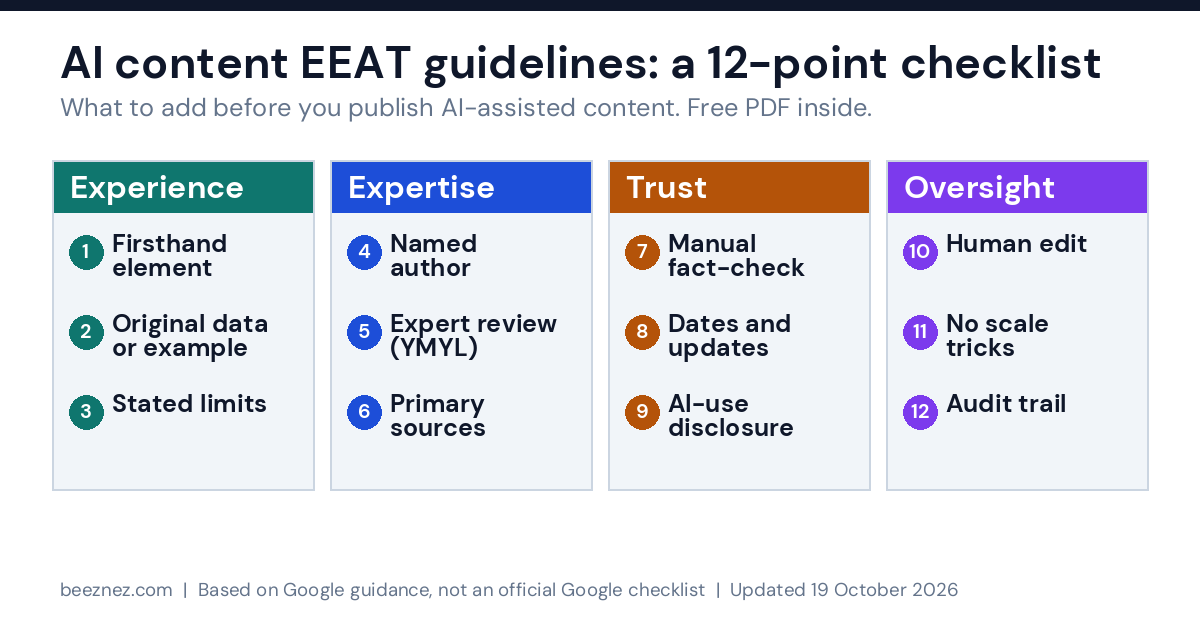
How to Optimize AI Content for Google EEAT: The 12-Point Checklist
This is the working part of the AI content EEAT guidelines. Each check has an action and a piece of evidence to keep, because “we reviewed it” means little unless you can show how. The same list, with a scoring column and an AI-use log, is in the free PDF checklist. It is my own heuristic built from Google’s published guidance, not an official Google document.
Experience: show that someone actually did the thing
1. Add a firsthand element. Include a test you ran, a measurement, a screenshot, a photo or a worked calculation. Say clearly what you tested and what you only researched. Keep your raw notes and files.
2. Add original data or a worked example. Include one number, table or case that a model could not produce from general knowledge. My n8n self-hosting cost breakdown is built around a calculator and dated server prices for this reason: the arithmetic is checkable and the inputs are the reader’s own.
3. State your limits. Say what you did not test, what is an estimate, and when prices or facts were last verified. Honest limits build trust faster than confident gaps. I label cost models as models, not tests, in articles like the Zapier vs Make vs n8n comparison.
Expertise: put accountable people behind the page
4. Use a named author with a real bio. Link to an author page that shows relevant background. Anonymous or invented personas are a trust problem, and the guidelines treat deception about creators severely.
5. Get expert review for high-stakes topics. For health, money, legal or safety content, have a qualified person review the page and name them with the date and scope of their review.
6. Cite primary sources. Link the original source, such as a law, a vendor page or a study, not a blog that summarises it. Open every link before you publish and note the date you accessed it.
Trust: verify, date and disclose
7. Fact-check manually, including the small parts. Check every claim, number, quote and link by hand. After 1 October, include the title, meta description, schema and alt text. Do not ask the same model to grade its own work and count that as a check.
8. Date and update honestly. Show published and updated dates, log real changes, and re-check fast-moving facts such as prices on a schedule. A “verified on” date is only worth showing if you actually verified.
9. Disclose AI use where it helps readers. Google has not mandated a disclosure format in its AI content EEAT guidelines. A plain line saying how AI was used and who reviewed the page, plus a published editorial policy, is enough. Mine is on the Editorial Policy page.
Editorial oversight: the part that stops scaled content abuse
10. Edit like a human editor. Rewrite for your voice, cut filler and generic introductions, and remove leftover AI phrases and citations you cannot find. If you cannot defend a sentence, delete it.
11. Do not scale for its own sake. Publish one page per distinct reader need. Avoid near-duplicate pages for keyword variants. A useful rule: publish only as many pages as you can genuinely review.
12. Keep an audit trail. For each article, record the tool used, what the AI did, what a human did, who reviewed it and when. If your site is ever questioned, this record is your evidence. It also makes updates easier.
How to Humanize AI Content for SEO Without Gimmicks
The popular meaning of “humanize” is making text slip past AI detectors. That is the wrong target. Nothing in the AI content EEAT guidelines ranks pages by detector score, and Google’s documents talk about value, effort and accuracy, not writing style. To humanize AI content for SEO in a way that helps, add what a model cannot: specifics, judgement and accountability.
| Generic AI draft | After a human added something real |
|---|---|
| “Self-hosting n8n is a powerful way to save money on automation.” | “On a 4 GB server, self-hosting n8n costs about $28 to $30 a month in cash. Two hours of upkeep at $40 an hour adds $80, so the time costs nearly three times the server.” |
| “Many businesses find AI tools helpful.” | “I did not run these five scenarios on all three tools, so this article makes no claim about which scored highest.” |
Both rewrites contain something checkable. The first has numbers and a calculation. The second has an honest limit. Here is how to get there:
- Replace claims with numbers and dates. Every adjective like “powerful” or “significant” should become a figure, an example or a source.
- Take a position and give the reason. Models hedge. A reader wants to know what you would choose and why.
- Show trade-offs and exceptions. Generic text lists benefits. Experienced writers say when the advice does not apply.
- Add the detail only you have. The mistake you made, the setting you changed, the figure that surprised you. If you have none, you may not be the right author for that page.
- Read it aloud and cut. Remove padding, stock introductions and repeated points.
Two things to avoid. First, do not use “humanizer” tools that rewrite text to defeat detectors. Some vendors of writing tools warn that synonym-swapping can distort meaning, and a distorted claim is a new accuracy problem. Second, do not disguise AI involvement. Disclosure is cheap, and it builds the trust that the Experience and Trust parts of E-E-A-T are meant to reward.
Self-Audit: The AI Content Risk Scorecard
Use this scorecard to apply the AI content EEAT guidelines to a draft. Score each of the 12 checks from 0 to 2: 0 for not done, 1 for partly done, 2 for done with evidence you can show. The maximum is 24.
| Total | What to do |
|---|---|
| 20 to 24 | Ready to publish |
| 14 to 19 | Fix the gaps first, starting with the lowest scores on checks 1, 2 and 7 |
| Under 14 | Rewrite, merge into a stronger page, or do not publish |
Automatic stops, whatever the total: any fact you have not verified, any invented personal experience or fake review, any leftover AI text, and any page with no named person accountable for it. The thresholds are my own judgement, not Google’s, so adjust them to the stakes of your topic.
A Reality Check: Authoritativeness Takes Longer Than Any Single Page
In the AI content EEAT guidelines, experience, expertise and trust can be demonstrated on one well-made page. Authoritativeness cannot, because it is a judgement about the site over time and about what other credible sources say about it. A new site can publish a page that satisfies the other three pillars and still have no measurable authority yet.
If your content clears the checklist and still is not ranking, the honest diagnosis is often time and credible references, not another rewrite. You can fix on-page problems this week. Site-level authority comes from months of accurate, useful pages. For how AI answer engines pick sources, see my guide to generative engine optimisation.
Common Mistakes
These are the mistakes that most often undermine the AI content EEAT guidelines in practice.
Inventing experience. A first-person story a model made up is deception, and fabricated reviews or credentials are among the clearest triggers for a Lowest rating.
Trusting AI citations. Models can produce sources that do not exist or do not say what is claimed. Open every link.
Fact-checking the body and forgetting the rest. Titles, meta descriptions, schema and alt text are now named in Google’s guidance.
Publishing in bulk. Volume you cannot review is the pattern the spam policy is written against.
Treating the rater guidelines as a ranking checklist. Google says they are not one. Use them to understand quality, not to reverse-engineer scores.
Chasing detector scores. A page can pass every detector and still be thin. A page can fail one and still be excellent.
Hiding authorship. A named author with a real page, an editorial policy and a contact route all support trust.
Ignoring site-level signals. One excellent article on a site full of thin pages still sits in a weak context.
What to Do This Week If You Already Publish AI-Assisted Content
Here is a one-week plan for applying the AI content EEAT guidelines to a site that already exists.
- List your 20 most important pages by traffic or revenue and score each against the checklist.
- Search your own site for AI residue, such as stock phrases and placeholder text, and fix every hit.
- Re-check titles, meta descriptions, schema and alt text on those pages for accuracy.
- Add or fix authorship: a named author, a bio page and a link to your editorial policy.
- Improve, merge or remove pages that score under 14 and that you cannot make genuinely better.
- Start the audit log and set a weekly time slot to review it.
Frequently Asked Questions
What are the AI content EEAT guidelines in one sentence?
They ask whether a page took real effort, added something original, was checked for accuracy and has accountable people behind it, whether or not AI helped write it.
Does Google penalise AI content under the AI content EEAT guidelines?
Not for being AI-generated. Google’s guidance says AI can be a helpful tool, and it ties problems to scaled content abuse and to pages with little or no added value. The same standards apply to human-written content.
What does the Lowest quality rating mean for my site?
It is the bottom level on the page-quality scale raters use. It is not a penalty applied to your site. Ratings feed Google’s testing of its systems, but the guidelines say no single rating changes how a page appears in Search.
Do I have to disclose that I used AI?
Google has not mandated a disclosure format. A plain statement of how AI was used and who reviewed the page, where it helps readers, is a sensible way to show transparency and supports trust.
Can Google detect AI content?
Google has not published a rule that ranks pages by AI detection. What it has described are quality signals such as effort, originality and accuracy, and spam policies aimed at scaled, low-value pages. Optimise for those instead of a detector score.
Are AI humanizer tools worth using?
I would not rely on them. They target detectors, which Google has not said it ranks on, and rewriting for evasion can distort facts. Adding firsthand detail, numbers and honest limits does more, and it is what the guidelines reward.
What did Google change on 1 October 2026?
It updated its generative AI content guide to stress manual fact-checking of all AI-generated content before publishing, with reported coverage of titles, meta descriptions, structured data and alt text. It also added effort-related language to its people-first content page.
How many AI-assisted articles can I publish per month?
Google gives no number. The safer rule is to publish only as many pages as you can genuinely research, fact-check and edit, and to keep each page distinct in purpose. Volume is judged by value, not by count.
Does E-E-A-T apply to every page?
It applies as a framework, but the bar varies with the topic. High-stakes health, finance and legal pages face the most scrutiny, while many everyday topics do not need formal credentials.
How do I show experience under the AI content EEAT guidelines if AI helped write the draft?
Add what you did: tests, screenshots, measurements, examples and mistakes. State what was tested and what was only researched, and name the person accountable. Experience is shown by evidence, not by tone.
The Bottom Line on AI Content EEAT Guidelines
The AI content EEAT guidelines are less mysterious than the headlines suggest. Google does not ban AI. It asks whether a page took real effort, added something original, was checked for accuracy and has accountable people behind it. Pages that fail those tests are exposed whether a person or a model wrote them.
So treat AI as a fast first draft and your own judgement as the product. Add what you know, verify what you state, say what you did not do, and keep a record. Download the checklist, score your top pages this week, and fix the lowest scores first. I will update this article when Google’s documents change, and I will correct anything that turns out to be wrong. You can tell me if you spot an error.
Related reading: The AI Slop Backlash Is Real | Generative Engine Optimization (GEO) Explained | Beeznez Tech Editorial Policy | AI Agent Governance 101
Sources
- Search Engine Roundtable: Google on manually fact-checking AI-generated content: the 1 October 2026 update, the hallucination wording and the October 2025 prior version.
- Relevant Audience: Google’s AI content guidance and manual fact-checking: the Search Central changelog entry and the extension to titles, meta descriptions, structured data and alt text.
- Digital Applied: Google now says fact-check all AI content: what changed on the page and what it does not say.
- PPC Land: Explaining Search Quality Rater Guidelines: edition history, the 182-page September 2025 edition, the rater workforce, section 0.1 and the May 2026 statements. Published 2 October 2026.
- PPC Land: Google spam policies now cover AI Overviews and AI Mode: the 15 May 2026 clarification.
- Search Engine Land: Google quality raters now assess whether content is AI-generated: the January 2025 changes, including leftover-AI-phrase guidance.
- Stan Ventures: Where Google stands after seven spam updates and BrandViz: What the August 2026 spam update hit: 2026 spam update timing and reported impact. Case-study evidence is secondary.
- Seomatic: Scaled content abuse policy: the policy wording and the 2026 update dates.
- MediaPost: Google urges fact-checking for generative AI content: coverage of the October 2026 guidance and the disclosure point.
- Google Search Central: guidance about AI-generated content: Google’s 2023 position that AI use is not itself against its guidelines.
- NeuronWriter: humanizing AI content: vendor opinion on humanizer tools and meaning drift, cited as opinion, not evidence.
Google guidance checked 19 October 2026. This article explains the published AI content EEAT guidelines and secondary reporting; it is not legal advice or a guarantee of rankings. The checklist and scorecard are Beeznez Tech’s own heuristic, not an official Google tool. Google’s documents change often, so confirm details on Google’s own pages before you rely on them.