
Consumer excitement about AI has dropped to 19% in 2026, down from 50% just two years ago. The biggest driver isn’t fear of job loss or safety concerns- it’s exhaustion with “AI slop,” the flood of low-effort, generic AI-generated content now estimated to make up 52% of the entire web, up from just 10% three years ago. The AI slop backlash is no longer a niche complaint on Reddit. It’s showing up in platform algorithms, brand strategy, and real audience behavior.
What “AI Slop” Actually Means

LinkedIn’s own definition, published as part of its 2026 content policy update, describes AI slop as content that may look polished but offers little unique perspective or substance- technically competent, but saying nothing a reader couldn’t have predicted before reading it. That definition matters because it’s not really about whether AI was used. It’s about whether judgment, expertise, or a real point of view was applied on top of it.
The Trust Data Behind the AI Slop Backlash
This isn’t a vibes-based trend. Sprout Social’s research found that 88% of people say AI-generated video tools have eroded their trust in the news they see on social media, with misinformation and AI slop ranked as the top two drivers of that skepticism. As a result, two in three social media users now say they’re more selective about what content they engage with at all.
The preference for human-made content is showing up elsewhere too. iHeartMedia’s internal research found that 90% of its listeners- including people who actively use AI tools themselves- want their media created by humans. Deloitte’s Connected Consumer research found nearly 70% of people are concerned AI-generated content will be used to deceive them.
Platforms Are Already Penalizing It
The backlash has moved from audience sentiment into actual algorithm behavior. LinkedIn confirmed that posts appearing AI-generated and lacking a clear point of view are now less likely to receive distribution beyond the author’s immediate network- its detection system reportedly identifies generic content correctly about 94% of the time. YouTube CEO Neal Mohan has publicly named “managing AI slop” a top priority for 2026. Google’s core algorithm updates have specifically targeted reducing low-quality, mass-produced content in search results.
The Business Case for Avoiding AI Slop
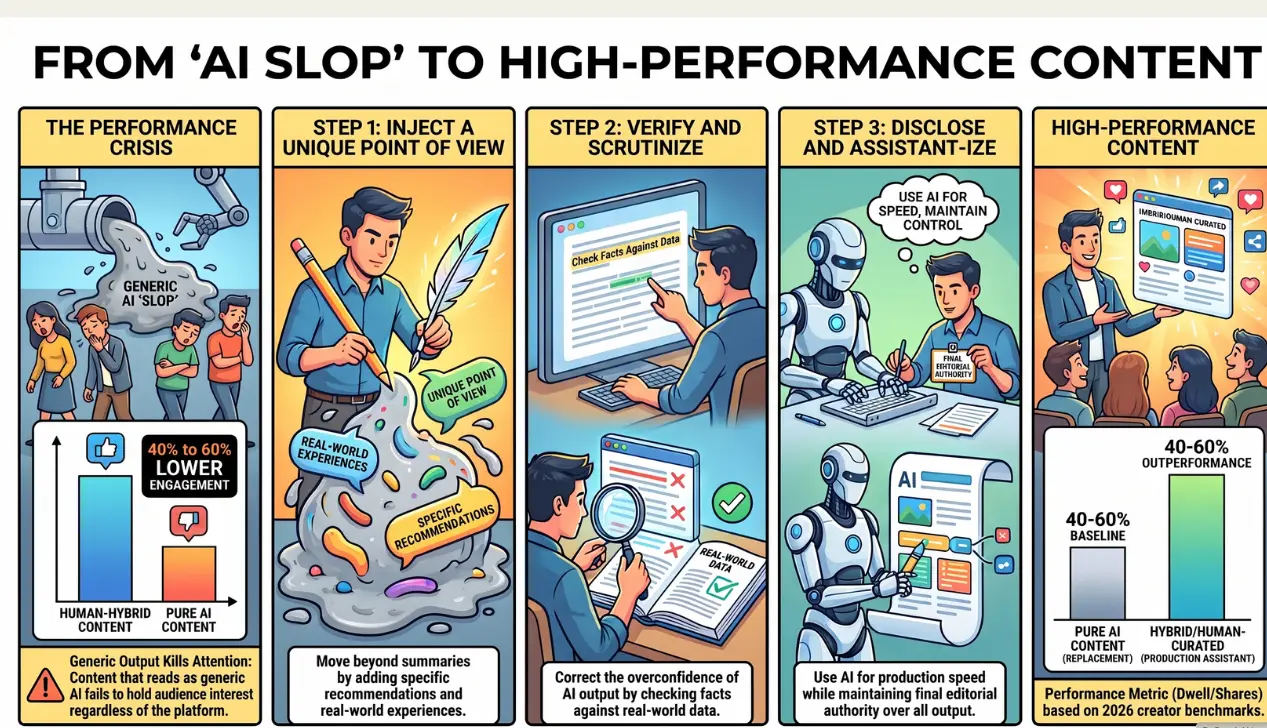
There’s a real performance gap behind the backlash, not just a reputational one. Creator analytics benchmarks from 2026 show human-curated or hybrid content- AI-assisted but shaped by real editorial judgment- outperforming pure AI-generated content by 40 to 60% in dwell time and shares. That’s a meaningful business case, not just an ethical one: content that reads as generic AI output is measurably less likely to hold attention or get shared, regardless of platform.
How to Avoid Being “AI Slop” Without Avoiding AI Entirely
The answer to the AI slop backlash isn’t to stop using AI- it’s to stop treating AI output as a finished product. A few practical shifts:
- Add a real point of view. Content that states an actual position, makes a specific recommendation, or draws on real experience reads differently than content that summarizes what’s already been said elsewhere.
- Verify claims before publishing. Generic AI output tends to state things with more confidence than the underlying facts support- checking and correcting that is exactly the judgment readers are now explicitly saying they want.
- Disclose when it materially matters. The IAB’s 2026 AI Transparency and Disclosure Framework recommends disclosure specifically when AI use could mislead an audience about authenticity or identity- not necessarily for routine production assistance.
- Use AI as a production assistant, not a replacement for editorial judgment. The businesses that are actually winning the trust shift aren’t the ones avoiding AI- they’re the ones using it to move faster while still applying real scrutiny before anything goes out.
What Google’s Own Documents Say About AI-Generated Content
The backlash is not only about audience taste. Google’s published guidance draws a fairly precise line. In its guidance on generative AI content, Google says AI can be useful for researching a topic and adding structure to original work. The risk comes from using AI tools to produce many pages without adding value for users, which its spam policies treat as scaled content abuse.
Two details matter for any publisher. First, the policy is about outcome and intent, not method: the same standard applies to pages produced by people, by automation, or by a mix. Second, Google points to two sections of its Search Quality Rater Guidelines for how such content is evaluated: 4.6.5 on scaled content abuse and 4.6.6 on main content created with little to no effort, originality, or added value.
A Pre-Publish Checklist for AI-Assisted Posts
- Source every number. Each statistic should link to where it came from, and you should have opened that source yourself.
- Add something a competing page cannot: first-hand testing, your own data, a specific example, or a clear recommendation.
- Cut the generic opening. If the first paragraph could introduce any article on the topic, rewrite it.
- Compare against the top results for the same query. If your post says nothing new, it is not ready.
- Read it aloud once. Repetition, vague claims, and inflated adjectives are easier to hear than to see.
- Show dates. Readers trust posts that state when they were written and when they were last updated.
Common Questions About AI Content and Trust
Is AI-assisted content against Google’s rules?
Not by itself. Google’s guidance treats generative AI as a legitimate tool. The problem is publishing many pages that add no value for users.
Does disclosing AI use fix a thin article?
No. Disclosure is about honesty with readers, and the IAB framework mentioned earlier recommends it when AI use could mislead people about authenticity or identity. It does not add the substance that makes a page worth reading.
Is publishing less better?
For most small publishers, often yes. When generation is nearly free, a smaller number of pages that each say something specific gives readers a reason to come back.
Final Talk on AI slop backlash
The AI slop backlash is a real, measured shift in how audiences and platforms treat AI-generated content- not a moral panic. Research on social media news consumption shows how trust in social content is shifting. When generation is nearly free, the differentiator stops being how much content you produce and becomes whether anyone can tell a real person stood behind it.
For more on producing content that holds up, see our guides on generative engine optimization and vibe coding for non-developers.
Related reading