By Md Abdur Rouf Mia | Updated 16 October 2026 | Prices verified 16 October 2026
Zapier vs Make vs n8n comes down to what each platform counts. Zapier charges for every successful action in a workflow. Make charges a credit for every module that runs, including polling triggers, multiplied by the items each trigger returns. n8n charges one execution per workflow run, however many steps sit inside it.
That difference is why most Zapier vs Make vs n8n cost comparisons mislead. A Zapier “task”, a Make “credit” and an n8n “execution” are not the same unit of work, yet pricing pages and many roundups set them side by side as if they were. A workflow with one trigger and five actions uses 5 tasks on Zapier, 6 credits on Make and 1 execution on n8n.
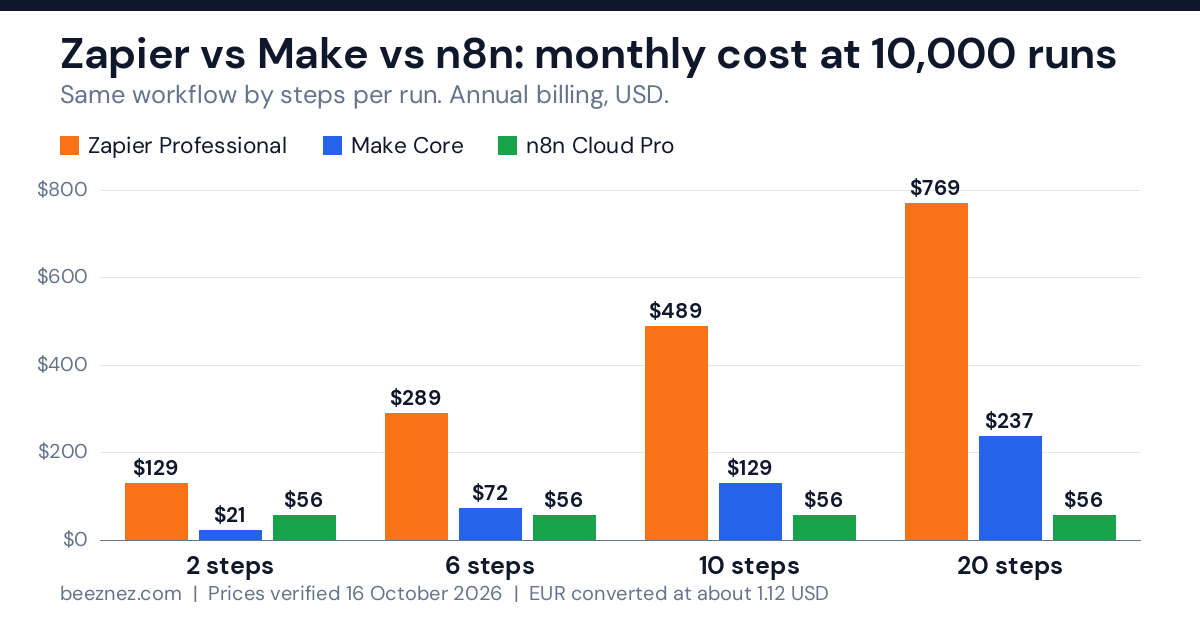
Below I define that one workflow, price it on all three platforms at 10K, 50K and 500K Zapier-task volumes (2,000, 10,000 and 100,000 runs a month), and show where the ranking changes. The Zapier vs Make vs n8n result is less tidy than the marketing suggests: at 10,000 runs the same job costs about $289 on Zapier, $72 on Make and $56 on n8n Cloud, and step count moves the answer more than volume does.
How This Zapier vs Make vs n8n Cost Comparison Was Built
Three disclaimers, stated up front because the numbers in any Zapier vs Make vs n8n comparison decide real money.
First, the structural findings are the part to trust. How each platform counts a unit of work is documented by the vendors, and I link those pages in the sources. Those mechanics do not change when a vendor adjusts a tier.
Second, the cost figures are modelled, not tested. I have not bought all three platforms and run them at these volumes, so nothing here describes how any of them performs. Plan cards and counting rules come from the vendors’ own pricing pages and help centres. The higher-volume price points sit behind dynamic selectors, so I took them from third-party write-ups that read those selectors between 30 September and 12 October 2026, and I mark anything I could not confirm twice as (est.).
Third, every price is annual billing, USD, before tax. n8n bills in euros, so I convert at about 1.12 dollars to the euro, the rate on 11 October 2026. One more caution on Make: some trackers still quote $9 a month for the 10,000-credit Core tier, while recent checks show $12. I use $12, which matches my Make vs n8n cost comparison. Confirm the live slider before you buy.
The Short Answer: Zapier vs Make vs n8n Cost at 10K, 50K and 500K Tasks
For the 6-module workflow above, here is the Zapier vs Make vs n8n bill at each volume, annual billing, USD:
| Monthly volume | Zapier Professional | Make | n8n |
|---|---|---|---|
| 2,000 runs (10K Zapier tasks) | $129 | $21 | about $22 (€20 Starter) |
| 10,000 runs (50K tasks) | $289 | $72 | about $56 (€50 Pro) |
| 100,000 runs (500K tasks) | about $1,499 (est.) | about $750 (est.) | Self-host: server cost. Business licence about $1,611 (est.) |
In Zapier vs Make vs n8n, Make is the cheapest at 2,000 runs, n8n Cloud pulls ahead at 10,000, and at 100,000 only self-hosted n8n beats Make. Zapier is the most expensive in every row. The figures behind that table:
What Each Platform Counts in Zapier vs Make vs n8n
This table is the whole Zapier vs Make vs n8n article. Everything else follows from it.
| Zapier | Make | n8n | |
|---|---|---|---|
| Unit name | Task | Credit (formerly operation) | Execution |
| Charged per | Each successful action step | Each module run, once per bundle processed | Each complete production workflow run |
| Does the trigger count? | No. Triggers never use tasks | Yes. 1 credit per check, found data or not | Part of the run. Schedule triggers count every time they fire |
| Does a 10-step workflow cost 10x? | Yes. 9 tasks | Yes. About 10 credits | No. 1 execution |
| Filters and formatting | Free (Filter, Formatter, Paths, Delay, Looping) | Counted, except the Router and error-handler modules | No per-node charge |
| Multiplier | None, but AI, MCP and Lead Router steps cost more than 1 | Bundles, see below | None |
| Free tier | 100 tasks, two-step Zaps only | 1,000 credits, 2 active scenarios | Self-hosted Community Edition: no execution quota |
Read the fourth row and the rest becomes predictable. On Zapier and Make, complexity costs money. On n8n, it does not. The price per unit then decides whether that matters, which is where the dollar tables below come in.
The Zapier Task Model: The Part Nobody Explains
For the Zapier vs Make vs n8n task question, Zapier’s help centre defines a task as a successful action in a Zap, and each successful action counts separately. Four consequences follow.
Triggers are free. Zapier’s documentation says Zap triggers never use tasks. On Professional the polling interval is 2 minutes, which is about 21,600 checks in a 30-day month, and none of them costs a task. A Zap that polls and finds nothing is free.
Filters, formatting and paths are free. Zapier lists Formatter, Filter, Paths, Delay, Looping, Digest, Storage, Tables and Forms among the built-in tools that do not use tasks, so the logic you build around your actions costs nothing.
Failed actions are free. Only successful actions count toward task usage.
Some steps cost more than one task. This sits on a help page, not the pricing page:
| Zapier feature | Tasks used |
|---|---|
| A normal action step | 1 per successful run |
| AI by Zapier | 1, 3 or 5 for Standard, Advanced and Premium model tiers |
| Zapier Lead Router | 5 per lead routed |
| Zapier MCP | 2 per tool call |
| Code by Zapier | 1 at the standard runtime, more beyond your plan’s runtime allowance |
| Sub-Zaps | 1 for each action inside, plus the Call and Return steps |
One secondary source reports that new AI steps created on paid plans since 15 June 2026 default to the Premium tier, which would make the default 5 times the Standard cost. Check the tier on every AI step you build. Zapier also says these rates may change.
The free plan’s real limit is not the task count. It is that the free plan supports two-step Zaps only, one trigger and one action, with 15-minute polling. You cannot build a serious automation on it however many tasks remain. That is a functional wall, not a usage cap.
The worked example. Trigger on a new form submission, then create a CRM contact, send a welcome email, add a spreadsheet row, notify Slack and create a project task. That is one trigger and five actions, so five tasks per submission. At 2,000 submissions a month that is 10,000 tasks, which needs the 10,000-task Professional tier at $129 a month. The 2,000-task tier at $49 covers a fifth of it.
To estimate your own workflow, count action steps only, ignore the trigger, filters and formatters, then multiply by monthly runs.
The Make Bundle Multiplier
Make’s model looks similar in a Zapier vs Make vs n8n lineup, a credit per module that runs, but two rules create costs Zapier does not have.
Make charges for polling triggers. Make’s help centre says a trigger module runs once to check for new data and costs 1 operation per check, whether it returns ten rows or none. At a 15-minute interval, the Free plan’s minimum, that is 2,880 credits a month on checks alone. At one-minute intervals, available on Core and up, it is 43,200. An instant webhook trigger avoids this because it runs only when data arrives.
Make multiplies by bundles. Make’s documentation states that if the trigger returns multiple bundles, the next modules run once for each. Take a 6-module scenario: one trigger plus five downstream modules. With one bundle you pay 1 + 5 = 6 credits. If the trigger returns 3 bundles, the five downstream modules each run three times: 1 + 5 × 3 = 16 credits, nearly triple the cost for identical automation. Make’s own help page shows the fix: adding an aggregator to combine rows cut a 10-response example from 11 operations to 3.
Zapier has no equivalent multiplier. Each run processes its own item, so per-run cost is more predictable when data arrives in unpredictable batches.
Failed modules are unclear. Make’s pricing FAQ says the Router and the error-handler modules (Rollback, Break, Resume, Commit and Ignore) use no credits, but I could not find a Make page that says plainly whether a module that errors is billed. Third-party sources disagree. Zapier states that failed actions are free, so if your workflow has an unreliable step, test the credit count on Make before you assume.
The Trigger Asymmetry
Pull the three Zapier vs Make vs n8n models apart and a structural pattern appears. Take a workflow that checks for new data every 5 minutes and finds nothing all month.
| Idle cost per month | Reason | |
|---|---|---|
| Zapier | 0 tasks | Triggers never use tasks |
| Make (polling) | 8,640 credits | 1 credit per check |
| n8n (Schedule Trigger) | About 8,600 to 8,900 executions | A schedule counts every time it fires |
The Make figure is most of the 10,000 credits on the $12 Core tier. The n8n figure, from n8n’s own estimating guide, is more than three times the 2,500 executions on Starter. n8n’s polling triggers behave differently: they count only when they find new data, and webhooks count once per inbound request.
So for a workflow that polls often but rarely finds anything, Zapier is structurally the cheapest of the three. It charges for results, while Make and a scheduled n8n workflow charge for looking. For a workflow that fires on events and completes many actions each time, the picture inverts, because you are paying per action and there are many actions.
The practical test is your ratio of idle checks to actions. Many checks and few actions favours Zapier. Many actions per trigger favours n8n. That one ratio predicts your bill better than the task slider on any Zapier vs Make vs n8n pricing page.
Why n8n Counts Differently
Of the three, n8n bills per execution, one run of an entire workflow. Its pricing page says it does not matter how many steps are in the workflow or how much data it processes, it is still a single execution. A 5-node and a 50-node workflow cost the same per run, so n8n is the only one of the three where adding steps is free.
Per n8n’s documentation, only production runs count, so test runs in the editor are free, and sub-workflows and error workflows do not count separately. If your execution count looks wrong, check your schedule triggers before you suspect a bug.
Two structural facts matter for Zapier vs Make vs n8n cost. First, the Community Edition is free to self-host with no execution quota, and you pay for the server and your own maintenance time. I price that honestly in Is n8n Really Free? The True Monthly Cost of Self-Hosting. Second, n8n’s Business plan, which adds SSO, environments and queue mode, is self-hosted only for now. n8n Cloud means Starter or Pro, so past the top Pro tier your options are self-hosting, the Business licence or an Enterprise quote.
Unit Conversion: One Workflow, Three Platforms
Here is the Zapier vs Make vs n8n conversion pricing pages do not publish. The workflow: 1 trigger plus 5 action steps, 6 modules, with one item per run and an instant trigger.
| Zapier | Make | n8n | |
|---|---|---|---|
| Units per run | 5 tasks | 6 credits | 1 execution |
| 2,000 runs a month | 10,000 tasks | 12,000 credits | 2,000 executions |
| 10,000 runs a month | 50,000 tasks | 60,000 credits | 10,000 executions |
| 100,000 runs a month | 500,000 tasks | 600,000 credits | 100,000 executions |
These three rows are the 10K, 50K and 500K task volumes in the title. Now the same workflow stretched to 10 steps, one trigger plus nine actions:
| Zapier | Make | n8n | |
|---|---|---|---|
| Units per run | 9 tasks | 10 credits | 1 execution |
| 2,000 runs a month | 18,000 tasks | 20,000 credits | 2,000 executions |
| 10,000 runs a month | 90,000 tasks | 100,000 credits | 10,000 executions |
| 100,000 runs a month | 900,000 tasks | 1,000,000 credits | 100,000 executions |
Going from 5 to 9 actions nearly doubles what you consume on Zapier and Make and changes nothing on n8n. Units are not dollars, though, because the price per unit differs enormously. That is the next section.
The Cost at 10K, 50K and 500K Tasks
To compare Zapier vs Make vs n8n in dollars, I derived a cost per unit from each vendor’s price ladder and applied it to the 6-module workflow. The tiers I used, annual billing:
| Platform | Tier | Price a month | Cost per unit |
|---|---|---|---|
| Zapier | Professional, 750 tasks | $19.99 | $0.0267 |
| Zapier | Professional, 10,000 tasks | $129 | $0.0129 |
| Zapier | Professional, 50,000 tasks | $289 | $0.0058 |
| Zapier | Professional, 500,000 tasks | $1,499 (est.) | $0.0030 |
| Make | Core, 20,000 credits | $21 | $0.00105 |
| Make | Core, 80,000 credits | $72 | $0.0009 |
| Make | Pro, 750,000 credits | about $750 (est.) | about $0.0010 |
| n8n Cloud | Starter, 2,500 executions | €20 (about $22) | €0.008 |
| n8n Cloud | Pro, 10,000 executions | €50 (about $56) | €0.005 |
| n8n Cloud | Pro, 50,000 executions | about €121 (est.) | €0.0024 |
| n8n self-hosted | Business, 100,000 executions | about €1,438 (est.) | €0.0144 |
How to read the results honestly.
At 2,000 runs, Zapier costs about 6x Make for the same workflow. Per unit the gap is bigger, about 12x ($0.0129 against $0.00105), but Make needs 1.2 times as many units because it also counts the trigger. At 10,000 runs the gap narrows to about 4x, and at 100,000 runs to about 2x, because Zapier’s per-task price falls steeply as you climb the slider. Zapier is expensive at entry and becomes merely pricey at scale. Anyone who says it is always ten times Make is quoting the entry tier.
n8n Cloud is not the cheapest at the bottom. At 2,000 runs Make’s $21 beats n8n Starter’s €20 by a hair, and the Make tier has headroom. At 10,000 runs the n8n Pro tier fits the workload exactly, with no spare executions, so a few schedule triggers would push you to the 50,000-execution tier at about €121.
At 100,000 runs the cloud-versus-cloud comparison breaks. Make’s Core plan stops at 300,000 credits, so 600,000 credits means Pro, and n8n Cloud’s top tier is 50,000 executions. The n8n Business licence at 100,000 executions, about €1,438 a month on annual billing, costs more than Make Pro for this 6-module workflow. Only the free Community Edition beats Make at this volume, which means you pay for a server and your own time instead.
Treat the 500K row as directional: the Zapier $1,499 figure comes from a single third-party ladder, the Make $750 is my interpolation between reported Pro prices of about $533 at 500,000 credits and $973 at one million, and n8n’s Business ladder is also a third-party reading of the selector.
The Finding That Decides It: Step Count
This is the table to put in front of anyone choosing between Zapier vs Make vs n8n. Same 2,000 runs a month, annual billing. Only the number of steps changes.
| Steps per run | Zapier | Make | n8n Cloud |
|---|---|---|---|
| 2 (1 action) | 2,000 tasks: $49 | 4,000 credits: $12 | 2,000 runs: about $22 |
| 6 (5 actions) | 10,000 tasks: $129 | 12,000 credits: $21 | about $22 |
| 10 (9 actions) | 18,000 tasks: $189 | 20,000 credits: $21 | about $22 |
| 20 (19 actions) | 38,000 tasks: $289 | 40,000 credits: $38 | about $22 |
At 2,000 runs, Make is cheapest all the way to 10 steps, and n8n only overtakes it at 20. Now the same steps at 10,000 runs a month:
| Steps per run | Zapier | Make | n8n Cloud |
|---|---|---|---|
| 2 (1 action) | 10,000 tasks: $129 | 20,000 credits: $21 | 10,000 runs: about $56 |
| 6 (5 actions) | 50,000 tasks: $289 | 60,000 credits: $72 | about $56 |
| 10 (9 actions) | 90,000 tasks: $489 | 100,000 credits: $129 | about $56 |
| 20 (19 actions) | 190,000 tasks: $769 | 200,000 credits: $237 | about $56 |
Read the n8n column. It does not move. At 20 steps and 10,000 runs n8n costs about a quarter of Make and about one-fourteenth of Zapier. In units, a 20-step workflow consumes 38,000 Zapier tasks at 2,000 runs against 2,000 n8n executions, nineteen times as many units, but the unit price is why Make still wins the short rows.
Four Zapier vs Make vs n8n conclusions worth keeping:
- If your workflows are short, Make is the cheapest at low volume and Zapier is the most expensive in every cell above. Zapier’s case is ease of building and the widest app catalogue of the three, not price.
- If your workflows are long or getting longer, n8n’s flat line wins. Its crossover with Make is near 20 steps at 2,000 runs and near 6 steps at 10,000 runs, which agrees with the crossover in my Make vs n8n article.
- Zapier’s price per task falls as you buy more, while n8n’s advantage grows as workflows get longer. These are two different curves, and the cheaper platform depends on which one you are on.
- Price the workflow you expect to have in a year, not the one you built last month. Automations tend to grow, and the billing model you pick is a bet on how much yours will.
The Free Tier Comparison
Zapier vs Make vs n8n free tiers look comparable and are not.
| Zapier Free | Make Free | n8n self-hosted | |
|---|---|---|---|
| Included | 100 tasks | 1,000 credits | No execution quota |
| Workflow complexity | Two-step Zaps only | Multi-step | Multi-step |
| Real constraint | Cannot build multi-step automations; 15-minute polling | 2 active scenarios, 15-minute minimum schedule | Your server, your maintenance |
| Practical verdict | A demo, not a plan | Usable for small webhook-driven workflows | Free in cash, not in time |
Zapier’s free plan is the most restrictive. Two-step workflows cannot express most real automations, so you hit the structural wall before the usage wall.
Make’s free tier is the most usable out of the box. 1,000 credits is about 166 runs of a 6-module workflow with no complexity restriction. Watch the polling rule, though: one scenario checking every 15 minutes spends 2,880 credits a month and would use the whole allowance in about ten and a half days with no data at all.
n8n’s free option is unlimited but costs labour. The Community Edition has no execution quota. If you cannot run a server, handle updates and debug your own failures, it is a project, not a free tool. n8n Cloud also offers a free trial, which n8n caps at 1,000 executions.
What the Pricing Pages Leave Out
Beyond the unit mechanics, five things reliably reach the invoice and never appear in a Zapier vs Make vs n8n comparison table.
Zapier’s overage billing is higher than your plan rate. When you pass your task limit, Zapier switches paid accounts to pay-per-task billing at a higher per-task rate. It is on by default for accounts that joined after January 2024, and Zaps stop at three times your plan’s task limit. Zapier does not print the rate, and one reading of its pricing data puts it at about 1.25 times the plan’s per-task price on annual billing, so confirm yours in Billing settings. You can turn the setting off, and then Zaps pause at the limit instead.
Make’s bundle multiplier and polling checks make cost unpredictable. Covered above. They are the largest sources of estimation error on Make, and webhooks plus aggregators are the usual fix.
n8n’s schedule triggers can use more executions than your leads do. A 5-minute schedule is about 8,600 to 8,900 executions a month by n8n’s own estimate. Prefer webhooks, or slow the schedule.
Self-hosting n8n is labour, not zero. The licence is free. The server, backups, updates and your maintenance hours are not, and my own cost estimates are in the self-hosting article.
Annual billing changes the answer. Zapier’s annual price is 33% below monthly, so the 2,000-task Professional tier is $49 billed annually against $73.50 billed monthly, a 50% premium for flexibility. Make Core at 10,000 credits is $12 against $16, a 25% saving. n8n advertises 17%. Compare platforms on the same billing cycle or you are not comparing platforms.
Zapier vs Make vs n8n in Detail: Make vs n8n
Make and n8n bill in genuinely different units, and the crossover sits somewhere around 40,000 to 50,000 operations a month on a five-step workflow. Below that Make tends to win, above it n8n does, and step count moves the answer more than volume does.
I derive that crossover in full, with the arithmetic and the self-hosting caveat, in Make.com vs n8n: Real Cost at 5K, 25K and 100K Operations. If you have narrowed your choice to those two, read that instead of this section.
Which Should You Choose?
Use this table to settle Zapier vs Make vs n8n once you know the shape of your workflow.
| Your situation | Pick | Why |
|---|---|---|
| Non-technical, needs it working today | Zapier | Largest app catalogue, lowest setup effort, free triggers |
| Short workflows, frequent polling, few actions | Zapier | Polls cost nothing |
| Best free tier to test an idea | Make | 1,000 credits and no complexity limit |
| Cheapest at low volume, short workflows | Make | About $0.001 per credit against about $0.013 per Zapier task at the tiers priced here |
| Long workflows (10+ steps) at 10,000+ runs | n8n | One execution regardless of node count |
| 100,000+ runs a month | n8n Community Edition, self-hosted | Cloud tiers stop at 50,000 executions and the Business licence costs more than Make for short workflows |
| Data arrives in unpredictable batches | Zapier or n8n | No bundle multiplier |
| Technical team, wants control and data on its own servers | n8n self-hosted | No quota on the Community Edition |
| AI steps without building anything | Zapier | AI by Zapier, at 1, 3 or 5 tasks by model tier |
Common Mistakes
Comparing task counts to credit counts to execution counts. The starting error, and the reason this Zapier vs Make vs n8n article exists. Convert to a common workflow first.
Pricing your workflow at today’s step count. Workflows grow. The platform that is cheapest for your two-step Zap may be the wrong bet for the ten-step one you build next year.
Assuming Zapier’s free plan is a small version of the paid plan. It is two-step only.
Forgetting Make’s bundle multiplier and polling checks. Per-run cost depends on how much data arrives at once and how often you check.
Leaving n8n schedules on a short clock. One 5-minute schedule can use more executions than the whole Starter plan.
Treating self-hosting as free. The server is cheap. Your time is not.
Choosing on price alone. Zapier’s catalogue and lower learning curve are real, and for some teams they are worth a multiple on the subscription. Just know you are paying for them deliberately.
Quick Checklist
Run through this before you commit to any of the three.
- Define one representative workflow and count trigger plus action steps
- Count only chargeable steps: actions on Zapier, all modules on Make, one run on n8n
- Estimate monthly runs, then multiply
- Convert all three platforms to the same workflow before comparing any price
- Re-run the comparison at the step count you expect in a year
- Check whether data arrives in batches, which triggers Make’s bundle multiplier
- Note your polling and schedule frequency: free on Zapier, metered on Make and on n8n schedules
- Check for AI steps, MCP or Lead Router on Zapier, which cost more than one task
- Compare like-for-like billing cycles
- If n8n wins, price self-hosting honestly, including your maintenance time
Frequently Asked Questions
Is a Zapier task the same as a Make credit?
No. A Zapier task is one successful action. Triggers and failed actions are free. A Make credit is charged for every module that runs, including the trigger, and is multiplied when the trigger returns multiple bundles. For a 6-module workflow Zapier charges 5 units per run against Make’s 6, and Make’s figure rises if data arrives in batches.
Why is n8n so much cheaper at high step counts?
Because n8n bills per workflow run, not per step. A 5-node and a 50-node workflow both cost one execution. Zapier and Make bill per step, so their cost rises with complexity while n8n’s stays flat. At 20 steps and 10,000 runs a month, n8n Cloud Pro is about $56 against about $237 on Make and $769 on Zapier.
Does Zapier really not charge for triggers?
Correct, and Zapier documents it. Polling triggers on Professional check every 2 minutes, which is over 20,000 checks a month, at no cost. That is a structural advantage over Make, which charges a credit each time a polling trigger checks.
What is Make’s bundle multiplier?
When a Make trigger returns several bundles in one run, every downstream module runs once per bundle. A 6-module scenario that costs 6 credits on a single bundle costs 16 when the trigger returns three. Zapier has no equivalent multiplier, and an aggregator module can cut Make’s cost.
Can I build a multi-step automation on Zapier’s free plan?
No. The free plan supports two-step Zaps only, one trigger and one action. Multi-step Zaps need a paid plan, so extra tasks would not help.
Does Zapier’s AI cost more than one task?
It can. AI by Zapier uses 1, 3 or 5 tasks depending on the model tier, Zapier MCP costs 2 tasks per tool call, and Lead Router costs 5 tasks per routed lead. Ordinary actions cost one task each.
Which is cheapest at 100,000 runs a month?
Self-hosted n8n Community Edition, which has no execution quota, so you pay for a server and your own time. For the 6-module workflow in this article my estimates are about $750 on Make, about $1,499 on Zapier and about $1,611 for the n8n Business licence. Treat them as directional and check the live price selectors.
Does n8n Cloud scale to 100,000 executions?
No. Cloud offers Starter and Pro, and the top Pro tier I found is 50,000 executions. The Business plan reaches 40,000 executions and above, but n8n currently offers it self-hosted only. Beyond Pro you are choosing between self-hosting and an Enterprise quote.
Which wins in Zapier vs Make vs n8n on cost?
It depends on workflow length and volume. For short workflows at low volume Make is the cheapest, at about $21 for 2,000 six-module runs. For long workflows at 10,000 runs or more n8n wins, at about $56 whatever the step count. Zapier is the most expensive in every case I priced, and its case is ease of use and catalogue breadth.
How does Zapier vs Make vs n8n pricing change with step count?
Zapier and Make bill per step, so cost rises with every step you add. n8n bills per run, so cost does not change. At 10,000 runs a month, going from 2 to 20 steps takes Zapier from $129 to $769 and Make from $21 to $237, while n8n Cloud Pro stays at about $56.
Which is cheaper for a small business, Zapier vs Make vs n8n?
For a small business running a few short, webhook-driven workflows, Make is usually cheapest, with Core at $12 a month for 10,000 credits. If the team is non-technical and values setup speed over price, Zapier costs more but is easier to build on. If workflows are long and technical staff are available, n8n Cloud Starter at €20 a month for 2,500 executions is worth pricing.
Should I switch platforms if I am already on one?
Only if your step count or volume is growing. If your workflows are simple and stable, the migration cost of rebuilding, reconnecting and retesting will usually exceed the savings. If they keep getting longer, the savings compound with every step you add.
The Bottom Line on Zapier vs Make vs n8n Cost
In Zapier vs Make vs n8n, you are choosing between three billing philosophies. Zapier charges per action and gives you triggers, filters and failed attempts for free. It is the most expensive per unit and the easiest to build on. Make charges per module and per polling check, and its low credit price makes it the cheapest at low volume and on short workflows, though bundles make it the hardest to predict. n8n charges per run and does not care how complex you get, so its cost stays flat as workflows lengthen, and the Community Edition is the only option here without a usage meter.
The number on the pricing page is not the answer. The answer is your step count, your polling frequency and how your data arrives, three things none of the three pricing pages ask you. I will correct this article if a price moves. If you spot an out-of-date figure, tell me with a source.
Related reading: Make.com vs n8n: Real Cost at 5K, 25K and 100K Operations | Is n8n Really Free? The True Monthly Cost of Self-Hosting | Small Business AI Budget: What a 5-Person Team Actually Spends Each Month
Sources
- n8n pricing: Starter €20 a month annual for 2,500 executions; Pro €50 for 10,000; Business €667 for 40,000, self-hosted only; Community Edition free; execution definition and schedule estimates. Accessed 16 October 2026.
- Make pricing: credit definition, free plan, exempt Router and error-handler modules, credits expiry. Accessed 16 October 2026.
- Make Help Center: Operations: trigger costs 1 operation per check; downstream modules run once per bundle; aggregator example. Updated 14 October 2026.
- Zapier: How is task usage measured?: triggers never use tasks; successful actions count; built-in tools that do not count; multi-task steps.
- Zapier: What is a task?: pay-per-task overage and the 3x ceiling; Advanced AI steps count as three tasks.
- SuperDupr: Zapier pricing and SaaS Switcher: Zapier pricing: Professional ladder to 100,000 tasks, read 30 September to 1 October 2026; AI tiers and the 1.25x overage reading.
- Omid Saffari: Zapier pricing 2026: Professional ladder to 2 million tasks, including 200,000 and 500,000 tiers (single source for the 500,000 figure).
- SuperDupr: Make pricing and Coworker: Make pricing: Core ladder to 300,000 credits, Pro prices at 500,000 and one million credits.
- SuperDupr: n8n pricing: the 50,000-execution Pro tier and the Business ladder to 500,000 executions.
- Make.com vs n8n: Real Cost at 5K, 25K and 100K Operations: Beeznez Tech, the full Make vs n8n derivation and crossover.
Prices verified 16 October 2026. This is a cost model built from list prices and documentation, not a test of any platform. Higher-volume price points come from third-party reads of dynamic selectors and are marked (est.) where I could not confirm them twice. Vendors change prices often, so confirm each figure on the live pricing page before you buy.
See also: How to Use AI to Automate a Small Business: A Step-by-Step Guide for 2026 for a worked inquiry workflow, with costs and privacy checks.
See also: To build an AI agent on any of the three, see How to Build a No-Code AI Agent Pipeline.
See also: Best Self Hosted SaaS Alternatives for Startups in 2026, ten tools with licences, RAM needs and real server costs.