By Md Abdur Rouf Mia | Published 14 October 2026 | Last updated: 22 October 2026 | Prices verified 14 October 2026; Make and Claude cache rates corrected 22 October 2026
A realistic small business AI budget for five people comes to about $423 a month, roughly $5,076 a year or $85 per person per month, before tax. Add VAT at 15% and card fees and it is closer to $499 a month. A lean version of the same team runs on about $180, and a heavy one pays about $1,136. The gap between those three numbers is not the cost of the models. It is which tools you bought twice, which seats nobody uses, and whether you chose annual billing.
This article is a modelled budget built from the vendors’ published prices, not a receipt from one company. Below is an itemised small business AI budget with a price and a source on every line, run at three team sizes and three spending levels. You can copy it, delete what you do not need, and get your own number in about twenty minutes.
What I Tested vs What I Researched
Tested: I did not buy or use this stack to produce the budget, and no receipts or invoices were used.
Researched: List prices as published by each vendor, checked on 14 October 2026 and listed under Sources, plus the survey benchmarks cited near the end.
Not tested: The totals are my own arithmetic on those prices. The 15% VAT and 2.5% card fee are example assumptions for a buyer who pays tax and foreign-card fees, not a universal rate.
How This Small Business AI Budget Was Built?
To build this small business AI budget, I took one realistic profile, a five-person services business that writes, sells and runs its own operations, and priced each line against the vendor’s published pricing on 14 October 2026. Where a vendor sells in tiers, I picked the cheapest tier that delivers the feature described. Where usage is variable, the arithmetic is shown so you can change one assumption and re-run it.
This is a cost model, not a report of what any real company spent. Treat the total of this small business AI budget as a well-built estimate, not a quote. Your number will differ by 30% in either direction. Everything below assumes annual billing unless stated otherwise, and USD prices before tax.
One honest caveat about the label. Not every line in a small business AI budget is AI. Google Workspace, 1Password and Canva are the work stack the AI sits inside. The AI-specific lines (chat seats, Grammarly, the two APIs, meeting notes, automation and storage) add up to about $266 of the $423, or $53 per person per month.
The Short Answer: Three Small Business AI Budget Stacks
Same five people. Same work. Three different small business AI budget answers.
| Lean | Typical | Heavy | |
|---|---|---|---|
| Monthly | $180 | $423 | $1,136 |
| Annual | $2,159 | $5,076 | $13,636 |
| Per person, per month | $36 | $85 | $227 |
| What you get | One chat seat each, email, passwords | The lean stack plus a second model, writing and design tools, meeting notes, automation and API usage | Typical, plus premium chat seats, a second automation platform, SEO tooling and $400 a month of API volume |
| ChatGPT Business seats | 5 Standard | 5 Standard | 3 Standard + 2 Premium |
| Automation | None | Make Core | Make Teams + n8n Cloud Pro |
| API spend | $0 | $40 | $400 |
Lean is five ChatGPT Business Standard seats ($100), Google Workspace Business Starter at $7 a seat ($35) and 1Password Business ($44.95). Heavy adds the items listed in its column to the typical stack. All annual billing, verified 14 October 2026.
The Heavy Stack, Line by Line
The heavy stack is the typical stack with five changes: two ChatGPT seats upgraded to Premium, Make Teams in place of Make Core, n8n Cloud Pro added, Semrush Pro added, and API spend raised from $40 to $400. Every other line is unchanged.
| Line | Basis | Monthly |
|---|---|---|
| ChatGPT Business | 3 Standard at $20 + 2 Premium at $100 | $260.00 |
| Claude Team (Standard) | 2 seats at $20 | $40.00 |
| Google Workspace Business Standard | 5 seats at $14 | $70.00 |
| Grammarly Pro | 5 seats at $12 | $60.00 |
| Canva Business | 2 seats, $250 a year each | $41.67 |
| 1Password Business | 5 seats at $8.99 | $44.95 |
| Otter.ai Pro | 2 seats at $8.33 | $16.66 |
| API usage, OpenAI and Claude combined | The $400 a month in the stack definition | $400.00 |
| Make.com Teams | Replaces Core; 10,000 credits, annual billing | $29.00 |
| n8n Cloud Pro | 50 euros at $1.12 per euro, annual billing | $56.00 |
| Semrush Pro | Annual billing | $117.33 |
| Cloudflare R2 | Storage | $0.75 |
| Total | $1,136.36 |
That is about $227 per person per month and $13,636 a year.
Premium seats are $100 each on annual billing ($125 monthly), per OpenAI’s help center, so each upgrade adds $80 over a Standard seat. The euro rate is the $1.12 used in the n8n cost guides. The table assumes Make Teams replaces Core rather than running alongside it.
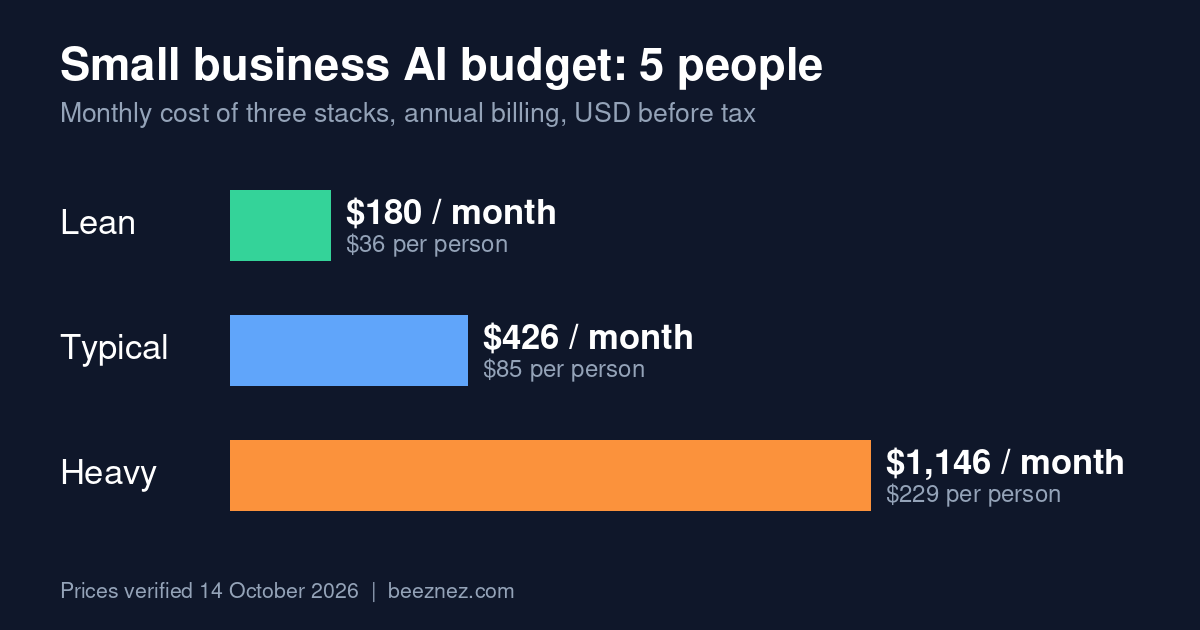
The most useful number in this small business AI budget is not the $423. It is the 6.3x spread between $180 and $1,136 for the same five people. Almost none of that spread comes from the cost of intelligence itself. Most of it comes from decisions you make in a browser tab in about four minutes each.
The Typical Small Business AI Budget, Line by Line
This is the small business AI budget I would treat as a sensible default for a five-person services business. Everything is billed annually.
| Line | What it is for | Seats | Unit price per month | Monthly | Annual |
|---|---|---|---|---|---|
| ChatGPT Business (Standard) | Primary AI seat for everyone | 5 | $20.00 | $100.00 | $1,200 |
| Claude Team (Standard) | Second model for long-form work and cross-checking | 2 | $20.00 | $40.00 | $480 |
| Google Workspace Business Standard | Email, docs and Gemini | 5 | $14.00 | $70.00 | $840 |
| Grammarly Pro | Writing quality control | 5 | $12.00 | $60.00 | $720 |
| Canva Business | Design | 2 | $250 a year ($20.83) | $41.67 | $500 |
| 1Password Business | Credentials and shared vaults | 5 | $8.99 | $44.95 | $539 |
| OpenAI API | Content, classification, drafts | usage | n/a | $25.00 | $300 |
| Claude API (Sonnet 5.5) | Higher-volume automated work | usage | n/a | $15.00 | $180 |
| Otter.ai Pro | Meeting notes | 2 | $8.33 | $16.66 | $200 |
| Make.com Core | Automation platform | usage | n/a | $9.00 | $108 |
| Cloudflare R2 | Storage for generated assets | usage | n/a | $0.75 | $9 |
| Total | $423.03 | $5,076 |
That is $84.61 per person per month, or about $1,015 per person per year.
Why two chat vendors?
Not redundancy for its own sake. Long-form drafting, careful reading of contracts and a second opinion on important work suit a second model, while the connector ecosystem around ChatGPT suits day-to-day internal work. Two seats on the second vendor, not five, is usually enough.
Why the second model in a small business AI budget is $20 and not $17?
Claude Pro is $17 a month billed annually, but Claude Team Standard, with central billing and admin controls, is $20 per seat on annual billing ($25 monthly). Once you buy for a business rather than yourself, you want the admin layer. The $3 difference per seat buys you the ability to remove someone’s access when they leave. One wrinkle: Anthropic has been reported with different Team minimums during 2026 (five seats earlier, two seats in recent checks), so confirm the current minimum before you plan on two seats.
Why Grammarly is a real line item in a small business AI budget?
It looks small per person and becomes $720 a year across five seats. In the levers section below, it is one of the first places to look.
Why Make Core and not Pro in this small business AI budget?
Make Core at 10,000 credits is $9 a month on annual billing ($10.59 monthly), which is enough for a handful of light scenarios. Pro is $16 annual ($18.82 monthly) at the same credit level and adds priority execution and log search. Make’s prices changed in 2026, and older price lists still show $12 and $21, so check the live slider. If you want the full automation cost model, see Make.com vs n8n: Real Cost at 5K, 25K, and 100K Operations.
The single biggest structural choice in a small business AI budget
If you are choosing a productivity suite, that decision is bigger than any other line here.
| Suite | Price per user, per month | AI included |
|---|---|---|
| Google Workspace Business Standard | $14 (annual) | Gemini bundled |
| Microsoft 365 Business Standard with Copilot | $23.50 (annual) | Copilot bundled |
| Microsoft 365 Business Basic | $7.00 (annual) | No Copilot |
Across five seats that is $70 versus $117.50 a month, a $570-a-year difference for broadly comparable bundled AI. Neither is objectively better. If your team lives in Excel and Outlook, Microsoft’s premium is worth paying. If not, Google Workspace at $14 per user with Gemini included is the cheaper default, and it is the one built into the table above.
Seats vs Usage: The Part of a Small Business AI Budget That Surprises People
Everything in the table splits into two kinds of cost, and most budgets fail because they only plan for the first. Before you let any agent spend money, set the rules; see AI Agent Governance 101.
Seats are predictable. ChatGPT Business, Claude Team, Grammarly, Canva, 1Password, Otter and Google Workspace. You know the number on the first of the month, and seats scale with headcount and nothing else.
Usage is variable. The two API lines, and every automation credit beyond your plan’s allowance. This is the line that arrives as a surprise, because nothing in the product stops you from spending more.
Here is the arithmetic behind the $25 and $15 usage lines, so you can check the working.
OpenAI API, the $25 line. At $2 per million input tokens and $10 per million output tokens (the mid-tier rate for GPT-6.1 Sol), 8 million input tokens cost $16 and 0.9 million output tokens cost $9, which is $25. One automated process that summarises every inbound email can triple that without anyone deciding to spend more.
Claude API, the $15 line. Claude Sonnet 5.5 is also $2 and $10 per million tokens. Five million input tokens cost $10 and 0.5 million output tokens cost $5, which is $15.
Why usage does not scale with headcount. If your automation classifies 4,000 support tickets a month, the cost is the same whether you have five people or twenty-five. The API does not care how many humans read the output. For the full token maths, see How Much Does It Cost to Run an AI Agent Every Month?
The practical rule: for every usage line, decide the monthly ceiling before you connect the tool, and set an alert at 70% of it. Both OpenAI and Anthropic let you cap spend on the platform side. A cap you set on a calm Tuesday is worth more than a spreadsheet you build after the invoice.
What a Small Business AI Budget Costs at 5, 10 and 25 People?
The same typical stack at three team sizes. Seats grow with headcount except where a tool only needs a few seats to cover the whole team.
| Line | 5 people | 10 people | 25 people |
|---|---|---|---|
| ChatGPT Business (Standard) | $100.00 | $200.00 | $500.00 |
| Claude Team (Standard) | $40.00 | $80.00 | $160.00 |
| Google Workspace Business Standard | $70.00 | $140.00 | $350.00 |
| Grammarly Pro | $60.00 | $120.00 | $240.00 |
| Canva Business | $41.67 | $62.50 | $104.17 |
| 1Password Business | $44.95 | $89.90 | $224.75 |
| OpenAI API | $25.00 | $45.00 | $120.00 |
| Claude API (Sonnet 5.5) | $15.00 | $30.00 | $80.00 |
| Otter.ai Pro | $16.66 | $24.99 | $49.98 |
| Make.com Core | $9.00 | $9.00 | $29.00 |
| Cloudflare R2 | $0.75 | $1.50 | $4.00 |
| Monthly total | $423.03 | $802.89 | $1,861.90 |
| Per person, per month | $84.61 | $80.29 | $74.48 |
| Annual total | $5,076 | $9,635 | $22,343 |
Seat counts used: Claude Team 2, 4 and 8; Grammarly 5, 10 and 20; Canva 2, 3 and 5; Otter 2, 3 and 6; every other seat line is one per person. Make is Core at 10,000 credits for 5 and 10 people and the 40,000-credit tier for 25. API usage is 8, 15 and 40 million input tokens for OpenAI, and 5, 10 and 25 million for Claude, with output tokens scaled to match.
Look at the per-person row of this small business AI budget. It is the reason this section exists.
Why Cost Per Person Falls as You Grow?
Per-person cost drops from $84.61 to $80.29 to $74.48 as the team grows fivefold. That is the opposite of what most people assume, and it is not a rounding artefact. Two things drive it.
1. Fixed and shared lines do not grow with headcount. The automation platform and storage barely move, and tools such as Canva, the second model and meeting notes cover a few seats rather than everyone. A fixed slice of the budget is divided by a bigger number.
2. Usage grows sub-linearly in reality. API spend in this model grows about five times for a fivefold headcount increase only because I deliberately weighted the 25-person case toward heavier agent use. Left alone, it grows more slowly, because automated workloads depend on how much work flows through the business, not how many people sit in the room.
It flips at a certain point. Once a business runs agents continuously, meaning processes that poll, decide and act on their own, usage stops tracking headcount and starts tracking machine time. Cost per person then rises again, and it can rise fast.
The Four Levers That Cut Your Small Business AI Budget
Ranked by how much each one saves in a small business AI budget for the least effort. Nothing here requires giving up capability.
1. Bill annually: the biggest small business AI budget saving
This is the largest saving available for clicking one dropdown.
| Tool | Monthly billing | Annual billing | Extra cost of paying monthly |
|---|---|---|---|
| ChatGPT Business, 5 seats | $125.00 | $100.00 | $25.00 |
| Claude Team, 2 seats | $50.00 | $40.00 | $10.00 |
| Grammarly Pro, 5 seats | $150.00 | $60.00 | $90.00 |
| Canva Business, 2 seats | $50.00 | $41.67 | $8.33 |
| Otter.ai Pro, 2 seats | $33.98 | $16.66 | $17.32 |
| Total | $408.98 | $258.33 | $150.65 per month |
$150.65 a month is $1,808 a year for choosing the annual toggle on five tools. Grammarly alone accounts for $1,080 of that, because its monthly plan is $30 per member against $12 on annual billing. The trade-off is real: annual billing locks you in, so only do it for tools you have already used for a full month.
2. Audit seats against actual logins in your small business AI budget
Ask every vendor for last month’s active-user report. In many small teams, at least one tool has a seat whose owner logged in once to look and never returned. A worked cut of the typical stack, keeping every capability:
| Change | Monthly saving |
|---|---|
| Grammarly from 5 seats to 2 (only client-facing writers) | $36.00 |
| Second model from 2 seats to 1 | $20.00 |
| Otter Pro from 2 seats to 1 | $8.33 |
| Route 60% of API volume to a lighter model | $15.00 |
| Total saved | $79.33 |
The API line is conservative. Moving 60% of volume to a model that costs a twentieth as much could save about $23 on paper, so $15 allows for work that fails a quality check.
That is a 19% cut. The typical stack falls from $423 to $344 a month, a saving of about $952 a year, and you have removed nothing anyone was using.
3. Turn on prompt caching to shrink your small business AI budget
Both major vendors charge far less to re-read context they have already seen. For Claude Sonnet 5.5, a cache read is $0.20 per million tokens against $2.00 for fresh input, a 90% discount on the cached portion. If your API workloads repeat the same long system prompt or reference document on every call, and most do, caching it is the highest-return change you can make to a usage line. It needs no product decision. The mechanics are in the agent cost breakdown.
4. Match the model to the task in your small business AI budget
You do not need a frontier model to extract a date from an invoice. Most production workloads mix a small share of hard reasoning with a large share of classification, extraction and formatting. Per million input tokens, Claude Haiku 5.5 is $0.10 and Claude Fable 5.1 is $10, a hundredfold gap. Routing the simple majority to a cheaper tier can cut a mixed API bill sharply with little visible difference to the end user. Do this after caching, not before. Caching has no quality trade-off at all.
What I Deliberately Left Out of This Small Business AI Budget?
Almost every small business AI budget article lists what you should buy. Very few tell you what not to buy. For the cost of running your own automation server instead of buying seats, see Is n8n Really Free? The True Cost of Self-Hosting n8n. If you sell software rather than buy it, how much an AI feature costs covers the per-task version of this arithmetic. A CRM is another recurring SaaS cost that this budget does not include; see HubSpot alternatives for startups for pricing.
Enterprise tiers. ChatGPT Enterprise and Claude Enterprise are quote-based. At five people you are unlikely to beat self-serve pricing, and you add a procurement cycle and a minimum term. To check whether the spend is paying off, see AI Agent ROI: How to Actually Measure Whether Your Automation Is Paying Off.
A dedicated agent platform. Not until you have a process you have already run manually for a month and can describe in numbered steps. Buying the platform first is how small businesses end up with a $99-a-month tool and nothing running inside it.
A second automation platform in year one. Pick one. The typical stack has Make only. Running two side by side means paying twice for overlap and debugging two systems.
Meeting transcription for everyone. Two seats cover most meetings a five-person team holds, because meetings are shared. It is one of the clearest seat-audit savings available.
A vector database, self-hosting or your own model deployment. At $40 a month of API usage, the infrastructure bill would exceed the API bill while adding operational risk.
SEO tooling at five people. A Semrush Pro plan runs $117.33 a month on annual billing. It sits in the heavy stack, which is where it belongs: a growth investment, not a baseline cost.
The Costs That Never Appear on a Pricing Page
Everything above is the invoice for your small business AI budget. This is what you actually pay.
| Item | Applied to | Monthly |
|---|---|---|
| Typical stack | $423.03 | |
| VAT at 15% | Most vendors add tax at checkout | $63.45 |
| Card foreign-transaction fee, 2.5% | Applied to the VAT-inclusive charge | $12.16 |
| Real monthly cost | $498.64 |
$498.64 a month is $5,984 a year, about 18% more than the headline figure. Four things to watch:
Tax varies enormously by country. If you buy from Bangladesh or anywhere in the EU, expect VAT or an equivalent at checkout on top of every published price. US buyers may or may not see sales tax depending on the vendor. Budget the tax, then forget it.
Currency risk is a real line. Almost every tool here prices in USD. If your revenue arrives in another currency, a 5% move in the exchange rate is a 5% move in your AI budget.
Prices change without notice. Several vendors in this stack restructured in 2026: Make moved from operations to credits, Grammarly folded Business into Pro, Microsoft bundled Copilot into Business Standard, and both OpenAI and Anthropic added premium seat tiers. Re-check live pricing before you rely on any figure here, including these.
Seat creep. Adding a seat is one click and removing one is often a support ticket. Put a quarterly seat audit in your calendar and treat it as part of the budget. For a method, see Shadow AI Spend: How to Find It Before It Drains Your Budget.
How This Small Business AI Budget Compares to Published Benchmarks?
A sanity check against the largest survey I could find. The Federal Reserve Bank of Atlanta reports that firms spent about $1,358 per employee on AI in 2025 and expect to spend about $2,068 in 2026 on an employment-weighted basis. More than half of respondents expect to spend no more than $200 per employee in 2026, the top 10 percent plan at least $2,800, and professional and business services expect about $3,470.
| Measure | Per employee, per year |
|---|---|
| Atlanta Fed survey average, 2025 | $1,358 |
| Atlanta Fed survey average, 2026 (expected) | $2,068 |
| Atlanta Fed, professional and business services, 2026 | $3,470 |
| This model, AI-specific lines only | $639 |
| This model, whole typical stack | $1,015 |
The AI-specific lines in this model land at about $639 per person per year, comfortably under the survey average, and the whole stack at $1,015 is about half of it. That is not evidence of a secret discount. The survey counts software, subscriptions, hardware, worker training and IT support, and its averages include large employers with procurement, security review and enterprise tiers that a five-person business does not carry. The “$200 or less” figure is also a plan, not a receipt, and actual spend usually runs above plan.
Treat benchmarks as a check on direction for any small business AI budget, not as a target. If your own number lands above $2,068 per employee, you are not necessarily overspending, but you should be able to name what you get for it.
Common Small Business AI Budget Mistakes
Budgeting seats and forgetting usage. The predictable lines are the easy half. Surprise invoices come from the usage side.
Buying the enterprise tier to feel safe. At five seats, self-serve plans include more capability than a small team can use.
Paying monthly out of caution. Defensible for the first month of a new tool, and expensive as a permanent policy. Here it costs $1,808 a year.
Letting every tool be a personal plan. Personal seats are cheaper until someone leaves and takes the account, the history and the shared workspace with them. Buy team tiers for anything that holds company data. If you are weighing ChatGPT seat types specifically, read ChatGPT Plus vs Team vs Business: Real Cost for a 5-Person Team.
Never revisiting the stack. A tool that was right at three people is often wrong at fifteen. The audit is a quarterly habit, not a one-off.
Quick Checklist
- List every AI-related subscription and who owns the billing
- Separate each line into seat or usage
- Switch every tool you have used for a month to annual billing
- Request active-user reports and cut unused seats
- Turn on prompt caching for any repeated long context
- Route simple workloads to a cheaper model tier
- Set a hard monthly spend cap on every API account
- Add VAT and card fees to get your real number
- Re-check all published prices against the vendor’s live page
- Put the next seat audit in your calendar for three months from today
How to Build Your Own Small Business AI Budget in 20 Minutes?
- Open a spreadsheet with five columns: Tool, Seat or Usage, Unit price, Seats, Monthly.
- Paste every AI-related line from your last card statement.
- Mark each line S or U.
- Pull the current unit price from the vendor’s own pricing page, not from an article, including this one.
- Total it. Then multiply by your local tax rate and add about 2.5% for card fees.
- Sort the S rows by total cost. Those are your audit targets, biggest first.
- Set the 70% spend alert on every U line before you close the laptop.
If you are also deciding how to evaluate tools before buying them, How to Choose the Right AI Automation Tool for Your Business covers the non-price questions.
Frequently Asked Questions
How much should a small business AI budget be for 5 people per month?
In this model, roughly $180 to $423 a month covers a services business using AI for real daily work, which is about $36 to $85 per person. The lean end gives each person one chat seat plus email and passwords. Above about $1,136 you should be able to point at a specific automated process that earns back the money.
Is there a minimum number of seats I have to buy?
Several plans have one. ChatGPT Business requires two paid seats. Claude Team has been reported with a two-seat minimum in recent checks and a five-seat minimum earlier in 2026, so confirm it on the live page. A five-person team meets either, but the minimum matters if you are budgeting for a one- or two-person business.
Why does AI cost less per person as we grow?
Because fixed and shared lines, such as the automation platform, storage and a design seat that covers a few people, do not grow with headcount, and usage-based lines grow with how much work flows through the business rather than how many people sit in it. In this model per-person cost falls from $84.61 at five people to $74.48 at twenty-five. It reverses once you run continuous agents.
Should I pay monthly or annually?
Annually, once you have used the tool for a month and know you are keeping it. On the five tools in the billing table, annual billing saves $150.65 a month, $1,808 a year, for the same service.
Does a small business AI budget need two AI chat subscriptions?
Usually two or three seats on a second model, not a full second subscription. Teams doing long-form writing, careful document review or contract reading tend to get enough value from a second vendor to justify a few seats. Whether you need both for everyone is a different and usually unnecessary question.
What is the biggest hidden cost in a small business AI budget?
Tax and currency, together about 18% on top of the headline figure in this model. After that come unused seats and usage lines that grow without anyone deciding to spend more.
Can I run an AI stack for free?
Partly. Make has a free plan with 1,000 credits a month, most chat tools have free tiers, and Cloudflare R2 storage costs about $0.75 for 50 gigabytes. What you cannot get free is team admin controls, central billing or meaningful automated volume. The lean stack above, at about $180 a month, is the practical floor for a team that wants the admin layer.
How often do these prices change?
Frequently. Several vendors in this stack restructured tiers during 2026. Treat every figure here as a snapshot verified on 14 October 2026 and check the vendor’s own pricing page before you commit.
How do I put a spending limit on an AI API?
Both major AI providers let you set spending limits or budgets on the platform side. Set one before you connect a workflow to a paid API key, and check each provider current settings page for the exact steps.
How often should I audit AI subscriptions?
A quarterly audit is a sensible rhythm: compare paid seats with actual logins, then remove or downgrade seats nobody uses, as in the seat-audit lever above.
How much should I add for tax and card fees?
The worked example adds 15% VAT and a 2.5% card fee, which takes the typical five-person budget from about $423 to about $499 a month. Use your own tax rate and card terms.
The Bottom Line on a Small Business AI Budget
A small business AI budget for five people can cover a capable stack for about $423 a month, $499 once tax and card fees land, and somewhere between $180 and $1,136 depending on choices that each take a few minutes. The point of itemising it is not to hit a target. It is that once the budget is on one page the decisions become obvious. Annual billing is worth about $1,808 a year. A seat audit is worth about $952. Caching is free and cuts cached input costs by up to 90%. None of those require giving anything up, and all of them stay invisible until you write the lines down.
Prices change often. If you spot a figure that has moved, tell me and I will correct it.
Related reading: Make.com vs n8n: Real Cost at 5K, 25K, and 100K Operations | ChatGPT Plus vs Team vs Business: Real Cost for a 5-Person Team | How Much Does It Cost to Run an AI Agent Every Month?
Sources
- OpenAI ChatGPT Business overview: Standard seat $20 annual, $25 monthly; Premium seat $100 annual, $125 monthly (re-checked 22 October 2026); two-seat minimum. Accessed 14 October 2026.
- Anthropic Claude pricing: Pro $17 annual, $20 monthly; Team Standard $20 annual, $25 monthly. Accessed 14 October 2026.
- Google Workspace pricing: Business Starter $7, Business Standard $14 per user per month, annual. Accessed 14 October 2026.
- Microsoft 365 and Copilot pricing: Business Standard with Copilot $23.50, Business Basic $7.00 per user per month, paid yearly. Accessed 14 October 2026.
- Grammarly plans and its pricing help article: Pro $12 annual average, $30 monthly. Accessed 14 October 2026.
- Otter.ai pricing: Pro $8.33 annual, $16.99 monthly. Accessed 14 October 2026.
- 1Password business pricing: Business $8.99 per user per month, billed yearly. Accessed 14 October 2026.
- Canva pricing: Business $25 monthly or $250 a year per person. Accessed 14 October 2026.
- Make.com pricing: Core $9, Pro $16 and Teams $29 a month annual at 10,000 credits ($10.59, $18.82 and $34.12 monthly); corrected 22 October 2026 from an older $12 figure; free plan 1,000 credits. Accessed 14 October 2026.
- n8n pricing: Cloud Pro 50 euros a month annual at 10,000 executions. Accessed 14 October 2026.
- Claude API pricing and OpenAI API pricing: $2/$10 per million tokens for the mid tier; Sonnet 5.5 cache reads $0.20 per million (corrected 22 October 2026 from $0.10). Accessed 14 October 2026.
- Semrush pricing: Pro plan $117.33 a month on annual billing ($139.95 monthly). Re-checked 22 October 2026. Accessed 14 October 2026.
- Cloudflare R2 pricing: $0.015 per GB-month. Accessed 14 October 2026.
- Federal Reserve Bank of Atlanta, How Much Are Firms Spending on AI: per-employee spending averages and planning thresholds. Accessed 14 October 2026.
Prices verified 14 October 2026. This is a cost model built from list prices, not a measurement from a real company. Vendors change prices and plan structures often, so check each live page before you rely on a figure.
See also: AI Answering Service Cost: Real Prices at 100, 500 and 2,000 Calls a Month for per-minute, per-call and per-customer pricing compared.
See also: AI Voice Agent Cost Per Minute: Vapi vs Retell vs ElevenLabs vs Bland at 100, 1,000 and 10,000 Calls for the per-minute cost of building your own voice agent.
See also: Choosing between ChatGPT, Claude and Gemini for the team? See ChatGPT vs Claude vs Gemini for Business (2026 Guide) for plans, prices and a free test kit.
See also: Best AI Tools for Solo Entrepreneurs 2026: A Lean 10-Tool Stack, a one-person version of this budget.
See also: How Much Does an AI Feature Cost? if you sell software with AI features, and Best HubSpot Alternatives for Growing Startups 2026 for the CRM side of the software bill. For team plans, see ChatGPT Plus vs Team vs Business, and for unmanaged subscriptions, Shadow AI Spend.
Correction, 22 October 2026. Make’s pricing page lists Pro at $16 and Teams at $29 a month on annual billing for 10,000 credits, and trackers reading the same page list Core at $9 ($10.59 on monthly billing). This article had used an older price list ($12, $21 and $38). The Make line is now $9 in the 5- and 10-person budgets and $29 in the 25-person budget (Core at 40,000 credits). That lowers the typical five-person stack from $426.03 to $423.03 a month, the annual total from $5,112 to $5,076, and the tax-inclusive figure from $502.18 to $498.64. We also corrected the Claude Sonnet 5.5 prompt-caching rate: a cache read is $0.20 per million tokens, a 90% discount on fresh input, not $0.10 and 95%. Heavy stack: the heavy stack is now itemised line by line in its own table. It moves from $1,146 to $1,136.36 a month ($13,636 a year, about $227 per person) because it used Make Teams at the old $38 price, now $29. The spread between the lean and heavy stacks is 6.3x, not 6.4x.