By Md Abdur Rouf Mia | Updated 14 October 2026 | Prices verified 14 October 2026
The AI answering service cost at 500 calls a month ranges from $129 to $4,945 across five services doing the same job. That is a 38x spread, and most of it comes from the billing unit each vendor chose, not from the quality of the service. Among the four AI services alone, the range is $129 to $800, still a 6.2x difference for a product that looks identical from a distance.
That is the problem with every AI answering service cost article you will read, and the reason this one exists. One vendor quotes per minute, another per call, a third per customer. The pages that list them side by side rarely convert those units into the same thing, so the list is technically accurate and practically useless.
Below I normalise every AI answering service cost model to the same two numbers, cost per call and cost per month, at 100, 500 and 2,000 calls. Then I re-run it on 5-minute calls instead of 3-minute calls, because call length changes the answer more than volume does. It is the most important number in this article, and almost nobody prices it.
How This AI Answering Service Cost Comparison Was Built
Every figure comes from vendor pricing pages and pricing documentation checked on 14 October 2026, cross-checked against independent write-ups where vendors disagree with each other. Where a vendor publishes a tier table I used it. Where they quote a rate I did the arithmetic. This is a cost model, not a test. I have not bought these services and run them for a month at these volumes, so nothing here describes how well any of them answers a phone.
What the model does is convert every pricing scheme into the same unit. Base assumptions, so you can change them:
- Average inbound call: 3 minutes, then 5 minutes as a sensitivity case.
- Volumes: 100, 500 and 2,000 calls a month. 100 is a solo operator with a quiet phone, 500 is a busy trades or clinic line, and 2,000 is a multi-location or high-demand business.
- Monthly list prices, so vendors compare like for like. Annual billing is cheaper at several vendors and is noted separately.
- USD, before tax.
Figures marked (est.) are my estimates where a vendor stops publishing prices, typically above 2,000 minutes, 1,000 calls or 2,500 human minutes.
The Short Answer: AI Answering Service Cost at 500 Calls
At 500 calls a month, with 3-minute calls:
| Provider | Monthly cost | Cost per call |
|---|---|---|
| Goodcall (per customer) | $129 | $0.26 |
| Rosie (per minute, tiered) | $299 | $0.60 |
| Trillet (per minute) | $319 | $0.64 |
| Smith.ai (per call) | $800 | $1.60 |
| Ruby (human, per minute) | $4,945 | $9.89 |
The cheapest AI option is $129. The cheapest human option is $4,945. Now the same services at all three volumes.
Why AI Answering Service Cost Cannot Be Compared As Published
There are four billing models in this market, and they behave differently as your volume and call length change.
| Model | Vendors in this article | What drives your bill |
|---|---|---|
| Per minute | Rosie, Trillet, Ruby (human) | Total talk time |
| Per call | Smith.ai | Number of calls; length is free |
| Per customer | Goodcall | Unique phone numbers, once a month |
| Per seat or flat | Some phone-system add-ons | Agents or lines, not calls |
Per-minute-equivalent prices in this market run from about $0.15 a minute (Rosie on its 1,000-minute plan) to $3.15 to $5.40 a minute for human minutes at Ruby. Multiply the wrong rate by the wrong volume and you are off by a factor of twenty before you have chosen a vendor.
Smith.ai is not really a per-minute service at all. Its AI receptionist plans work out to about $2.00 a call on the 75-call Pro plan, which only becomes a per-minute rate if you know your average call length. At 3 minutes it is about $0.67 a minute. At 10 minutes it is $0.20 a minute. Same bill, radically different rate.
Rule one for any AI answering service cost comparison: never compare a per-minute rate to a per-call rate without knowing your average call length. If you do not know it, that is the first thing to find out.
The Normalised AI Answering Service Cost Table
Everything converted to the same unit: 3-minute calls, monthly list pricing.
| Volume | Minutes | Rosie | Smith.ai | Trillet | Goodcall | Ruby (human) |
|---|---|---|---|---|---|---|
| 100 calls | 300 | $149 | $212.50 | $79 | $79 | $1,160 |
| 500 calls | 1,500 | $299 | $800 | $319 | $129 | $4,945 |
| 2,000 calls | 6,000 | $1,299 (est.) | ~$3,200 (est.) | $1,219 | $299 | ~$18,900 (est.) |
How each figure was built, so you can check the arithmetic:
Rosie. Plans are $49 for 250 minutes, $149 for 1,000 and $299 for 2,000. 300 minutes needs the 1,000-minute plan ($149), and 1,500 minutes the 2,000-minute plan ($299). Above 2,000 minutes Rosie says regular use needs a custom arrangement. Sources disagree on overage: Rosie’s own FAQ describes automatic moves to the next plan, while some third-party pages quote $0.25 a minute. For 6,000 minutes I used the $299 plan plus 4,000 minutes at $0.25, which is $1,299, as an indicative figure. Treat it as a floor and get a quote.
Smith.ai. The Pro plan is $150 for 75 calls with extra calls at about $2.50, so 100 calls costs $150 + (25 x $2.50) = $212.50. The Enterprise plan is $800 for 500 calls ($1.60 each). Above 1,000 calls pricing is custom, so the 2,000-call figure applies the $1.60 rate and is an estimate. Published overage rates vary between sources, from $2.00 to $2.50.
Trillet. $49 a month includes 150 minutes, then $0.20 a minute. At 300 minutes: $49 + (150 x $0.20) = $79. At 1,500: $49 + (1,350 x $0.20) = $319. At 6,000: $49 + (5,850 x $0.20) = $1,219.
Goodcall. Billed per unique caller, meaning one phone number in one month, not per minute or call. Starter is $79 for 100 callers, Growth $129 for 500 and Scale $299 for 2,000. Goodcall’s own conversion is about 1.5 calls per caller, so 100 calls is about 67 callers, 500 calls about 333 and 2,000 calls about 1,333, all inside their tiers. One caveat: Goodcall prices have been reported differently by source (earlier 2026 write-ups show a $249 Scale plan with a 500-caller cap), and the Starter price is per agent, so a three-location business pays three times.
Ruby is the human benchmark. Public plans are $250 for 50 minutes, $395 for 100, $720 for 200 and $1,725 for 500, with larger plans at $4,945 for 1,500 minutes and $7,875 for 2,500. At 300 minutes the cheapest route is the 200-minute plan plus 100 overage minutes at $4.40, which is $1,160. Above 2,500 minutes Ruby stops publishing prices, so 6,000 minutes is an extrapolation at $3.15 a minute.
Two caveats. Rosie’s above-2,000-minute figure and every other (est.) figure are estimates, not quotes. And annual billing is cheaper at several vendors: Rosie advertises two months free, with monthly equivalents of about $41, $124 and $249 on its three plans.
AI Answering Service Cost Per Call at 100, 500 and 2,000 Calls
The same data, expressed the way a business owner thinks about it.
| Volume | Rosie | Smith.ai | Trillet | Goodcall | Ruby (human) |
|---|---|---|---|---|---|
| 100 calls | $1.49 | $2.13 | $0.79 | $0.79 | $11.60 |
| 500 calls | $0.60 | $1.60 | $0.64 | $0.26 | $9.89 |
| 2,000 calls | $0.65 | $1.60 | $0.61 | $0.15 | $9.45 |
Three things stand out in the AI answering service cost per call.
Metered plans get cheaper per call as volume rises; per-call plans barely move. Trillet falls from $0.79 to $0.61 per call while Smith.ai stays near $1.60 once you pass the 500-call tier.
Goodcall is the outlier, and it is not a pricing trick. It does not meter minutes or calls, only unique callers. A roofing company whose customers call back four times before booking pays for one caller, not four calls. That repeat-caller effect is why its cost per call drops to about $0.15 at volume. It also cuts the other way: if every caller is new, you reach the per-customer ceiling quickly.
Smith.ai looks expensive here and is not, in the right use case. At roughly $2.00 a call it is poor value for two-minute booking calls and good value for twenty-minute legal intake calls. Which brings us to the most important table in this article.
The Finding That Changes AI Answering Service Cost: Call Length
Most vendor pricing pages stay quiet on this, and it moves the answer more than your call volume does. Here are the same volumes at 5-minute calls instead of 3.
| Volume and call length | Rosie | Smith.ai | Trillet | Goodcall | Ruby (human) |
|---|---|---|---|---|---|
| 100 calls, 3 min | $149 | $212.50 | $79 | $79 | $1,160 |
| 100 calls, 5 min | $149 | $212.50 | $119 | $79 | $1,725 |
| 500 calls, 3 min | $299 | $800 | $319 | $129 | $4,945 |
| 500 calls, 5 min | $424 (est.) | $800 | $519 | $129 | $7,875 |
| 2,000 calls, 3 min | $1,299 (est.) | ~$3,200 (est.) | $1,219 | $299 | ~$18,900 (est.) |
| 2,000 calls, 5 min | $2,299 (est.) | ~$3,200 (est.) | $2,019 | $299 | ~$31,500 (est.) |
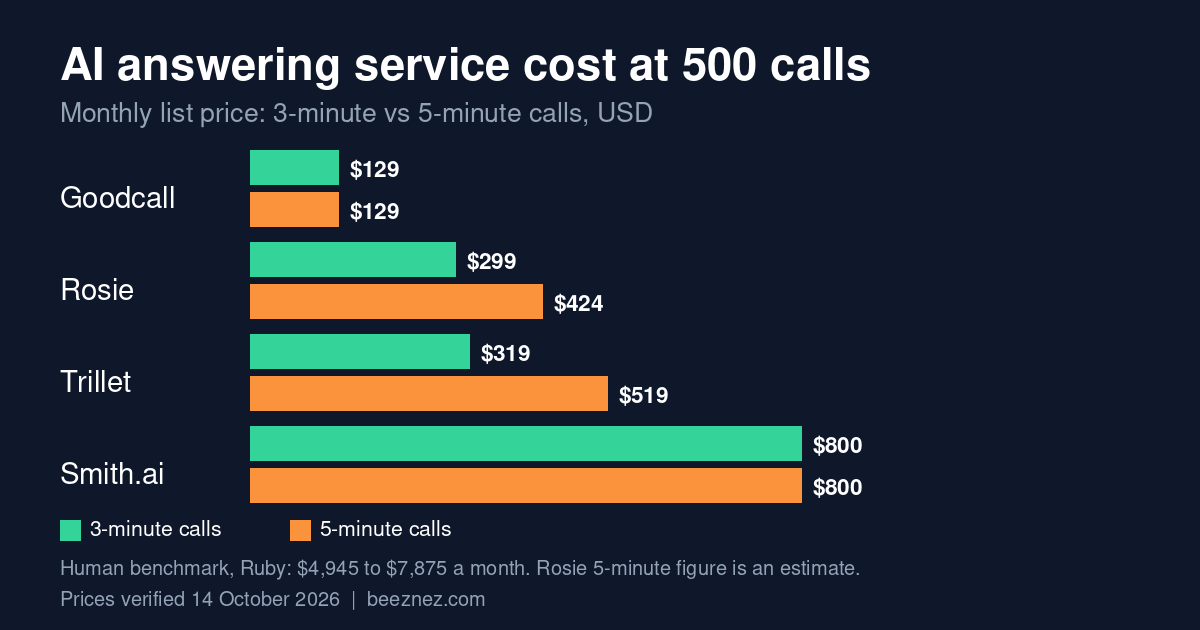
At 500 calls a month, moving from 3-minute to 5-minute calls, a 67% increase in talk time, raises the per-minute bills by about 42% to 63%, and raises the per-call and per-customer bills by exactly $0.
| Provider | Model | 3-minute | 5-minute | Change |
|---|---|---|---|---|
| Trillet | Per minute | $319 | $519 | +63% |
| Rosie | Per minute, tiered | $299 | $424 (est.) | +42% |
| Ruby | Per human minute | $4,945 | $7,875 | +59% |
| Smith.ai | Per call | $800 | $800 | 0% |
| Goodcall | Per customer | $129 | $129 | 0% |
Rosie’s 5-minute figure exceeds its top published plan, so it uses the indicative $0.25 a minute overage described above.
Finding one on AI answering service cost: per-call and per-customer pricing is insurance against talkative customers. If your callers ramble or need hand-holding, a metered plan charges you for the very problem you are trying to fix. Flat plans do not.
Finding two: bucket-based plans jump, they do not slope. Rosie’s $49 plan covers 250 minutes, which is 83 three-minute calls. The 84th call pushes you onto the $149 plan, a threefold jump for one extra call. Ruby works the same way across its plan ladder. Your cost is not a line, it is a staircase, and you can be standing on the wrong step without doing anything differently.
Practical rule: before choosing a tiered plan, multiply your busiest month’s call volume by your longest typical call, not your average. If your 90th-percentile call is six minutes, price the plan on six minutes.
When Per-Call Beats Per-Minute: The AI Answering Service Cost Crossover
There is an exact crossover, and you can calculate it for your own business. The formula: per-call rate divided by per-minute rate equals the crossover call length.
| Comparison | Per-minute rate | Per-call rate | Crossover call length |
|---|---|---|---|
| Trillet vs Smith.ai | $0.20/min | $2.00/call | 10.0 minutes |
| Rosie Professional ($0.196/min) vs Smith.ai | $0.196/min | $2.00/call | 10.2 minutes |
| Rosie Scale ($0.149/min) vs Smith.ai | $0.149/min | $2.00/call | 13.4 minutes |
| Goodcall vs Trillet, at 100 calls | $49 + $0.20/min after 150 | $79 flat | 3.0 minutes |
Read the first line plainly: Trillet beats Smith.ai on marginal cost unless your calls average longer than about ten minutes. Below that, metered pricing wins. Above it, Smith.ai’s flat per-call rate wins and keeps winning the longer your calls run. So per-call pricing is genuinely right for long, information-dense calls such as legal intake, technical support and detailed consultations. It is the wrong answer for a plumber booking a two-minute appointment, who would pay about $2.00 for a call that costs about $0.40 on a per-minute plan.
Smith.ai makes the structural argument itself, and it is a fair one: per-minute providers are financially rewarded for long calls while you want short ones. What it leaves out is that per-call pricing only pays above ten minutes, and most small-business calls are shorter.
The last line is the sneaky one. At 100 calls, Goodcall and Trillet break even at exactly three-minute calls, the assumption used throughout. Stretch calls to five minutes and Trillet costs $119 against Goodcall’s $79, about 50% more, while Goodcall has not moved a dollar.
AI vs Human: The Honest AI Answering Service Cost Comparison
Ruby is the human benchmark, and the gap is not a rounding error.
| Volume | Cheapest AI | Ruby (human) | Multiple |
|---|---|---|---|
| 100 calls | $79 (Trillet or Goodcall) | $1,160 | 15x |
| 500 calls | $129 (Goodcall) | $4,945 | 38x |
| 2,000 calls | $299 (Goodcall) | ~$18,900 | 63x |
That table is the whole business case for AI answering service cost savings, and it is also where you should slow down.
What the cheap AI options do not do. Most handle a booking, take a message, answer questions from your website and Google profile, and send you a summary. That is most of what a small business phone line needs. What they handle less well is an angry customer, a negotiation, an edge case that needs judgement, or recovering a conversation that has gone wrong. Smith.ai builds human escalation into its AI plans, and its human receptionist plans start at $300 a month for 30 calls. Most cheaper vendors instead offer to transfer the call to you.
The honest read. If your calls are transactional (booking, hours, pricing, directions, availability) then AI at $129 is not a compromise, it is simply cheaper. If your calls need judgement, a human service or a direct hire is not overpriced, it is a different product, and the 38x multiple is the price of that distinction.
One practical point the price tables hide: concurrent calls. Rosie advertises simultaneous call handling, so there are no busy signals. Human services answer one call per agent, and a second simultaneous call either waits or goes to voicemail. In your busiest hour that matters more than the rate.
What the AI Answering Service Cost Does Not Include
Every figure above is the plan. Here is what can arrive on top of the AI answering service cost.
| Extra | What the sources show | Notes |
|---|---|---|
| Overage | Trillet $0.20 a minute after 150; Smith.ai $2.00 to $2.50 per extra call; Goodcall 79 cents (Starter), 26 cents (Growth) and 15 cents (Scale) per extra caller | Rosie moves you up a plan instead, which is a step, not a slope |
| Setup fees | Trillet lists none and offers a 28-day money-back guarantee | Ask every vendor before you sign |
| Per-agent pricing | Goodcall plan prices apply per agent | Three locations can mean three plans |
| Website chat or texting | Rosie lists website texting at $50 a month; website chat free | Check each vendor add-ons |
| Spam calls | Smith.ai counts every answered call toward your quota, with an allowance to remove up to 10% from the bill | Check the spam policy on per-call plans |
| Compliance | Trillet states its $49 self-serve plan is for non-PHI use | For patient data, get a signed BAA first |
Spam will inflate your AI answering service cost on per-call plans. If your AI answers 25 robocalls a month, a per-call vendor charges for them unless you use the removal allowance. Read the spam policy before choosing.
Language and location limits vary. Rosie supports English and Spanish and, according to its help center, currently serves US businesses and does not issue international numbers. If you serve a multilingual customer base or operate outside the US, that is a functional requirement, not a footnote.
Free tiers let you hear it first. Smith.ai has a free plan with 25 calls a month, Goodcall offers a free demo agent, and Trillet has a 28-day money-back guarantee. Use them before paying.
Building Your Own: DIY Voice Agent vs AI Answering Service Cost
A do-it-yourself voice agent looks dramatically cheaper on paper, until you read the whole bill. Voice platforms advertise base rates of about $0.07 to $0.09 a minute, but the realistic all-in rate, once the language model, voice and telephony layers are added, is more like $0.12 to $0.30 a minute on the platforms that publish ranges.
| Layer | Cost |
|---|---|
| Voice platform, all-in | About $0.12 to $0.30 per minute (Retell, Synthflow and similar; base rates of $0.07 to $0.09 are only the starting layer) |
| 6,000 minutes a month (2,000 calls) | About $720 to $1,800 in usage |
| Phone number and carrier fees | A few dollars a month plus per-minute carrier charges |
| Your engineering time | The real cost |
At 2,000 calls a month that puts DIY usage at roughly $720 to $1,800, compared with $1,219 on Trillet and $299 on Goodcall. At this volume a managed per-customer plan is cheaper than the raw ingredients, before you spend a minute of developer time on prompts, failures, latency and transcripts.
So build only if you have a developer and a requirement no vendor supports. There is a data argument in the other direction too: self-hosting keeps recordings and transcripts on your own infrastructure, which matters for health, legal or financial information. For the token-level maths behind running your own agent, see How Much Does It Cost to Run an AI Agent Every Month?
Does an AI Answering Service Pay for Itself?
This is the only question that matters for AI answering service cost, and it depends on your own numbers. Here is a worked example with every assumption labelled. These are my placeholders, not measured figures. Replace them with yours.
- 500 inbound calls a month
- You currently miss 25% of them
- 10% of recovered calls convert to a booking
- Your average job is worth $280
| Step | Value |
|---|---|
| Calls currently missed | 125 |
| Bookings recovered at 10% conversion | 12.5 |
| Value of recovered bookings | $3,500 |
| Cost of Goodcall Growth | $129 |
| Revenue-to-cost ratio | 27x |
Even if only one in twenty recovered calls converts, that is 6.25 bookings and $1,750 of value against $129, still about 14x. This is revenue against cost, not profit, so subtract the cost of doing the jobs.
Be sceptical of the inputs, not the method, when you model AI answering service cost. Miss rates and job values vary enormously by trade, and published figures often come from vendors that sell answering services. Pull your own call log, count the calls that went unanswered, and use your own conversion rate and job value. If your average job is worth $50 and you genuinely miss four calls a month, an AI service will not pay for itself and you should not buy one.
The After-Hours Part of AI Answering Service Cost
For many service businesses this is where the return actually lives, and it is worth pricing separately. AI services generally do not distinguish between hours, so 24/7 is the same price as 9-to-5, whereas many human answering services charge more or restrict coverage after hours. For a five-person team that cannot staff evenings, that single structural difference is often worth more than the per-call rate.
Before assuming it applies to you, check three things: does the agent handle after-hours calls identically to daytime calls, does it book into your calendar, and who gets woken up if something genuinely urgent comes in. And check your own data first. Pull six months of call logs and count how many calls arrived outside business hours. If it is under 10%, buy the cheapest plan and skip features you do not need.
Which Plan Should You Pick on AI Answering Service Cost?
| Your situation | Pick | Why |
|---|---|---|
| Long, complex calls (legal intake, tech support) | Per-call (Smith.ai) | Length is free; crossover is around 10 minutes |
| Short transactional calls (trades, salons, clinics) | Per-minute (Trillet) or tiered (Rosie) | You pay only for talk time |
| Many repeat callers | Per-customer (Goodcall) | Repeat callers never re-bill |
| Every caller is new | Per-minute or per-call | The per-customer ceiling arrives fast |
| Seasonal or spiky volume | Per-call or per-customer | No minute buckets to overrun |
| High volume, 2,000+ calls | Per-customer, or a custom quote | Managed per-minute gets expensive fast |
| Need human escalation | Smith.ai | Human backup is built into the plans |
| Regulated or patient data | Any vendor that signs a BAA | Do not rely on a compliance toggle alone |
| Need 24/7 without a surcharge | Any AI vendor | Many human services charge more after hours |
| Under $100 a month total budget | Trillet or Goodcall entry tier | Published entry prices start at $49 and $79 |
Common AI Answering Service Cost Mistakes
Comparing a per-minute rate to a per-call rate without your average call length. This single mistake makes most published comparisons useless, including some from the vendors themselves.
Pricing your average call instead of your busy-month, long-call combination. Tiered plans jump. Price the 90th percentile, not the median.
Forgetting per-agent and per-location pricing. A plan that looks like $79 can be $237 across three locations.
Assuming spam is free. On per-call plans it is not, unless you use the removal allowance.
Buying for 2,000 calls when you make 200. Every tier above your actual volume is money you will not recover.
Skipping the free tier. Before you commit to any AI answering service cost, hear the agent answer before you pay for it.
Quick AI Answering Service Cost Checklist
- Count your actual inbound calls per month, by hour of day
- Measure your average and longest typical call length
- Multiply volume by long-call length to price the right tier
- Classify every vendor by billing unit before comparing prices
- Calculate your own crossover point with the formula above
- Add overage, add-ons and per-agent pricing to the monthly figure
- Check the spam policy if the plan is per call
- Confirm concurrency: can it take a second call at the same time?
- Audit your after-hours volume from six months of records
- Run a free tier or trial before signing anything
If you are budgeting the rest of your tool stack at the same time, see Small Business AI Budget: What a 5-Person Team Actually Spends Each Month.
Frequently Asked Questions
What is the typical AI answering service cost per month?
For a small business at 100 to 500 calls a month, expect roughly $79 to $319 on the cheapest published plans, depending on billing unit, which is about $0.26 to $0.79 per call at 3-minute call lengths. Entry tiers start at $49 (Trillet and Rosie) and $79 (Goodcall).
Is per-minute or per-call pricing cheaper?
Per-minute is cheaper for calls under about 10 minutes, and per-call is cheaper above that. The crossover is your per-call rate divided by your per-minute rate. Trillet at $0.20 a minute against Smith.ai at about $2.00 a call breaks even at 10 minutes.
Why does AI answering service cost differ so much between providers?
Because they bill for different things, not because they deliver wildly different quality. Per-minute, per-call and per-customer models produce different bills for identical usage. At 500 calls a month the spread across the four AI providers is about 6.2x, and most of it is the billing unit.
What is the cheapest AI answering service cost at 2,000 calls a month?
On published prices, Goodcall Scale plan at $299, because it bills per unique caller and repeat callers do not re-bill. Smith.ai at an estimated $3,200 is the most expensive AI option at that volume. Check Goodcall current caller caps first, since reported plan limits have changed during 2026.
Is AI answering service cost lower than a human receptionist?
At 500 calls a month, yes by a wide margin: $129 against $4,945 at Ruby. But the comparison is only fair if your calls are transactional. If they need judgement, negotiation or recovery of difficult conversations, you are comparing different products, not different prices.
Can AI answering services handle multiple calls at once?
Some can. Rosie advertises simultaneous call handling, which is an advantage over human services that answer one call per agent. Confirm it with any vendor before buying, because it decides what happens in your busiest hour.
What happens to AI answering service cost if I exceed my plan?
You pay overage or move up a plan. Trillet charges $0.20 a minute after 150 included minutes. Smith.ai charges roughly $2.00 to $2.50 per extra call on its Pro plan. Goodcall charges 79 cents per extra caller on Starter, falling to 15 cents on Scale. Rosie moves you up a tier, which can cost more than overage would because it is a step, not a slope.
How long does setup take?
Trillet advertises setup in about five minutes by scanning your website. Goodcall lets you build a free demo agent before connecting a number. Fully managed deployments take longer.
The Bottom Line on AI Answering Service Cost
AI answering service cost is mostly a question of billing unit and call length. If your calls are short, per-minute or per-customer plans win. If they are long, per-call pricing wins above about ten minutes. At 500 calls a month the cheapest AI plan costs $129 and a human service $4,945, so the real decision is whether your calls need judgement, not which vendor is cheapest. Measure your average and longest call, price the plan on the longer number, and try a free tier before you commit.
Related reading: Small Business AI Budget: What a 5-Person Team Actually Spends Each Month | How Much Does It Cost to Run an AI Agent Every Month? | Make.com vs n8n: Real Cost at 5K, 25K, and 100K Operations
Sources
- Smith.ai AI Receptionist pricing: Free 25 calls; Pro $150 for 75 calls, $270 for 150, $500 for 300; Enterprise $500 for 300 calls and $800 for 500; spam quota and 10% removal allowance. Accessed 14 October 2026.
- Rosie pricing: $49 for 250 minutes, $149 for 1,000, $299 for 2,000; annual discount; simultaneous calls; English and Spanish. Accessed 14 October 2026.
- Trillet pricing: $49 a month with 150 minutes then $0.20 a minute; no setup fees; 28-day money-back guarantee. Accessed 14 October 2026.
- Goodcall pricing: $79 for 100 unique callers, $129 for 500, $299 for 2,000; overage 79, 26 and 15 cents. Accessed 14 October 2026.
- Ruby Receptionists pricing: $250 for 50 minutes, $395 for 100, $720 for 200, $1,725 for 500; larger plans as listed in independent write-ups. Accessed 14 October 2026.
- Synthflow pricing and independent voice-agent cost guides: base rates of $0.07 to $0.09 a minute, all-in $0.12 to $0.30. Accessed 14 October 2026.
Prices verified 14 October 2026. This is a cost model built from list prices and independent write-ups, not a test of any service. Vendors change prices often, and several differ between sources, so confirm each figure on the live pricing page before you buy.
See also: AI Voice Agent Cost Per Minute: Vapi vs Retell vs ElevenLabs vs Bland at 100, 1,000 and 10,000 Calls for the per-minute cost of building your own voice agent.