By Md Abdur Rouf Mia | Published 13 October 2026 | Prices verified 13 October 2026
Make.com is cheaper at low volume, n8n is cheaper at high volume, and the crossover sits at roughly 40,000 to 50,000 operations a month for a five-step workflow. The reason is that Make charges for every module action, while n8n charges once per workflow run. That single difference makes most published Make vs n8n cost comparisons misleading, because a Make “operation” and an n8n “execution” are not the same unit. Below I price both at three volumes to give you a clear Make vs n8n cost answer, show the arithmetic, and re-run the biggest tier at ten steps, because step count moves the answer more than anything else.
If you have not ruled out Zapier yet, start with Zapier vs Make vs n8n: Real Cost at 10K, 50K and 500K Tasks, which converts all three platforms to the same workflow. Everything below assumes you have already narrowed the choice to Make and n8n.
What I Tested vs What I Researched
Tested: No live scenarios were run on either platform for this article.
Researched: Make and n8n pricing and documentation as listed under Sources, with the date each was read. Where two sources disagreed I say so, as in the note on conflicting Make prices.
Not tested: The credit and execution counts for the five-step and ten-step workflows are modelled from each platform’s counting rules, not measured. The section on how the model was calculated shows the arithmetic.
Make vs n8n Cost: The Short Answer
At 5,000 operations a month, Make is cheaper: about $12 to $16 against roughly $23 to $27 on n8n Cloud. At 25,000, Make still leads. At 100,000 the two are nearly level on a five-step workflow, and n8n wins decisively if your workflows run more than five steps. Self-hosted n8n wins on cash everywhere, and loses on your time.
| Monthly volume | Make.com (Core) | n8n Cloud | Cheaper |
|---|---|---|---|
| 5,000 ops (about 1,000 runs) | 10k credits: $12 annual / $16 monthly | Starter, 2,500 executions: about $23 / $27 | Make |
| 25,000 ops (about 5,000 runs) | 40k credits: $38 / $51 | Pro, 10,000 executions: about $56 / $68 | Make |
| 100,000 ops (about 20,000 runs) | 150k credits: $129 / $175 | Larger Pro, 50,000 executions: about $137 / $164 | n8n (narrowly, on monthly billing) |
| 100,000 ops, 10-step workflows | 150k credits: $129 / $175 | Pro, 10,000 executions: about $56 / $68 | n8n by about 2.6x |
Make prices in USD. n8n bills in euros, so USD figures are indicative at about 1.13 dollars to the euro. Annual and monthly billing shown as annual / monthly. Verified 13 October 2026.
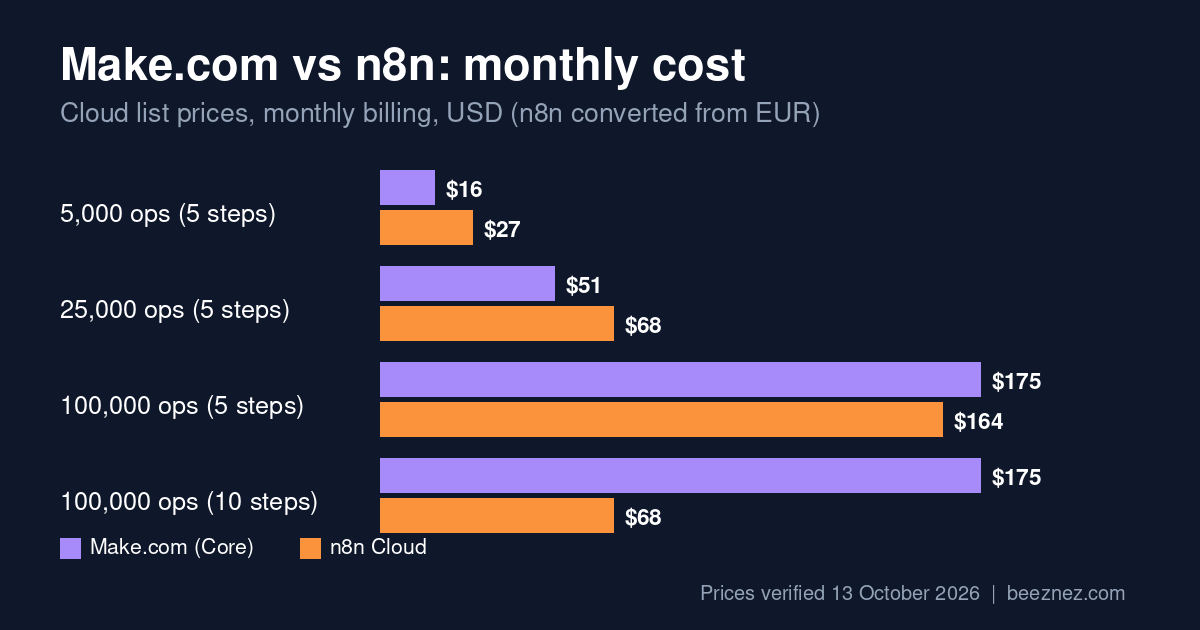
The three tiers in this Make vs n8n cost comparison
These volumes are not arbitrary for a Make vs n8n cost test. Five thousand operations is one active workflow at moderate volume, the size of a solo operator or a pilot. Twenty-five thousand is where a small team runs lead routing, CRM syncs and reporting together. One hundred thousand is production scale: several workflows and a few hundred runs a day.
I priced all three on five module actions per workflow run, because that is the shape most business automations take. I then re-ran the 100,000 tier at ten steps. It is the variable neither pricing page will tell you about.
A note on conflicting Make prices in any Make vs n8n cost comparison
Make’s pricing is reported inconsistently. Several trackers still list Core at $9 annual and $10.59 monthly for 10,000 credits, while recent checks show $12 annual and $16 monthly, which is what this article uses. Both vendors adjust tiers periodically, so confirm the figure on the live page and slider before you buy.
How Make and n8n Count Work Differently
Make credits explained: the first half of the Make vs n8n cost gap
Make used to bill in operations and now bills in credits. For ordinary modules nothing changed: one module action costs one credit. Adding a spreadsheet row is one. Fetching an email is one. Two rules trip up almost everyone:
- Triggers charge per check, not per result. A “Watch New Rows” module polling a sheet costs a credit every time it looks, even when it finds nothing.
- Bundles multiply. If a trigger returns ten form responses and three action modules sit downstream, that is 1 + 30 = 31 credits for a single run.
Routers, filters and error-handler modules such as Rollback, Break, Resume, Commit and Ignore are free. AI and code steps can consume more than one credit, so check Make’s credit documentation before you budget for them.
n8n executions explained: the other half of the Make vs n8n cost gap
n8n counts executions, and an execution is one run of a whole workflow. A three-step workflow and a thirty-step workflow cost the same: one. The counting rules are generous:
- Manual runs are free. Only production executions count toward your quota.
- Polling triggers only charge when they find new data. Empty polls cost nothing, the opposite of Make.
- Webhooks charge once per inbound request.
- Sub-workflows and error workflows are free. Only the parent run counts.
One trap is identical on both platforms: a schedule trigger fires on the clock regardless of outcome. A workflow scheduled every five minutes burns about 8,640 executions a month even if it never does anything useful.
Why this makes most Make vs n8n cost comparisons misleading
Five modules that run once are five Make credits and one n8n execution. So “100,000 operations” on Make and “100,000 executions” on n8n describe workloads roughly five times apart in scale. A comparison that puts those two numbers side by side without stating steps per run is comparing a litre to a gallon. That is the main reason I wrote this article.
Zapier bills in a third unit again — a task, which is one successful action, with triggers and failed actions costing nothing at all. If you are comparing all three, the unit conversion for the three platforms is here.
Make vs n8n Cost at 5,000 Operations a Month
Assumption: five module actions per run, so about 1,000 workflow runs.
Make.com plan and price
5,000 credits does not fit the free plan (1,000 credits, two active scenarios, a 15-minute minimum schedule interval). You are on Core at the 10,000-credit tier: $12 a month billed annually, $16 billed monthly. You will use half of it, but the credit ladder starts here and climbs through 20k, 40k, 80k and 150k.
n8n Cloud plan and price
1,000 executions fit the Starter plan: 2,500 executions at 20 euros a month billed annually (24 euros monthly), about $23 to $27. You get unlimited workflows, unlimited users and every integration.
Self-hosted n8n alternative
The Community Edition is free software with no execution quota. You pay for the server instead, which is my estimate at about $5 a month at the very bottom and $20 to $40 for a production-ready instance with Postgres.
Winner at this tier
Make, on a like-for-like cloud comparison: roughly $12 to $16 against $23 to $27 for the same job. n8n Starter is still worth the extra if you expect to outgrow 2,500 runs, because the next rung is Pro at 50 euros annual.
Self-hosted n8n is cheapest in cash, but at this volume you pay more in DevOps time than you save in subscription. Only self-host here if you already run servers. For the full breakdown, read Is n8n Really Free? The True Monthly Cost of Self-Hosting.
Make vs n8n Cost at 25,000 Operations a Month
Make.com plan and price
25,000 credits outgrows the 20k rung, so you move to the 40,000-credit Core tier: $38 a month annually, $51 monthly.
n8n Cloud plan and price
5,000 executions need Pro at 10,000 executions: 50 euros a month annually, 60 euros monthly, about $56 to $68. That adds 20 concurrent runs, workflow history and admin roles.
Self-hosted n8n alternative
A 5,000-execution workload is comfortable on a $20 to $40 a month server, plus an estimated two to four hours a month of maintenance.
Winner at this tier
Make still wins at five steps: $38 to $51 versus $56 to $68.
Run the same arithmetic at ten steps and the answer flips. 25,000 operations becomes just 2,500 runs, which fits n8n Starter at about $23 to $27 (with no headroom, so watch the counter), while Make still charges $38 to $51. n8n is then roughly 40 to 47 percent cheaper for identical work. That is not a rounding error. It is a different pricing philosophy, and it is why “which is cheaper” has no single answer.
Make vs n8n Cost at 100,000 Operations a Month
Make.com plan and price
100,000 credits lands on the 150,000-credit Core tier: $129 a month annually, $175 monthly. Make’s ladder has no 100k rung, so you buy 150k and leave 50k unused.
n8n Cloud plan and price
20,000 executions need the larger Pro tier, which is a 50,000-execution tier with up to 50 concurrent runs. It is listed at about 121 euros a month annually and 145 euros monthly, roughly $137 to $164. Confirm the exact figure on n8n’s tier selector, since this is the tier above the base prices.
Self-hosted n8n alternative
Infrastructure climbs to an estimated $40 to $150 a month for a high-volume instance, plus four to eight hours of maintenance. Still unlimited, still your problem.
Winner at this tier
n8n, narrowly, on monthly billing ($164 versus $175), and Make narrowly on annual ($129 versus $137). This is the crossover zone, and at five steps it is essentially a dead heat.
Push to ten steps and it is not close. You need only 10,000 executions, which is n8n’s 60-euro Pro tier (about $68), against Make’s $175. That is n8n at roughly 40 percent of the cost for the same workload.
The Make vs n8n Cost Crossover Point
The Make vs n8n cost arithmetic
Cost per 1,000 operations, using monthly billing so neither vendor is flattered by annual discounts:
- Make, 100,000 operations: the 150,000-credit Core tier is $175 a month. $175 / 100,000 = $0.00175 per operation, or $1.75 per 1,000.
- n8n, 100,000 operations at five steps (20,000 executions): the 50,000-execution tier is about 145 euros, or $164. $164 / 100,000 = $1.64 per 1,000, so n8n wins by about 6 percent.
- n8n, 100,000 operations at ten steps (10,000 executions): Pro at 60 euros is about $68. $68 / 100,000 = $0.68 per 1,000, so n8n wins by about 2.6 times.
Working backwards, the crossover for a five-step workflow sits just above 40,000 operations. Past Make’s 40k rung you are forced onto the next one, while n8n’s 10,000-execution Pro tier covers up to 50,000 five-step operations. For a ten-step workflow it arrives earlier, somewhere between 25,000 and 40,000 operations.
The Make vs n8n cost rule: the more steps per run, the earlier n8n wins. Make’s price scales with how much your workflow does. n8n’s scales with how often it starts. Complex workflows are where the difference compounds.
The self-hosting caveat: your time is not free
On pure cash, the Community Edition wins at every tier: unlimited executions and zero licence cost. That is also the most misleading number in this article. Budget realistically for an estimated $20 to $150 a month in infrastructure, plus two to eight hours a month of updates, backups, monitoring and security patching. At a modest $50 an hour of internal cost, four hours is $200 a month, which is more than Make’s entire 150,000-credit tier. See the real cost of self-hosting n8n. For ten self-hosted tools and what they cost to run, see Best Self Hosted SaaS Alternatives for Startups in 2026.
Self-hosting wins when you have existing DevOps capacity, when volume runs into the hundreds of thousands of executions, or when data legally cannot leave your infrastructure. It loses when none of that is true.
What the Pricing Pages Leave Out of the Make vs n8n Cost Picture
What happens when you hit the limit
Make: your scenarios stop when you run out of credits. Incoming webhooks queue and polling resumes from the last successful run, and you can upgrade your tier or buy extra credits to continue. Continuous running past the limit is an Enterprise feature.
n8n: the picture depends on the plan. Self-hosted Business overage is invoiced at 4,000 euros per extra 300,000 executions, and monthly subscribers on the larger Cloud Pro tier can add executions themselves. Check how your plan behaves before you rely on it.
The practical difference: Make tends to hard-stop, n8n to soft-stop with a bigger bill. Either way, set alerts at 75 percent of your quota.
Annual vs monthly billing
Make: the pricing page defaults to annual. At the 10,000-credit Core tier the real gap is 25 percent ($12 versus $16). On monthly plans, unused credits expire every cycle, so budget for your peak month, not your average.
n8n: annual saves about 17 percent: 288 euros becomes 240 euros on Starter, and 720 becomes 600 on Pro. The monthly execution allowance is identical either way, and unused executions do not roll over.
Feature gating that forces an upgrade before you hit your cap
This is where both vendors make real money.
Make: Core, Pro and Teams all include the same 10,000 credits at the base tier, so upgrading buys capability, not capacity. Pro adds priority execution and full-text log search. Teams adds team roles and shared templates, and billed monthly it costs more than three times Core for the same volume. If you only need more runs, buy a higher credit tier on your current plan instead of upgrading the plan.
n8n: Starter gives one shared project and five concurrent executions. Pro gives three projects and up to 50 concurrent runs on the larger tier. SSO is on the self-hosted Business plan, which starts at several hundred euros a month. If your compliance team needs SSO, that is the most common reason people leave n8n Cloud, and it has nothing to do with executions.
Which One Should You Choose on Make vs n8n Cost?
Choose Make if
Your workflows are broad but shallow: three to five modules, lots of integrations, lots of users. Make’s credit definition is unusually honest, one module action and one credit, which makes estimating possible. Paid plans include unlimited users, the app catalogue passes 3,000 integrations, and the visual canvas with routers and filters suits branching logic. At entry volume, Make is simply cheap.
Choose n8n if
Your workflows are deep: ten, twenty or thirty steps with heavy logic, AI calls and error handling. n8n charges for the run, not the steps, so complexity is free. If you have DevOps capacity, the Community Edition removes the ceiling entirely. Above roughly 50,000 operations a month it is usually the better buy. For AI-heavy workflows, remember that model usage is billed separately; How Much Does It Cost to Run an AI Agent Every Month? shows how to price that.
Choose neither if
Your automation is a handful of two-step workflows at low volume. Neither platform is expensive there, and neither is worth a migration project. Start on Make’s free plan, measure real credit consumption from the execution log, and revisit with numbers instead of estimates. If you are still choosing a platform at all, work through How to Choose the Right AI Automation Tool for Your Business first. It covers questions that matter more than price, such as data residency, error handling and who maintains the thing in six months.
How This Make vs n8n Cost Model Was Calculated
This is a cost model built on list prices, not a measurement from a live deployment. Prices and counting rules were cross-checked on 13 October 2026 against the vendors’ published pricing and documentation. Where sources disagreed, such as Make’s Core price, the article says so. I modelled a five-step workflow as the baseline and a ten-step workflow as the sensitivity case, priced on monthly billing to avoid flattering either vendor with annual discounts. Server and maintenance figures for self-hosting are estimates. All arithmetic is shown so you can substitute your own step count. No vendor reviewed or influenced this article.
The Bottom Line on Make vs n8n Cost
The Make vs n8n cost question comes down to steps per run and runs per month. Below about 40,000 operations, or for short workflows, Make is cheaper. Above that, or for long workflows, n8n Cloud is cheaper, and self-hosted n8n is cheapest on cash if you can afford the maintenance time. Whichever way the Make vs n8n cost maths falls for you, count your steps, multiply by your runs, and price the result on both vendors’ live sliders before you commit.
Frequently Asked Questions
Is n8n cheaper than Make.com?
Not at low volume. Make is cheaper up to roughly 40,000 to 50,000 operations a month on a five-step workflow. Past that, or earlier if your workflows run more than five steps, n8n is cheaper. At ten steps and 100,000 operations, n8n costs about 40 percent of Make.
What counts as an operation in Make.com?
One module action. Reading, searching, creating, updating or deleting data, and transforming data with built-in tools, each cost one credit. Triggers charge one credit per check, even when they find nothing, and bundles multiply because every downstream module runs once per item. Routers, filters and error handlers are free.
Can I use n8n for free forever?
Yes. The Community Edition is free to self-host with no execution quota and no time limit. You pay for the server and your maintenance time. Features such as SSO and multiple environments need a paid Business licence, which is self-hosted only.
Which is cheaper at 100,000 operations per month?
n8n, though narrowly at five steps: roughly $164 versus $175 a month on monthly billing. At ten steps it is not close, at about $68 versus $175. Self-hosted n8n is cheaper again on cash once you ignore your own maintenance hours.
Does Make.com charge for failed scenarios?
Generally yes. Credits are consumed by modules that run, not modules that succeed, so a failed action still costs. Error-handler modules such as Rollback, Break, Resume, Commit and Ignore are the exception. Always count retries and error paths when you estimate.
Why is a Make operation not the same as an n8n execution?
Make counts every module action in a scenario, while n8n counts one execution per complete workflow run, however many steps it has. That is why the cost curves of the two platforms cross at high step counts.
How do I count Make credits for my own workflow?
Count the steps that act in one run, multiply by how many times it runs a month, and add the checks a trigger makes on its schedule even when it finds nothing. AI and code steps can use more than one credit, so check the cost of each module you use.
When does self-hosting n8n beat n8n Cloud?
When your monthly volume is high enough that a flat server bill beats the Cloud tier, and when you are willing to count your own upkeep time as a cost. The break-even point and a calculator are in the guide to the true cost of self-hosting n8n.
Sources
- Make.com pricing page, plan cards and credit selector, accessed 13 October 2026
- n8n pricing page, plan cards and tier selector, accessed 13 October 2026
- Make Help Center, Credits and Operations articles, accessed 13 October 2026
- n8n documentation, Understand executions and Cloud FAQ, accessed 13 October 2026
Prices verified 13 October 2026. Some third-party articles still quote Make Core at $9 and $10.59 for 10,000 credits. Both vendors adjust tiers periodically, so re-check the live pages before you commit.
See also:
Zapier vs Make vs n8n: Real Cost at 10K, 50K and 500K Tasks for all three platforms converted to the same workflow · Is n8n Really Free? The True Monthly Cost of Self-Hosting for the server and maintenance side · If you want to see how a full n8n build fits together, read How to Build a No-Code AI Agent Pipeline. For a step-by-step approach to deciding what to automate first, see How to Use AI to Automate a Small Business.
Small Business AI Budget: What a 5-Person Team Actually Spends Each Month for the full monthly stack.
See also: Best Self Hosted SaaS Alternatives for Startups in 2026 for ten self-hosted tools and what each costs to run.