By Md Abdur Rouf Mia | Updated 17 October 2026 | Prices and models verified 17 October 2026
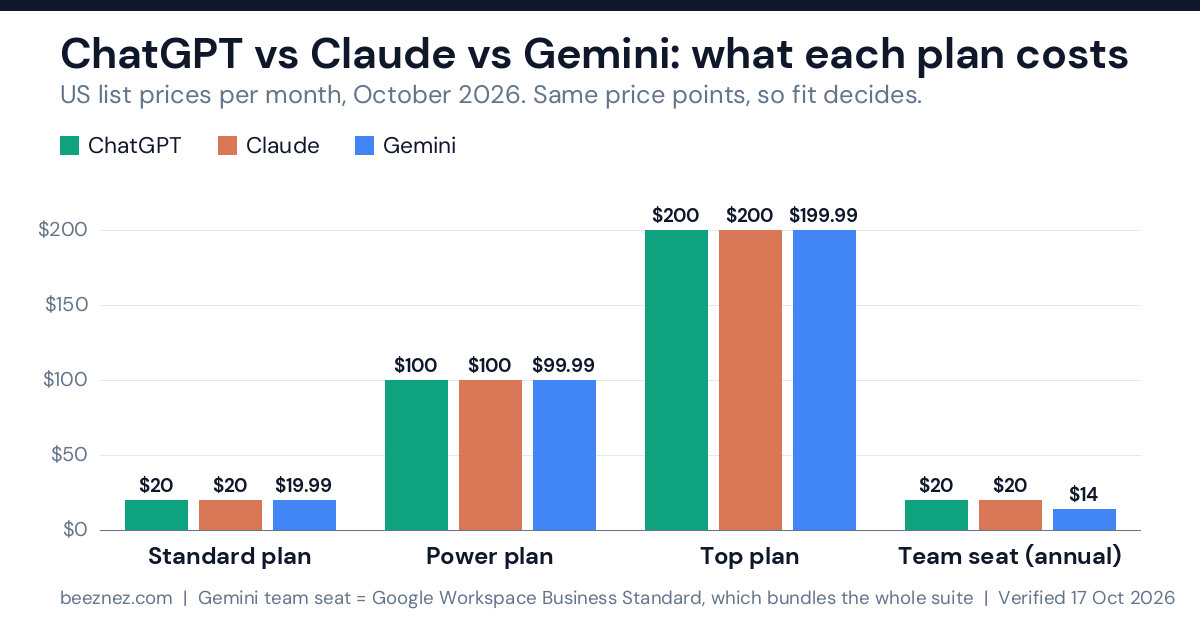
ChatGPT vs Claude vs Gemini is no longer a price decision. In October 2026 all three sell a roughly $20 individual plan, a $100 power tier and a $200 top tier at near-identical US list prices, so the real choice is which one fits how your team works: inside Google’s apps, inside Microsoft’s, or in a standalone chat window.
That makes most ChatGPT vs Claude vs Gemini articles less useful than they look. They declare a winner on writing, data or research, usually from one afternoon of prompts on whichever model versions were live that week. The models change monthly. Google released Gemini 4 Argon to AI Pro and Ultra subscribers on 13 October, four days before this update, so any Gemini test run earlier than that used a different model.
So this guide does two things. First, it compares the three platforms on the facts that can be verified today: plans, prices, models, context limits, team seats, integrations and data controls. Second, it gives you a free, reproducible test kit with five business scenarios, identical inputs, a scoring rubric and an answer key, so you can score all three on your own work instead of trusting anyone’s opinion, including mine.
One thing this article is not: it is not a report of hands-on scored tests. I have not run the five scenarios on all three tools and I do not publish scores I did not earn. When results exist, they will go in a follow-up with the tested model versions, dates and plan tiers named. Until then, read this as a researched buyer’s guide plus a test you can run yourself in an afternoon.
The Short Answer: ChatGPT vs Claude vs Gemini for Business
Match the tool to your situation, not to a leaderboard:
| Your situation | Start your trial with | Why |
|---|---|---|
| Your team lives in Gmail, Docs, Sheets and Meet | Gemini | Workspace Business Standard ($14 per user, annual) includes Gemini across the apps |
| You want the widest toolbox in one app: images, voice, agents, custom GPTs, scheduled tasks | ChatGPT | Longest feature list on OpenAI’s own pricing page at the $20 tier |
| Long, careful documents and polished writing matter most | Claude | Most published side-by-side tests favour it on tone and long-form writing, though mostly on older model versions |
| You run Microsoft 365 | ChatGPT or Claude | Both list Office integrations; Gemini’s deepest hooks are in Google’s apps |
| Tight budget, light use | Free tiers, then Gemini AI Plus ($4.99) or ChatGPT Go ($8) | Claude has no cheaper paid tier below Pro |
| Client or patient data is involved | Any of the three, on a business plan only | Consumer plans are the wrong place for confidential data |
Notice what this table does not say: that one assistant wins everywhere. The honest summary of the ChatGPT vs Claude vs Gemini race in October 2026 is that the top models are close, and the platform around the model (your existing apps, your admin needs, your usage limits) decides more of the outcome than the model does.
How This ChatGPT vs Claude vs Gemini Comparison Was Built
What I did. I read OpenAI’s pricing page directly and checked prices for all three platforms against at least two independent sources, with the vendors’ own plan pages as the reference point. I reviewed ten published side-by-side comparisons and one independent benchmark index to see where findings agree. I checked model names against the vendors’ own pages and recent release coverage.
What I did not do. I did not run scored tests of the five scenarios on all three assistants, so this article makes no claim that one of them scored higher than another on my inputs. Where I report what other testers found, I say who ran the test and which model versions they used.
A conflict of interest worth stating. Beeznez Tech’s Editorial Policy explains that AI assistants help with research and drafting here. This article was drafted with the help of Claude, which is one of the three products compared. To offset that, every price, plan and model claim was checked against the sources listed at the end, I avoid declaring a winner, and the test kit lets you check any conclusion yourself. This article contains no affiliate links.
Names change quickly. OpenAI lists models under a mix of GPT-6 and GPT-5.6 names, Google just launched a new flagship, and Anthropic lists several model tiers. I use the names as vendors list them on the dates above, and I would treat any model-specific claim, here or elsewhere, as valid for weeks, not years.
ChatGPT vs Claude vs Gemini Plans and Prices (US, October 2026)
| Tier | ChatGPT | Claude | Gemini |
|---|---|---|---|
| Free | $0, GPT-6 Luna, limited uploads and tools | $0 | $0, automatic model choice, mostly a Flash-Lite model since 9 October |
| Entry paid | Go, $8 (may include ads) | None | Google AI Plus, $4.99 |
| Standard | Plus, $20 | Pro, $20 ($17 a month billed annually) | Google AI Pro, $19.99 |
| Power | Pro, $100 | Max 5x, $100 | Google AI Ultra, $99.99 (5x Pro usage) |
| Top | Pro, $200 (a $500 tier also exists) | Max 20x, $200 | Google AI Ultra, $199.99 (20x Pro usage) |
| Team seat | Business: $25 monthly or $20 annual, 2+ seats. Premium seat $125 or $100 | Team: Standard $25 monthly or $20 annual, 2 to 150 seats. Premium $125 or $100 | Included in Google Workspace: Business Starter $7, Standard $14, Plus $22 per user (annual) |
| Enterprise | Custom quote | $20 per seat a month (annual) plus all usage at API rates | Custom for Workspace Enterprise; Gemini Enterprise priced separately |
Three details change what these numbers mean:
- The team seats cost the same on two platforms. ChatGPT Business and Claude Team Standard are both $20 per user on annual billing and $25 on monthly, so seat price is a tie. I break that down for a five-person team in ChatGPT Plus vs Team vs Business.
- Gemini’s team price is a different kind of number. Business Standard at $14 is the price of Google Workspace itself, with Gemini bundled in. If you already pay for Workspace, the marginal cost of Gemini is close to zero. If you do not, you are buying an email and office suite, not just an assistant.
- Claude Enterprise is metered. The seat fee does not include usage, so the monthly bill follows how much your people use it. That can be cheaper or much more expensive than a flat seat, depending on your team.
Small differences exist by country, and Google cut Google AI Plus from $7.99 to $4.99 on 8 June 2026, so some older articles still quote the higher figure.
The 10-Person Team Cost, Side by Side
For ten users, in US dollars, on a standard seat:
| Option | Annual billing, per month | Monthly billing, per month |
|---|---|---|
| ChatGPT Business Standard (10 seats) | $200 | $250 |
| Claude Team Standard (10 seats) | $200 | $250 |
| Google Workspace Business Standard (10 users, Gemini bundled) | $140 | $168 |
| Google AI Pro on 10 personal accounts | Not offered | $199.90 |
| Any of the three, 10 Premium seats | $1,000 (ChatGPT, Claude) | $1,250 (ChatGPT, Claude) |
The cheapest line is only comparable if your team genuinely needs Google Workspace. For a ChatGPT vs Claude vs Gemini rollout, a common and sensible pattern is mixed seats: Standard for most people, a few Premium seats for the heavy users, and free accounts for occasional ones. My small-business AI budget breakdown shows what that looks like over a month.
Models and Context: What Each $20 Plan Actually Runs
ChatGPT. OpenAI’s pricing page lists the GPT-6.1 Sol, GPT-6 Astra, GPT-6 Sol and GPT-6 Luna models, alongside a GPT-5.6 family, as included with Plus, with Pro getting expanded access and a GPT-5.6 Sol Pro model. The page gives Plus a 54K-token window for instant responses and 256K for reasoning, and Pro 128K and 400K. Free users get GPT-6 Luna.
Claude. Anthropic’s current lineup is Claude Opus 5.5, Sonnet 5.5 and Haiku 5.5, plus the higher Fable 5.1 tier. I could not find a per-plan context figure for Claude’s consumer plans in the sources I reviewed, so if you plan to feed it very large documents, test the limit on your own plan before you commit.
Gemini. The newest model is Gemini 4 Argon, rolling out from 13 October to Google AI Pro and Ultra subscribers in the Gemini app and AI Mode in Search, with a gradual global rollout. Google AI Pro lists a 1M-token context window, and AI Plus a smaller one. Argon’s headline results are Google’s own figures, not independent findings, so treat them as claims to verify.
The practical lesson from this ChatGPT vs Claude vs Gemini comparison: a model name on a pricing page is not a test result. What a plan includes, and how fast you hit its usage cap, will affect your day more than a few points on a benchmark.
The Five Business Scenarios That Make ChatGPT vs Claude vs Gemini Testable
Benchmarks measure what benchmark designers think matters, and a ChatGPT vs Claude vs Gemini leaderboard is no exception. Business work is different: a proposal has to add up, a research summary must not invent facts, a spreadsheet analysis has to catch the broken rows. So the test kit uses five tasks with checkable answers. For each, here is what is worth testing and what is already known.
1. Business writing: a client proposal. The brief asks for a proposal for a fictional three-clinic physiotherapy group, with a fixed USD 18,000 budget that the price breakdown must total exactly, a 30 November deadline, a ban on promising rankings, and a reader who dislikes jargon. Check the arithmetic, the constraints and whether the draft invents credentials or case studies. In the ChatGPT vs Claude vs Gemini tests I reviewed, results lean towards Claude on tone and polish, towards ChatGPT on following a structure precisely, and one reported Gemini adding product details nobody supplied. Those tests used older model versions, so this is a hypothesis to test, not a verdict.
2. Research from supplied documents. Three short documents contain two deliberately conflicting figures (online booking at 41% against 52%, new-patient value of $640 against $580) with different dates and populations. The task forbids outside facts and requires a document letter for every number. This tests grounding, citation discipline and whether the assistant explains a conflict instead of silently picking one. Gemini’s 1M-token window and Google’s NotebookLM are relevant for large document sets; ChatGPT offers Projects and Deep Research on Plus; Claude offers Projects on Pro.
3. Data analysis: a sample sales spreadsheet. A 141-row export contains a duplicate order, two rows with no region and one negative quantity. The key lists the correct totals under both ways of handling the duplicate. The scoring question is not only whether the numbers are right but whether the assistant noticed the problems and said how it treated them. ChatGPT’s pricing page lists data analysis and interactive tables and charts at Plus. Gemini works inside Sheets on Google AI Pro and on Workspace Business Standard and above. Claude’s Pro plan lists a Microsoft 365 integration. Which of these routes produces the cleanest check-able answer is exactly what the test shows.
4. Marketing: a seven-day campaign. The brief sets a USD 500 budget, a 150-unit target, a one-email-a-day cap, a 15% discount ceiling and banned claims. Constraint-following is the whole test. A beautiful plan that sends two emails on day three fails.
5. Productivity: an actionable project plan. The team has stated weekly hours, a 330-hour build and a vendor approval that cannot start until the contract is signed. The correct answer needs capacity arithmetic and a clear feasibility statement. Plans that schedule payment testing before approval, or ignore the dependency, fail the task however good they look.
What Independent Tests Say, and Why to Be Careful
Several published comparisons agree on a broad pattern, and a few include numbers worth knowing.
- Writing. A 2026 side-by-side test by Geekflare, which used GPT-5.4, Claude Sonnet 4.6 and Gemini 3.1 Pro, judged Claude’s customer-facing copy the most polished and ChatGPT the safest at following the brief, and flagged Gemini for inventing product details. A separate blind test with 134 participants reported Claude winning four of eight rounds, with ChatGPT taking the strategic-analysis round.
- Business fit. Roundups from several consultancies repeat one pattern: ChatGPT for breadth and tools, Claude for long documents and writing, Gemini for teams inside Google Workspace.
- Overall scores are close. The Vals Index, as reported in a 14 October comparison, lists Gemini 4 Argon at 68.9%, Claude Sonnet 5.5 at 67.0% and Claude Opus 5.5 at 67.0%. A gap of under two points is smaller than the variation you will see between two runs of the same prompt.
Three reasons to hold these ChatGPT vs Claude vs Gemini results loosely. Most of those tests predate the models available today. Many ran each prompt once, and a single run is an anecdote. And several roundups are written by vendors or agencies that sell implementation services for one platform. That is why the kit asks for three runs per scenario and blind scoring.
Run the ChatGPT vs Claude vs Gemini Test Yourself
For a fair ChatGPT vs Claude vs Gemini trial, the kit is a single zip with every input and prompt, a blank scoring sheet and an answer key. Download the Beeznez Tech AI Test Kit (v1.0, 12 small files). All people, companies and figures in it are fictional, so you can use it with any account without exposing real data. The protocol takes about three hours for all five scenarios across three tools.
- Fix the tier. Use the same price point on each tool, for example the $20 plan, and write it down. Comparing a $20 plan with a $200 plan tells you about budgets, not models.
- Start clean. New chat for every run, memory off, no custom instructions, same attached files.
- Paste the task text exactly as written. Do not add hints, and do not follow up on the first run.
- Record the model shown. If the interface hides it (Gemini’s free tier now chooses automatically), record “auto”.
- Run each scenario three times per tool. Keep every output. One run is an anecdote.
- Score blind. Remove tool names, shuffle the outputs and score them before opening the answer key.
- Time the clean-up. Record the minutes you need to make each output send-ready. That number is often the one that matters most in real work.
- Average the three runs and note the spread. If one tool’s best run beats another’s worst by a little but their averages are close, call it a tie.
The rubric scores each output from 0 to 5 on five criteria, weighted to 100:
| Criterion | Weight | A score of 5 means | A score of 1 means |
|---|---|---|---|
| Output quality | 30 | Clear, well organised, right tone, ready for the reader | Generic, padded or confusing |
| Accuracy | 25 | Every figure and claim matches the inputs and the answer key | Wrong numbers or invented facts |
| Instruction-following | 20 | Obeys every rule: word limits, caps, banned claims, required sections | Ignores or breaks several rules |
| Editing effort | 15 | Under 5 minutes of fixes to send | More than 30 minutes, or faster to rewrite |
| Usability | 10 | Easy to export, reuse and iterate; no friction with files or limits | Hit usage caps, upload limits or format problems |
Score each criterion from 0 to 5, multiply by the weight divided by five, and add the five results for a total out of 100. Treat gaps of under about five points as noise. If two tools tie, decide on cost, integrations and data controls, which is where the first half of this article matters.
Report it reproducibly. If you share results, state them like this: “Tested [date]: [tool], [plan tier], [model shown], three runs, scored blind against the Beeznez rubric.” Without those four facts a comparison cannot be repeated.
Data Controls in ChatGPT vs Claude vs Gemini: Decide This Before Features
The most expensive mistake in this category is not choosing the wrong assistant. It is pasting client data into the wrong plan.
- ChatGPT. OpenAI’s pricing page lists training on your content as an opt-out setting on the Free, Go, Plus and Pro plans. Business and Enterprise carry the admin features that individual plans lack: SSO, an admin console, role-based controls and compliance reporting. In my ChatGPT plan breakdown, business workspaces do not use your data for training by default.
- Claude and Gemini. Both vendors also separate consumer plans from business ones (Claude Team and Enterprise; Google Workspace). The terms differ by plan, so read the data-use and retention sections for the exact tier you will buy, not the marketing page.
- For any of them, use a business plan for anything confidential, get the data-processing terms in writing where regulation applies, and keep a written rule on what staff may paste in. My guide to shadow AI spend covers how unsanctioned personal subscriptions creep in.
Usage Limits and Hidden Costs Across ChatGPT vs Claude vs Gemini
Price tiers are only half of the price. The other half is how soon you hit the cap.
- Claude meters usage in five-hour sessions with a weekly limit on paid plans, and Pro is listed as at least five times the Free allowance per session. Max multiplies Pro’s usage by 5x or 20x.
- Gemini usage is compute-based and refreshes every five hours up to a weekly cap, with AI Plus at 2x Free, AI Pro at 4x and Ultra at 5x or 20x of Pro.
- ChatGPT offers unlimited everyday text chats on every plan subject to abuse guardrails, with caps on tools such as deep research, uploads and agents that rise by tier.
- Ads and storage. ChatGPT Go may include ads. Google’s plans bundle cloud storage (400 GB on AI Plus, 5 TB on AI Pro), which is worth money if you would buy storage anyway.
The test that reveals this in a ChatGPT vs Claude vs Gemini trial is simple: during the three-hour protocol, note when any tool slows you down or refuses more work. That is your real limit.
Which Should You Choose?
Use this table to settle ChatGPT vs Claude vs Gemini once you know your workflow and your admin needs.
| If this is you | Lean towards | Reason |
|---|---|---|
| Google Workspace company, mixed technical ability | Gemini | No new login or tool; AI inside Gmail, Docs, Sheets and Meet |
| Solo consultant writing long proposals and reports | Claude, tested against ChatGPT | Writing quality is the main variable, and it is the one the kit measures best |
| Small team that wants one assistant for text, images, voice and data | ChatGPT | Broadest feature set at the $20 tier |
| Finance or ops team living in spreadsheets | Run scenario 3 on all three | Each route (ChatGPT data analysis, Gemini in Sheets, Claude’s file and Excel tools) differs; the test shows which is cleanest for your files |
| Budget under $10 per person per month | Gemini AI Plus or ChatGPT Go | The only paid tiers below $20 |
| Heavy daily use, repeatedly hitting limits | The $100 tier of your preferred tool | All three price it the same, so fit decides |
| Regulated data, central admin, audit needs | A business or enterprise plan from whichever passes your security review | Data controls outrank model quality |
If you also use AI agents that act inside your browser, my comparison of browser AI agents covers that separate decision.
Common Mistakes
Choosing ChatGPT vs Claude vs Gemini on a leaderboard. A two-point difference on an index will not survive contact with your own files. Test your own work.
Testing once. Models vary between runs. Three runs per scenario is the minimum for a fair comparison.
Comparing different tiers. A $20 plan against a $200 plan is a budget comparison, not a model comparison.
Judging outputs with the tool names visible. Everyone has a favourite. Strip the names before you score.
Trusting a polished answer. Fluent text is not accurate text. The kit’s answer key exists so you check numbers and constraints instead of admiring prose.
Ignoring the platform around the model. If your company runs on Google or Microsoft apps, integration can matter more than a few benchmark points.
Using consumer plans for confidential work. The cheapest tier is not the cheapest mistake.
Quick Checklist Before You Choose
- List the two or three tasks your team repeats most
- Check which office suite your company already pays for
- Pick one price tier and use it for all three tools
- Download the kit and run the five scenarios, three runs each
- Score blind, then check numbers against the answer key
- Time the clean-up for every output
- Note any usage caps you hit
- Review data terms for the business plan you would actually buy
- Price the team, including premium seats for heavy users
- Re-run the test when a major model ships, which is every few weeks
Frequently Asked Questions
Which is best for business, ChatGPT vs Claude vs Gemini?
There is no single winner. ChatGPT has the broadest toolbox, Gemini is strongest inside Google Workspace, and Claude is frequently favoured in published tests for long documents and writing quality. Prices match at the $20, $100 and $200 tiers, so integrations and your own test results should decide.
What does ChatGPT vs Claude vs Gemini cost in 2026?
In the US, ChatGPT is $0 free, $8 Go, $20 Plus and $100 to $500 Pro. Claude is $0, $20 Pro ($17 annual) and $100 or $200 Max. Gemini is $0, $4.99 Google AI Plus, $19.99 AI Pro and $99.99 or $199.99 Ultra. Team seats are $20 to $25 on ChatGPT Business and Claude Team, and Gemini comes bundled with Google Workspace from $7 per user.
Are ChatGPT, Claude and Gemini tested in this article?
No. This is a researched comparison plus a reproducible test kit. I did not run scored tests on all three tools, so I do not claim a score for any of them. A follow-up with tested versions, dates and tiers will be published if and when results exist.
What is Gemini 4 Argon, and do I need it?
It is Google’s newest flagship model, available from 13 October to Google AI Pro and Ultra subscribers in the Gemini app, with a gradual rollout. You do not need it to benefit from Gemini in Workspace, but any Gemini test run before that date used an older model, so re-run it.
In ChatGPT vs Claude vs Gemini, which is best for analyzing a spreadsheet?
It depends on how your data is stored and how you work. ChatGPT lists data analysis and interactive charts at Plus, Gemini works inside Google Sheets on eligible plans, and Claude supports file analysis and Microsoft 365 integration. Scenario 3 in the kit has a known answer key, so you can see which one catches the bad rows.
Is it safe to put client data into ChatGPT vs Claude vs Gemini?
Only on a business or enterprise plan, with the data-use terms reviewed for that exact tier. Consumer plans are designed for individuals, and ChatGPT’s individual plans list training on your content as something you must opt out of.
Can I use more than one assistant from the ChatGPT vs Claude vs Gemini list?
Yes, and many teams do. A common setup is one main platform for the team and a second assistant for specific jobs. Keep a written rule on which data goes where, and watch for duplicate subscriptions.
How often should I re-run a ChatGPT vs Claude vs Gemini test?
Whenever a major model ships or a vendor changes its plans, which in 2026 happens every few weeks. The kit is built so a re-run takes an afternoon.
The Bottom Line on ChatGPT vs Claude vs Gemini
The prices are matched, the top models are close, and every vendor’s marketing says it is best for business. What differs is the platform around the model. Gemini is the natural fit if your company already runs on Google Workspace. ChatGPT offers the widest feature set in one app. Claude is the one to put in front of your long-document and writing work first, based on what other testers report, which you can confirm in an afternoon.
So do not take my word for the ChatGPT vs Claude vs Gemini result, or anyone else’s. Download the kit, run the five scenarios on the same tier of all three tools, score blind and check the numbers. If you share your results, include the tool, plan, model shown and date, and I will happily compare notes. I will update this article when plans or models move, and add scored results as soon as there are results worth publishing.
Related reading: ChatGPT Plus vs Team vs Business: Real Cost for a 5-Person Team | Small Business AI Budget: What a 5-Person Team Actually Spends Each Month | How to Choose the Right AI Automation Tool for Your Business | Browser AI Agents Compared
Sources
- OpenAI: ChatGPT plans and pricing: model list, context windows, features by plan, training opt-out. Read 17 October 2026.
- NoCode MBA: ChatGPT pricing and Lindy: ChatGPT pricing: Go, Plus, Pro $100/$200/$500, Business Standard and Premium seat prices.
- Walma AI: Claude plans compared, NoCode MBA: Claude pricing and BenchLM: Claude pricing plans: Pro, Max, Team and Enterprise prices, seat ranges and usage structure.
- Tandem: Claude pricing, October 2026: what Claude Pro includes (Projects, Microsoft 365 integration).
- AI Toolbox: Gemini pricing, NoCode MBA: Gemini pricing and Suprmind: Gemini pricing: AI Plus, Pro and Ultra prices, usage multipliers, the June 2026 AI Plus price cut.
- Android Police: which Gemini plan is worth paying for: context windows and storage by plan; free-tier model changes.
- Let’s Data Science: Gemini 4 Argon access and Mezha: Gemini 4 Argon release: 13 October rollout and plan access.
- Redress Compliance: Google Workspace pricing and Coworker: Gemini in Workspace pricing: Business Starter, Standard and Plus prices and Gemini access by tier.
- Geekflare: side-by-side comparison with real prompts and TeamAI: 2026 head-to-head: third-party test results on older model versions.
- Khalsa Website Designers: October comparison: the index figures cited, dated 14 October 2026 (single source).
- ChatGPT Plus vs Team vs Business: Beeznez Tech, Business seat limits and default data handling.
Prices and models verified 17 October 2026. This is a researched comparison, not a report of hands-on scored tests. Prices are US list prices before tax and change often, so confirm each figure on the vendor’s live pricing page before you buy. Third-party test results come from the publishers named and used the model versions they state.
See also: Best AI Tools for Solo Entrepreneurs 2026: A Lean 10-Tool Stack, how the assistant fits into a full solo stack.