By Md Abdur Rouf Mia | Updated 13 October 2026 | Prices verified 12 October 2026
The cost to run an AI agent that handles 1,000 support conversations a month is roughly $80 on a mid-tier model and about $12 on a budget tier in my cost model, or around $366 on a top-tier model. That gap is the whole story. Almost every published estimate counts only the token bill and leaves out the rest, which becomes the biggest line once the model is cheap. Below I build the model step by step, with every assumption written out so you can swap in your own numbers and check my arithmetic.
Throughout this article, “mid-tier” means $2 per million input tokens and $10 per million output tokens, “budget” means $0.10 and $0.50, and “top-tier” means $10 and $50. On the official pricing pages I checked on 12 October 2026, those rates match Anthropic’s Claude Sonnet 5.5, Claude Haiku 5.5 (for prompts up to 100,000 tokens) and Claude Fable 5.1, and OpenAI’s GPT-6.1 Sol, GPT-6 Luna and GPT-6 Astra. Prices change often, so the method matters more than any single figure.
How Much Does It Cost to Run an AI Agent? The Short Answer
For a support agent handling 1,000 conversations a month, here is the shape of the bill:
| Cost bucket | Top-tier model | Mid-tier model | Budget model |
|---|---|---|---|
| Token costs | $298.50 | $59.70 | $2.99 |
| Failed runs and retries (+20%) | $59.70 | $11.94 | $0.60 |
| Server | $8.00 | $8.00 | $8.00 |
| Vector storage | $0.00 (free tier) | $0.00 (free tier) | $0.00 (free tier) |
| Monthly total | about $366 | about $80 | about $12 |
| Cost per conversation | $0.37 | $0.08 | $0.012 |
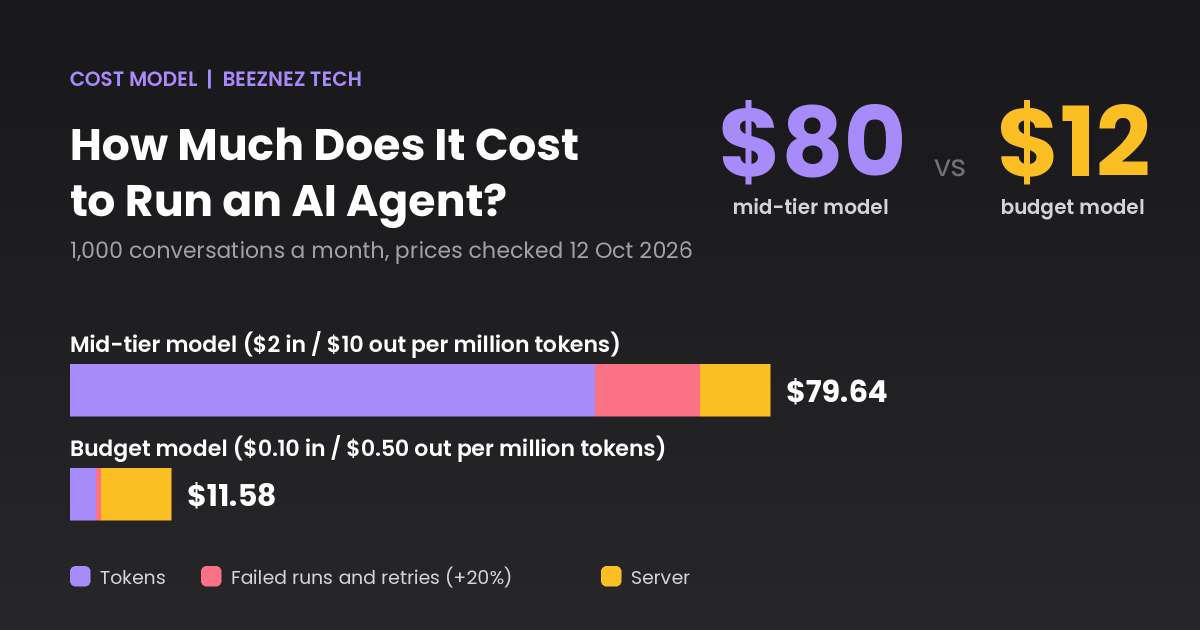
Monthly cost split for the same agent on two model tiers. Server cost is a fixed illustrative $8.
Totals use unrounded figures, so a column can differ from the sum of its rounded lines by a cent. Those are the headline numbers for the cost to run an AI agent at this volume. That is one agent, at one volume, on one set of assumptions, all of which I list below so you can change them.
Two things jump out immediately. First, the model you choose matters more than everything else combined. Second, the server bill is nearly irrelevant on the larger models at this scale, which is the opposite of what most cost guides imply. On the budget tier it flips: the server becomes the biggest line.
Why Published Estimates of the Cost to Run an AI Agent Disagree
Search for the cost to run an AI agent and you will find figures that differ by an order of magnitude or more for what sounds like the same job. Those numbers are rarely describing the same thing.
The first problem is that most estimates quote only the token bill. That is the visible cost, so it is the one everybody counts. It is not always the largest cost in a real deployment, and on low-volume agents the rest can outweigh it.
The second trap is that published estimates usually assume a clean, single-pass conversation. Real agents do not work that way. They run a retrieval step, grow their context on every turn, occasionally call a tool that fails, and retry. Every one of those behaviours adds tokens you pay for.
So instead of comparing other people’s numbers, I built the model myself. Here is what goes into it.
The Four Real Cost Buckets
The cost to run an AI agent splits into four buckets. Most guides count only the first one.
1. Token costs (the visible one)
Input and output tokens, priced per million. This is what everyone quotes, and it is genuinely the biggest variable, but only because the spread between model tiers is enormous, not because the volume is inherently expensive.
2. Orchestration and infrastructure
Something has to run the agent: a small server, a container, or a serverless function. At 1,000 conversations a month this is a small, fixed monthly cost. It does not scale with usage the way tokens do, which is why it dominates when the model is cheap and disappears into the noise when the model is expensive.
3. Retrieval and vector storage
If your agent looks things up in a knowledge base, you pay to embed and store those documents, and again to query them. Free tiers cover a lot at small scale. For example, Pinecone’s free Starter plan includes up to 2 GB of storage, 2 million write units and 1 million read units a month, and its own example workload is a knowledge base of about 30,000 documents. Past that size, or past those limits, expect to pay.
4. Testing, retries, and failures
This is the bucket nobody counts, and it is the one that surprises people. A failed run still bills. If your agent retries a tool call twice before succeeding, you paid for three attempts. Malformed responses, timeouts and validation failures all consume tokens and produce no output.
In my model I add a flat 20% on top of the token bill to cover this part of the cost to run an AI agent. Depending on how brittle your agent is, 10% to 40% is a reasonable range, and you will not know your real number until you log it.
Worked Example: The Cost to Run an AI Agent for 1,000 Conversations a Month
Here is the agent I am modelling. It answers customer questions using a knowledge base, escalates when unsure, and replies in plain text.
Assumptions
| Variable | Value |
|---|---|
| System prompt and tool definitions | 2,000 tokens |
| Knowledge base retrieval | 1,500 tokens, injected on turn 1 |
| Average conversation length | 6 turns |
| User message per turn | 100 tokens |
| Agent reply per turn | 150 tokens |
| Conversations per month | 1,000 |
Why context growth is the hidden multiplier
On a chat-based agent, every turn resends the entire conversation so far. Turn 1 sends 3,600 tokens. By turn 6 the agent is sending 4,850, for the same 100-token question.
That is the single most misunderstood part of agent pricing. Your cost per turn rises through the conversation. A six-turn conversation does not cost six times a one-turn conversation. It costs more.
Input token cost calculation
| Turn | Input tokens sent |
|---|---|
| 1 | 3,600 |
| 2 | 3,850 |
| 3 | 4,100 |
| 4 | 4,350 |
| 5 | 4,600 |
| 6 | 4,850 |
| Total per conversation | 25,350 |
Across 1,000 conversations that is 25.35 million input tokens. On a mid-tier model at $2.00 per million input tokens:
25.35 x $2.00 = $50.70
Output token cost calculation
6 turns x 150 tokens = 900 output tokens per conversation. Across 1,000 conversations that is 0.9 million output tokens. At $10.00 per million output tokens:
0.9 x $10.00 = $9.00
Total monthly token cost
$50.70 + $9.00 = $59.70, about 6 cents per conversation.
The same agent on a budget model tier
At $0.10 per million input tokens and $0.50 per million output tokens:
- Input: 25.35 x $0.10 = $2.54
- Output: 0.9 x $0.50 = $0.45
- Total: $2.99, about 0.3 cents per conversation.
Same agent, same conversations, same users. A 20x difference on the token bill, entirely from the model choice. On the all-in monthly total it is about 7x, because the $8 server is a fixed cost. On a top-tier model at $10 and $50, the same arithmetic gives $253.50 for input plus $45.00 for output, or $298.50, which is 100 times the budget token bill (about 30 times on the all-in monthly total).
That is why the cost to run an AI agent has no single answer, and why any guide that gives you one number without stating its model tier is telling you very little.
The formula, so you can rerun this with your own numbers:
Token cost = (input tokens / 1,000,000 x input price) + (output tokens / 1,000,000 x output price)
What Prompt Caching Does to the Bill
Caching is one of the biggest levers on the cost to run an AI agent once volume grows, second only to model choice. The worked example resends the whole conversation at full price on every turn. Both providers let you pay a fraction of the input price for text they have already seen.
On the pages I checked, a cache hit costs 5% of the base input price on the mid-tier models (for example $0.10 per million for Claude Sonnet 5.5 and for GPT-6.1 Sol) and 10% on the budget models ($0.01 per million). Writing to the cache costs 1.25 times the base input price. Claude Fable 5.1 is the exception at the top: its cache reads cost 2.5% of the base input price ($0.25 per million), so caching helps the top tier even more.
I reran the model with caching under a simple assumption: every turn arrives within the five-minute cache window, turn 1 writes its whole prompt to the cache, and each later turn reads the previous prompt from the cache and writes only its 250 new tokens. The cache prices are identical across the two providers for these two tiers, so the same figures apply to both.
| Item | Mid-tier model | Budget model |
|---|---|---|
| Input cost without caching | $50.70 | $2.54 |
| Input cost with caching | $14.18 | $0.81 |
| Output cost (unchanged) | $9.00 | $0.45 |
| Token total with caching | $23.18 | $1.26 |
| Monthly total with retries and server | about $36 | about $9.51 |
| Saving against the earlier total | 55% | 18% |
The pattern is clear. Caching is worth a great deal on a larger model, where input tokens dominate. On the budget tier the saving is small, because the fixed $8 server is now most of the bill. Caching has requirements, such as a minimum prompt length and a limited cache lifetime, so check each provider’s documentation before counting on these savings.
A Note on Token Counts
My model uses token counts as given, but the same text does not produce the same number of tokens everywhere. Anthropic’s pricing page notes that Claude 4.7 and later models use a newer tokenizer that produces roughly 30% more tokens for the same text than earlier models. Treat your token counts as something to measure with each provider’s token counter, not to assume. A 30% change in tokens is a 30% change in the input bill.
What Changes the Cost to Run an AI Agent Most
Ranked by impact, largest first. If you only optimize one thing, start at the top.
1. Model choice, by far the biggest lever
The 20x spread in the token bill above is not a typo or an edge case. It is the normal consequence of routing premium work to a premium model and routine work to a cheap one.
2. Prompt size and context handling
Your system prompt is sent on every single turn. A 5,000-token system prompt across a six-turn conversation costs more than the user’s actual messages. Trimming it is the cheapest optimization available, and it takes an afternoon.
3. Conversation length and memory strategy
Longer conversations get more expensive faster than linearly. If your agent has no strategy for summarising or trimming history, cost per conversation grows the longer someone stays engaged.
4. Caching and batch discounts
Cache hits cost 5% to 10% of the base input price on the models I checked, as shown above. Both providers also list batch processing at half price for input and output, which suits work that is not time-sensitive. A live support chat is not that kind of work, but overnight classification or summarising is.
Realistic Cost to Run an AI Agent by Volume and Use Case
These bands show how the cost to run an AI agent scales with volume and model tier, and they come straight from my model. They assume the same six-turn agent, a 20% retry allowance and a fixed $8 server. The server figure understates infrastructure at 100,000 conversations, so read that column as a floor.
| Model tier | 1,000 conversations | 10,000 conversations | 100,000 conversations |
|---|---|---|---|
| Budget | $12 | $44 | $366 |
| Mid-tier | $80 | $724 | $7,172 |
| Top-tier | $366 | $3,590 | $35,828 |
Translated into use cases, with the model tier and volume that typically go with each:
| Use case | Typical monthly range |
|---|---|
| Single-task agent, low volume (budget tier, 1,000 to 10,000 conversations) | $12 to $44 |
| Assisted agent with human review (mid-tier, 1,000 to 10,000 conversations) | $80 to $724 |
| High-volume autonomous agent (mid-tier, 10,000 to 100,000 conversations) | $724 to $7,172, and far more on a top-tier model |
Where the cost to run an AI agent explodes
Three patterns can multiply the cost to run an AI agent overnight:
- An agent that loops. A tool that fails and retries without a cap can burn tokens indefinitely on one conversation.
- Full-context resends at high volume. Fine at 1,000 conversations. Painful at 100,000.
- No spending limit set. If you have not set a hard cap at the provider level, a bug can run all night. Set the cap before you launch, not after. Controls like this are part of running agents safely, which I cover in my guide to AI agent governance for small businesses.
How to Cut AI Agent Costs Without Breaking It
These six changes lower the cost to run an AI agent without hurting the quality of its answers. They are listed roughly in order of payoff.
1. Route by task difficulty, not by habit
Send classification, summarising and extraction to a cheap model. Reserve the premium tier for reasoning that actually needs it. This is the highest-value change on this list and usually takes a day.
2. Trim the system prompt
Delete instructions the model does not need, move static reference material into retrieval instead of the prompt, and cut examples that do not change behaviour.
3. Cache what repeats
Turn on prompt caching for the system prompt and the growing conversation, as in the scenario above. If thousands of users also ask the same twenty questions, you are paying to generate the same twenty answers, and caching those answers serves them at close to zero marginal cost.
4. Summarise long conversations
Once a conversation passes a threshold, replace older turns with a short summary instead of resending everything.
5. Cap retries
Two attempts, then escalate to a human. An unlimited retry loop is a spending bug with no ceiling.
6. Log cost per run from day one
You cannot optimize a number you are not measuring. Store tokens and model per run from your first deployment. Retrofitting this later means starting your data from scratch. If you also want to know whether the agent pays for itself, see my article on measuring AI agent ROI.
A Simple Budget Template for the Cost to Run an AI Agent
Copy this, fill in your own volumes, and you have a defensible number before you build anything.
| Line item | Your value | Your monthly cost |
|---|---|---|
| Conversations per month | ||
| Average turns per conversation | ||
| Average input tokens per conversation | ||
| Input price per 1M tokens | ||
| Average output tokens per conversation | ||
| Output price per 1M tokens | ||
| Token subtotal | ||
| Retry multiplier (10 to 40%) | ||
| Server or container | ||
| Vector storage | ||
| Monitoring and logging | ||
| Total |
If your estimated cost to run an AI agent is uncomfortable, the fix is almost always in the model column, not the volume column. A similar budgeting approach works for self-hosted automation tools, as I showed in my breakdown of the real monthly cost of self-hosting n8n.
How I Calculated the Cost to Run an AI Agent
Every figure above about the cost to run an AI agent comes from the same model: six-turn conversations, a 2,000-token system prompt, one retrieval injection, and the full conversation history on every turn. Token prices, cache prices and batch prices were taken from the providers’ official pricing pages on 12 October 2026. The $8 server line is an illustrative figure for a small VPS or container, not a quote from any provider, so check your own provider’s price. The vector storage line is $0 because the example fits inside the free plan limits described above.
This is a cost model, not a measurement from a live deployment. It shows how the pieces interact and gives you a structure to fill with your own numbers.
Where prices have changed since, rerun the formula rather than trusting the dollar totals. The maths is stable; the prices are not. I update this post when pricing changes and note the date at the top.
The Bottom Line on the Cost to Run an AI Agent
The cost to run an AI agent is mostly a decision you make before you write any code: which model tier handles which work. In my model the same 1,000 conversations cost about $12, $80 or $366 a month depending on that one choice, while the server, storage and retries barely moved the total on the larger tiers. Measure your own token counts, add a retry allowance, turn on caching, set a spending cap and log cost per run from day one. Then rerun the formula whenever prices change.
Frequently Asked Questions
How much does it cost to run an AI agent per month?
For an agent handling 1,000 conversations a month, my model lands at roughly $12 on a budget model tier, $80 on a mid-tier model and $366 on a top-tier model, using list prices checked on 12 October 2026. On the mid and top tiers the infrastructure around the agent adds very little at that volume, but on the budget tier the fixed server is the biggest line.
Are AI agents expensive to run?
The tokens are not the problem, the model choice is. In my model the token bill is about 20 times higher on a mid-tier model than on a budget one, and about 100 times higher on a top-tier model. On the all-in monthly total that is about 7 and 30 times, because the server cost is fixed. Agents become expensive when they loop, resend full context at high volume, or run without a spending cap.
What is the biggest part of the cost to run an AI agent?
Input tokens, specifically the cost of resending the system prompt and the conversation history on every turn. In my mid-tier example, input tokens are about 85% of the token bill, which is why a six-turn conversation costs more than six times a one-turn conversation.
Can prompt caching reduce the cost to run an AI agent?
Yes, a lot on larger models. In my scenario, caching cuts the mid-tier monthly total from about $80 to about $36. On the budget tier the saving is smaller because the fixed server cost dominates.
Can I run an AI agent for free?
You can run one very cheaply with a free-tier model and free-tier hosting, but not reliably at volume. Free tiers come with rate limits and availability trade-offs that matter once real users depend on the agent.
How do I estimate token costs before building?
Work out four numbers: conversations per month, average turns per conversation, average tokens per turn, and the price of your chosen model. Then use the formula in this article. You do not need to build anything to get within about 20 percent.
Cheaper model or smaller context: which saves more?
A cheaper model, usually by a wide margin. Trimming context is worth doing, but it is a percentage improvement. Switching tiers is a multiple.
Sources
- Claude API pricing (Anthropic), accessed 12 October 2026
- OpenAI API pricing, accessed 12 October 2026
- Pinecone pricing, accessed 12 October 2026
Prices verified 12 October 2026. Providers change pricing; check the linked pages before budgeting.
Related reading: How Much Does an AI Feature Cost? A Framework for Founders, Shadow AI Spend: How to Find It Before It Drains Your Budget and How to Choose the Right AI Automation Tool for Your Business.
Also see: ChatGPT Plus vs Team vs Business: Real Cost for a 5-Person Team for per-seat pricing, and Make.com vs n8n: Real Cost at 5K, 25K, and 100K Operations if you run the agent inside an automation platform.
See also: Small Business AI Budget: What a 5-Person Team Actually Spends Each Month for the full monthly stack.
See also: AI Answering Service Cost: Real Prices at 100, 500 and 2,000 Calls a Month for per-minute, per-call and per-customer pricing compared.
See also: AI Voice Agent Cost Per Minute: Vapi vs Retell vs ElevenLabs vs Bland at 100, 1,000 and 10,000 Calls for the per-minute cost of building your own voice agent.
See also: 10 Real-World AI Agent Use Cases That Save Businesses Time and Money for ten practical examples, their limits and a working research agent demo.
See also: For the build itself, with approval gates and a test plan, see How to Build a No-Code AI Agent Pipeline.