
By Md Abdur Rouf Mia | Published 5 August 2026 | Last updated: 7 November 2026 | Prices checked 7 November 2026
Update note, 7 November 2026: I re-checked LangChain’s pricing page and corrected several details: LangSmith Plus now allows unlimited seats, LangGraph Platform has been renamed LangSmith Deployment and is billed in usage units, and CrewAI’s paid Professional tier is reported to have been removed. I also added the Microsoft Agent Framework status for AutoGen users, a section on how deployment usage is metered, sources and a methodology note. The token-cost model is unchanged.
Multi-agent orchestration means coordinating several AI agents on one task, and CrewAI, LangGraph and AutoGen are the three frameworks small teams meet first. Most comparisons rank them on features. This multi-agent orchestration cost guide starts with money, because the framework itself is free for all three and the bill comes from somewhere else.
One update before we start: Microsoft put AutoGen into maintenance mode in October 2025, which means bug and security fixes only. Its official successor, the Microsoft Agent Framework, which merges AutoGen with Semantic Kernel, reached version 1.0 general availability in April 2026, according to published coverage. A community fork, AG2, is maintained separately and is not a Microsoft product. AutoGen still works, but a new project in 2026 should not start there without a specific reason. It stays in this comparison because plenty of teams have existing AutoGen code and its conversational pattern is still worth understanding.
What I Tested vs What I Researched
Tested: None of the three frameworks was run in production for this article. The comparisons of learning curve and control reflect the frameworks’ own documentation and published community write-ups, not my hands-on testing.
Researched: Managed-platform pricing as of 7 November 2026. LangChain’s pricing page was read directly. CrewAI’s pricing page was not available to read directly, so its figures come from price trackers that disagree in places, and I say so. AutoGen’s status comes from published coverage of Microsoft’s announcements. The article was researched and drafted in a chat session with Claude using web search.
Modelled, not measured: The token-cost example is my own arithmetic with every assumption written out. The token counts and per-million prices are placeholders, so replace them with your model’s current rates.
There are no affiliate links in this article and no vendor paid for a place in it.
Who This Guide Is For (and Not For)
It is for small teams deciding whether multi-agent orchestration is worth its cost, and which framework to start with. It is not for readers who want benchmark results or a performance ranking, because none of the frameworks was benchmarked here. If you need a verdict on output quality, you will need to test with your own tasks.
What Multi-Agent Orchestration Is

Multi-agent orchestration is structuring several specialized agents, each with a narrower job, to collaborate on a larger task instead of asking one agent to do everything. A research agent hands off to a writing agent, which hands off to a review agent. The framework manages who does what, in what order and what happens when something fails.
The Three Frameworks in Brief
CrewAI uses a role-based model: give each agent a role, a goal and a backstory and it joins a crew. It has the gentlest learning curve and the fastest path to a working prototype. Error handling is fine when a failed task can simply be re-run, but it is less suited to workflows that need careful recovery from partial failures. Best for teams of one to four building linear business automation where speed to first result matters most.
LangGraph models a workflow as an explicit graph of nodes and edges, with checkpointing, typed state and durable execution. It is aimed at production agent systems, and it asks you to think in graph terms from day one. That costs learning time but pays off once you need branching, retries or human approval steps. Best for teams with at least one engineer who is comfortable with structured code.
AutoGen treats agents as conversational participants who talk, debate and converge on an answer. It suits negotiation and consensus patterns. With Microsoft’s shift, it is mainly for teams with an existing codebase. The community fork AG2 continues active development, and the Microsoft Agent Framework is the forward-looking option inside Microsoft’s stack.
What Each One Actually Costs
| Cost item | CrewAI | LangGraph | AutoGen |
|---|---|---|---|
| Framework licence | Free, open source | Free, open source | Free, open source |
| Managed platform | Optional. CrewAI’s hosted platform has a free Basic plan (50 workflow executions a month) and a custom-priced Enterprise plan. A $25 Professional tier existed from late 2025 and is reported removed in spring 2026, but sources disagree, so check the vendor page | Optional. LangSmith Deployment (formerly LangGraph Platform) needs the Plus plan at $39 per seat a month with unlimited seats, one free small serverless deployment, then usage billed in LangChain Standard Units | None from the framework itself. Microsoft Agent Framework is the successor |
| Tracing and observability | Basic tracing is part of its platform tiers | LangSmith Developer is free for 1 seat with 5,000 base traces a month. Plus includes 10,000, then pay as you go; a price tracker reports about $2.50 per extra 1,000 base traces | Bring your own tooling |
| Model usage (LLM tokens) | You pay your model provider | You pay your model provider | You pay your model provider |
| Development status in 2026 | Actively developed | Actively developed | Maintenance mode |
The licence line is the same for all three, which is the first useful finding: you cannot choose a framework to save on software cost. The managed layers are where prices diverge. LangChain’s own pricing page makes LangSmith the easier one to model, because the seat price is public. For a five-person team on Plus, the seats alone are $195 a month before any usage, and every extra seat adds $39. CrewAI’s managed pricing has been reorganised this year, so any article quoting a $29 or $99 CrewAI tier is out of date, and one quoting $25 may be too.
Many small teams need none of this. If you self-host the open-source framework and log to your own database, your software bill is $0 and your only variable cost is the model.
How LangSmith Deployment Usage Is Metered
LangChain bills deployment usage in LangChain Standard Units (LSUs), and its pricing page states that 1 LSU is $1. The metering rates it lists are: runtime compute at 0.0675 LSU per vCPU-hour, runtime memory at 0.0090 LSU per GiB-hour, database compute at 0.177 LSU per vCPU-hour and database memory at 0.025 LSU per GiB-hour. Plus includes one free small serverless deployment, and additional serverless or dedicated deployments are charged by size on resources consumed.
As arithmetic only, one vCPU of runtime compute running for a whole month (about 730 hours) would be roughly 49 LSU, or about $49, before memory and database charges. This is not a quote for any deployment size, so check LangChain’s size specifications. LangChain also says serverless deployments scale to zero when idle, so a background agent that runs rarely should cost far less than an always-on production one.
The Cost That Really Grows: Tokens
Multi-agent systems cost more per task than a single agent, because every handoff re-sends context and every agent writes its own output. Here is a worked example. The token counts and the per-million prices are illustrative assumptions, so replace them with your model’s current rates.
| Setup | Input tokens per task | Output tokens per task | Cost per task | Cost for 5,000 tasks a month |
|---|---|---|---|---|
| One agent | 10,000 | 1,500 | $0.0525 | $262.50 |
| Three-agent crew | 28,000 | 4,500 | $0.1515 | $757.50 |
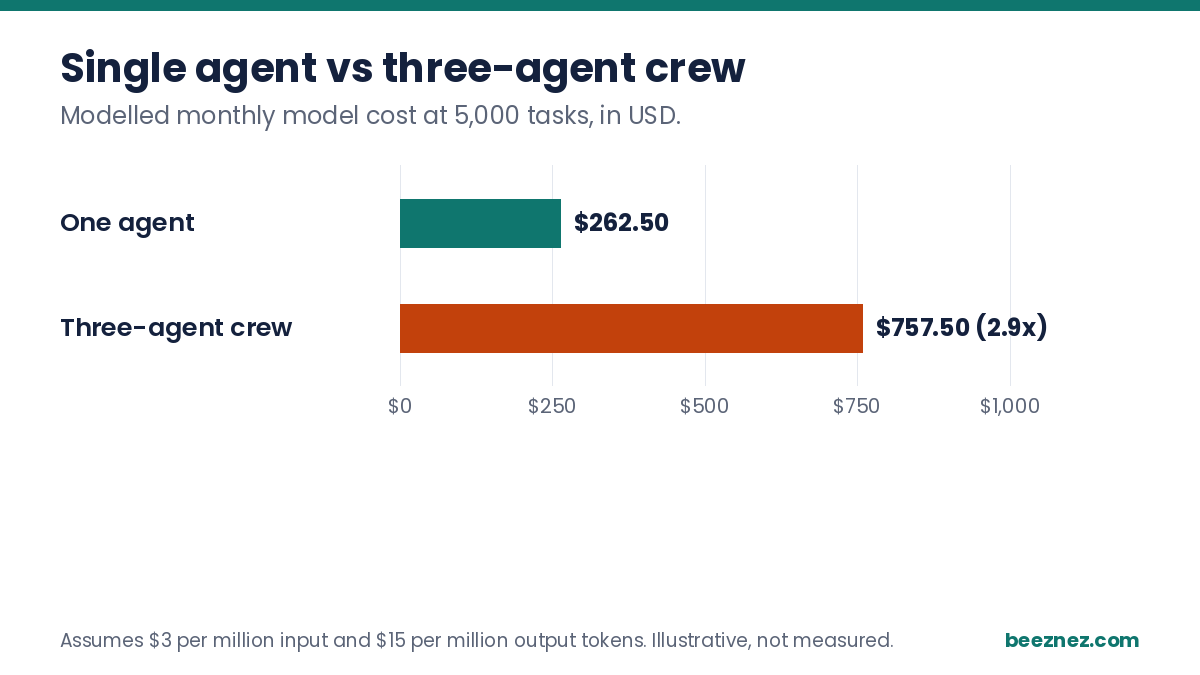
The rates used are $3 per million input tokens and $15 per million output tokens. Under these assumptions the crew costs about 2.9 times as much per task as the single agent, an extra $495 a month at 5,000 tasks. The crew may still be worth it if it produces better results or catches errors, but you should decide that on purpose. If one well-prompted agent does the job, the cheapest orchestration is none. Our guide to what an AI agent costs to run each month shows how to price a single agent before you add more.
Side-by-Side Comparison
| Factor | CrewAI | LangGraph | AutoGen |
|---|---|---|---|
| Learning curve | Easiest | Steepest | Medium |
| Control and flexibility | Least | Most | Medium |
| Production readiness | Solid | Most mature | Improving, but deprioritized |
| Mental model | Roles (crew) | Graph (nodes and edges) | Conversation |
| Best when | Speed matters most | Reliability matters most | You already have AutoGen code |
The Framework Is Rarely the Hard Part
The gap between good and bad multi-agent orchestration is usually the evaluation, logging and failure recovery around the framework. A team that picks CrewAI and builds solid logging will often beat a team that picks LangGraph and skips the basics. Choose a framework that stays out of your way, then spend your effort on those three things.
Which One Should a Small Team Pick?
- Need something working this week: start with CrewAI and keep the crew small.
- Need retries, branching and human approval in production: invest the extra time in LangGraph.
- Already have AutoGen code: keep it or move to AG2, but do not start a new project there in 2026.
- Unsure whether you need several agents at all: price a single agent first, then add agents only where the extra cost buys a measurable improvement.
Frequently Asked Questions
Is multi-agent orchestration free?
The frameworks are free and open source. You still pay your model provider for tokens, and optionally pay for a managed platform such as LangSmith Deployment (formerly LangGraph Platform), which needs the Plus plan at $39 per seat a month plus usage.
Why do multi-agent systems cost more than one agent?
Each agent receives its own prompt and often the previous agent’s output, and each writes its own response. Under the assumptions above, a three-agent crew uses roughly three times the tokens of a single agent for the same task.
Should a small team use CrewAI or LangGraph?
In a CrewAI vs LangGraph decision, use CrewAI for the fastest prototype and LangGraph when reliability and human approval steps matter more than speed. Cost will not decide it, since both frameworks are free.
The Bottom Line
For small teams in 2026, multi-agent orchestration is a trade-off between speed and control, and a separate trade-off between quality and token cost. The framework licence is $0 whichever you pick. Your real spend is model tokens, which grow with every extra agent, plus any managed platform you choose. For more on building agentic systems, see our guide on choosing the right AI automation tool.
How This Cost Guide Was Researched
I read LangChain’s pricing page directly on 7 November 2026 and searched for CrewAI’s and AutoGen’s current status, comparing price trackers and published coverage. Where sources disagreed I say so instead of picking a number. I did not benchmark any framework, and I left out enterprise quotes, startup credits and regional pricing, which vary by buyer.
Sources
- LangChain, LangSmith plans and pricing: seat prices, trace allowances, deployment metering and LSU rate.
- CostBench, LangGraph Platform vs CrewAI Enterprise (page no longer online when last checked on 10 November 2026): trace overage rate.
- UsagePricing, CrewAI pricing history and Automation Atlas, CrewAI pricing 2026: Basic and Enterprise tiers and the removed Professional tier.
- Activepieces, CrewAI pricing for 2026: an October 2026 write-up that still lists a Professional tier, which is why I flag the disagreement.
- Atlan, what is AutoGen and PromptQuorum, AutoGen review 2026: maintenance mode, the Microsoft Agent Framework and the AG2 fork.
Related reading