
Tiny AI teams are quietly rewriting the startup playbook in 2026. Floqer, a Halifax-based startup, reached seven-figure annual recurring revenue in under two years with a team of nine. Turbopuffer is on track to hit $100 million in revenue this year with 37 employees. Stan, an e-commerce platform for content creators, hit $30 million in annual recurring revenue on a single $5 million seed round and fewer than 30 people. None of these numbers would have been plausible for a software startup a few years ago.
Why Tiny AI Teams Are Winning Now

The pattern behind all three companies is the same: AI tools are now doing work that used to require dozens or hundreds of hires. Coding, customer support, content production, and operations that once meant a department now run through a handful of people directing AI agents instead of managing large teams. Gartner projects that 40% of enterprise applications will include task-specific AI agents by the end of 2026, up from under 5% just a couple of years earlier- and small, AI-native teams are the ones putting that shift into practice first, before it’s fully mainstream.
This isn’t just a handful of outliers, either. Broader small business data backs up the pattern: 58 to 77% of small businesses now use AI regularly (up sharply from under half just two years ago), and 91% of those using it report real revenue gains.
The Honest Caveat: Most AI Bets Still Don’t Pay Off
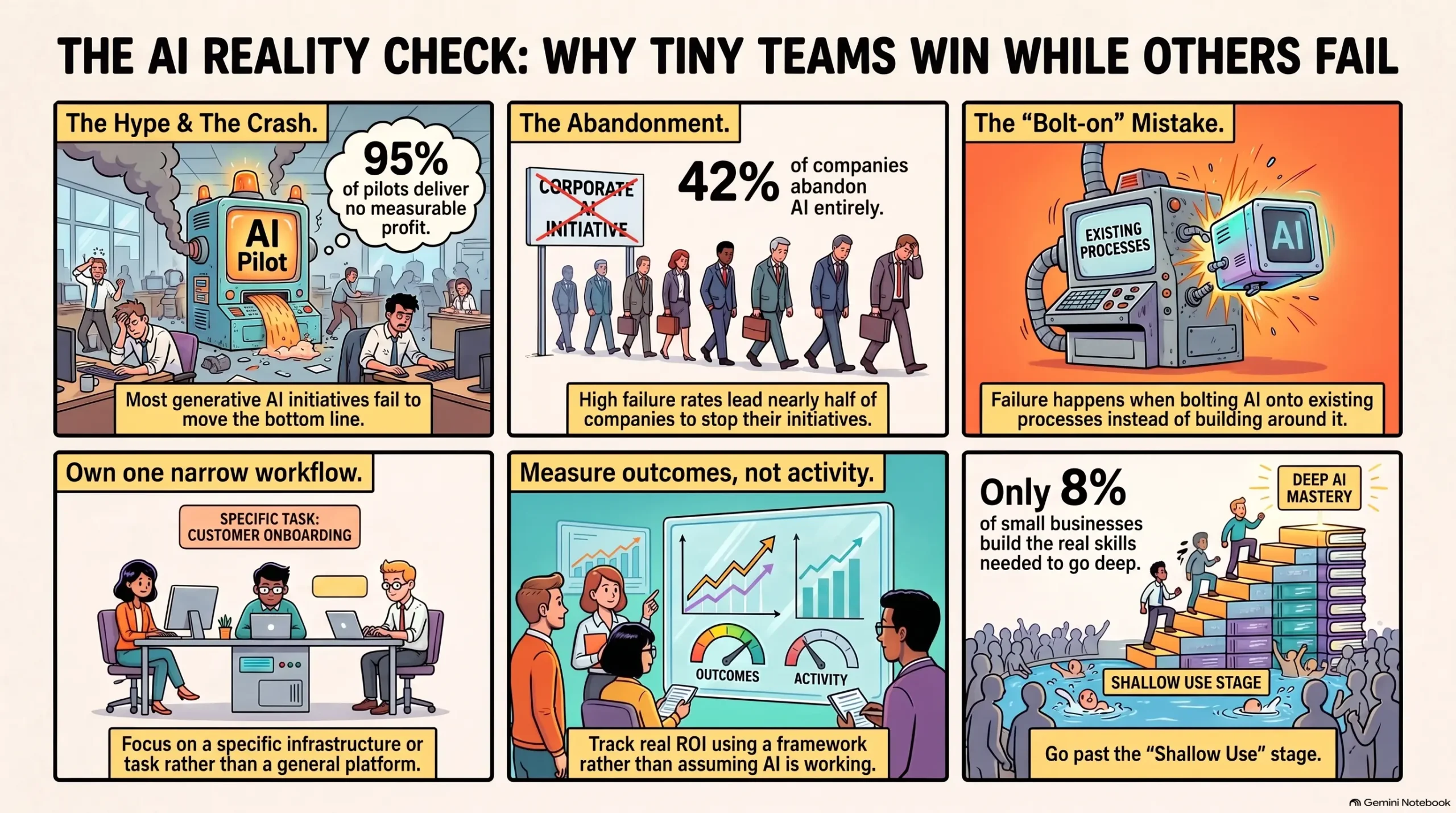
It would be dishonest to stop at the highlight reel. The same body of research that documents these wins also documents a much less exciting reality: roughly 95% of generative AI pilots deliver no measurable profit impact, and 42% of companies have abandoned most of their AI initiatives entirely. Tiny AI teams hitting eight-figure revenue are the visible success stories precisely because they’re the exception, not the norm.
The difference isn’t that Floqer or Turbopuffer found some secret AI tool nobody else has access to. It’s that they built a narrow, well-executed product around AI from day one, rather than bolting AI onto an existing team or process and hoping it would create leverage on its own.
What This Actually Means If You’re Building Something Small
You don’t need venture capital or a big team to build something real in 2026- but you do need the same discipline these tiny AI teams show: a narrow focus, and a willingness to measure whether the AI investment is actually working rather than assuming it is.
- Pick one workflow to fully own, the way Turbopuffer focused entirely on vector search infrastructure rather than trying to be a general AI platform.
- Delay hiring reflexively. Every one of these companies deliberately kept headcount low well past the point where a traditional startup would have started staffing up.
- Measure results the way you’d measure any investment. Given how many AI pilots produce no measurable return, tracking real outcomes matters more than tracking activity- see our guide to measuring AI agent ROI for a practical framework.
- Expect this to require real skill-building, not just tool adoption. Only 8% of small businesses using AI report going deep with it; most stay in shallow, exploratory use. The tiny teams making real money are the ones who went past that stage.
What Tiny AI Teams Still Need People For
Small teams do not remove human work. They concentrate it in the places AI agents are least able to own:
- Choosing the problem to solve and deciding what not to build
- Understanding what customers actually need, beyond what they ask for
- Reviewing AI output before it reaches customers
- Carrying accountability for security, compliance, and mistakes
- Measuring whether the AI is producing real results
Questions to Ask Before Copying the Lean-Team Model
- Can you describe the one problem you solve in a single sentence?
- Can you measure the outcome within 90 days?
- Who reviews AI output, and how many hours a week does that honestly take?
- What happens to quality if your customer count doubles and your team does not?
- Which task would you automate last, and why?
Common Questions About Tiny AI Teams
Are teams like Floqer and Turbopuffer typical?
No. The 95% failure rate for generic AI pilots cited above shows they are the visible exception, not the norm.
Does a small team mean no hiring?
Not necessarily. The companies above deliberately delayed hiring past the point where a traditional startup would have staffed up, but the point is to hire once the product and workflow are clear, not to avoid hiring forever.
Where should a solo founder start?
With one workflow you can own end to end and measure. Our guides on vibe coding for non-developers and the solo business survival guide cover practical starting points.
A 90-Day Plan to Test a Lean AI Workflow
You do not need a funding round to try the approach these companies use. A two-person team can run a disciplined 90-day experiment on a single workflow:
- Days 1 to 30, choose and baseline. Pick one repeatable workflow, such as lead qualification, support replies, or weekly reporting. Record how many hours it takes now and how often it goes wrong. Without this baseline you cannot tell whether AI helped.
- Days 31 to 60, automate one step at a time. Add AI to the single most time-consuming step, keep a person reviewing every output, and log each correction. The corrections show you where the tool is unreliable.
- Days 61 to 90, decide with data. Compare hours saved and error rates against the baseline. Keep the automation only if the net saving, after review time and tool costs, is clear. If it is not, change the step or drop it and try another workflow.
This mirrors the measurement habit highlighted above: the teams that make money from AI treat it as an investment to be tested, not a feature to be switched on.
The Bottom Line
Tiny AI teams hitting eight-figure revenue with a handful of people are real, verified, and increasingly common- not a one-off story. The Logic’s reporting on these Canadian founders is worth reading in full for more detail on how they’re doing it. But the 95% failure rate on generic AI pilots is just as real. The lesson isn’t that AI automatically creates leverage- it’s that a small, focused team willing to measure what’s actually working can now compete with companies many times its size.
For more on building lean with AI, see our guides on vibe coding for non-developers and the solo business survival guide.