The Google AI image tool controversy started on July 30, 2026, when Google switched on a new AI image generation feature inside Google Earth’s web version. Users could zoom into any location on the planet, click “create image,” type a description, and get an AI-generated visual anchored to real satellite and street-level imagery. Twenty-four hours later, Google pulled it. This is what happened, and the lesson it holds for any business shipping an AI feature.
What Google Actually Launched
The Google AI image tool, powered by Nano Banana 2, let anyone generate photorealistic AI images layered onto real Google Earth locations. Google framed it as a creative tool, with a product manager saying the goal was to spark user imagination — students visualizing historical scenes, realtors mocking up landscaping for an empty lot. Generated images carried AI watermarks and weren’t added to Google Earth’s core dataset itself; they only existed as something a user could create, view, and screenshot.
Why the Google AI Image Tool Got Pulled So Fast
Within hours, people were using the tool to generate convincing images of disasters, explosions, and destruction anchored to real, recognizable locations, including one widely circulated image showing fires at a strategic Iranian oil terminal that never actually happened. Because the images were built on real satellite imagery rather than generic backgrounds, the results looked far more credible than a typical AI fake.
That specific combination alarmed people who rely on satellite imagery for a living. Nathaniel Raymond, who leads Yale University’s Humanitarian Research Lab, said he was in shock when he saw it– satellite imagery is a tool journalists, researchers, and human rights investigators depend on precisely because it’s considered a trustworthy, hard-to-fake reference for verifying what’s actually happening somewhere in the world. A tool that could generate convincing fake versions of that same imagery threatened to undermine the credibility of the format itself, not just individual images.
Google rolled the feature back on July 31, stating in a public update that it had seen people sharing generated imagery that appeared to violate its policies, and that it was working on stronger guardrails before reconsidering.
The Gap That Actually Caused This
Google has said its generative AI tools already block image generation on explicitly harmful topics. That’s true, and it wasn’t enough. The Google Earth incident illustrates a gap that’s easy to miss when testing AI features: blocking someone from directly typing a request for a violent image is different from anticipating that the same capability, placed inside a tool people already trust for real information, would get used to fabricate convincing versions of real events at real locations. The individual prompts weren’t necessarily against policy on their own- it was the context the tool was embedded in that turned an image generator into a disinformation risk.
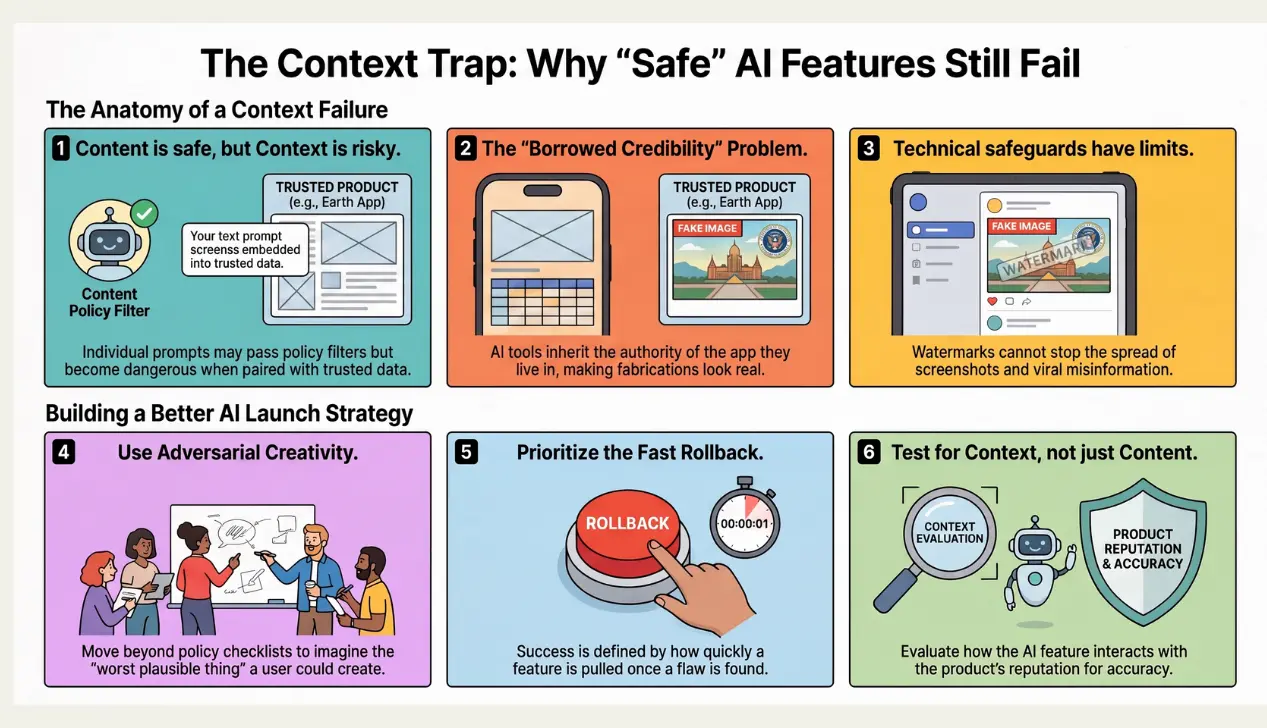
This points to a clear problem in Google’s generative AI and highlights why standard safety checks just don’t cut it. Sure, Google managed to block harmful content, but they missed something bigger-their platform’s reputation can make fake information look real and even more convincing. The author says companies need to move past basic policy lists and start using red-teaming-throwing every attack possible at their tool, paying attention to how and where it’s actually used. The source also makes it clear that technical fixes like watermarking aren’t enough. Misleading screenshots can still go viral and cause damage before anyone catches them. In the end, Google’s quick removal of the problematic feature stands out as a strong crisis response, even if they stumbled at first. The whole point here is a warning: test your AI for sneaky, creative misuse before letting it loose on the public, especially in products people already trust.
The Lesson for Any Business Shipping an AI Feature
The Google AI image tool episode matters because Google has more AI safety resources than almost any company on earth, and this still happened. That’s the part worth sitting with if you’re building or deploying AI features in your own product, not just watching this as tech industry drama.
- Test for context, not just content. A feature that’s safe as a standalone tool can become risky once it’s placed inside a product people already trust for accuracy or authority. Ask what your AI feature borrows credibility from, and whether that credibility could be weaponized.
- Red-team with adversarial creativity, not just policy checklists. The people who found this failure mode weren’t doing anything technically sophisticated — they just asked what the worst plausible thing someone could make with this would look like, before Google did.
- Watermarks and keeping generated content out of the core dataset aren’t sufficient safeguards on their own. Both were true here, and the tool still had to be pulled within a day — screenshots and shares happen regardless of what’s technically stored where.
- A fast rollback is the right move, not a failure to hide. Google shipped, found a real problem fast, and pulled the feature within 24 hours rather than defending it. That instinct is worth copying — the mistake was in the pre-launch testing, not in how quickly they responded once it went wrong.
Where This Connects to AI Agent Governance
The Google AI image tool follows the same underlying failure pattern we’ve covered before: a safeguard that existed on paper — blocking harmful prompts — didn’t hold up against real-world use once the tool was live. It’s the image-generation equivalent of the access-control lesson from Anthropic’s AI agent incident report: a stated limitation isn’t the same as an enforced one. If you’re deploying any AI feature, our AI agent governance guide covers the practical controls worth putting in place before launch, not after.
Google AI image tool Failure: Final Talk
The Google AI image tool lasted about 24 hours in the wild before the gap between blocked prompts and prevented harm caught up with it. NPR’s full reporting has more detail on how it unfolded. The takeaway for any business isn’t to avoid shipping AI features — it’s that adversarial testing needs to happen before launch, because the internet will always find the failure mode faster than a policy document can anticipate it.