By Md Abdur Rouf Mia | Updated 20 October 2026 | Prices verified 20 October 2026
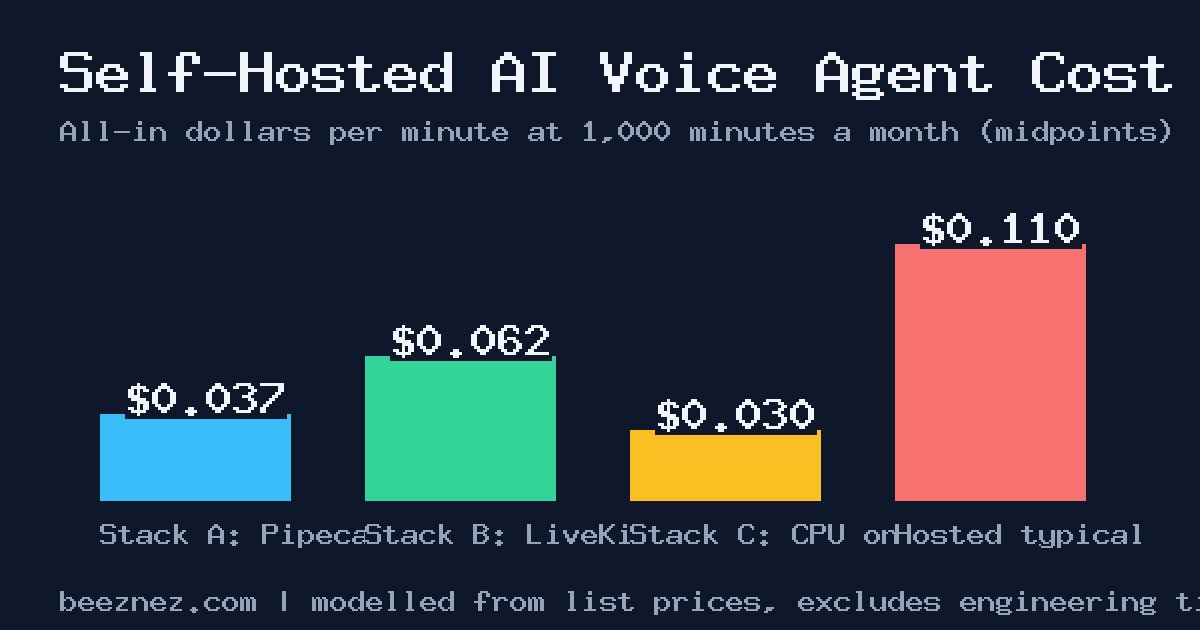
The self-hosted AI voice agent cost is about $0.03 to $0.06 per minute for a light Pipecat stack on a roughly $5-a-month VPS, falling toward $0.03 at 1,000 minutes a month. A heavier LiveKit stack with GPT-4o and ElevenLabs runs $0.04 to $0.15 per minute depending on volume. Hosted platforms charge $0.08 to $0.14 per minute for typical setups. Those figures leave out your time, which usually decides the comparison.
The VPS is the smallest line on the bill. Speech-to-text, the voice, the language model and the phone carrier are still billed per minute or per character, and you pay them whether or not you host the orchestration yourself. What self-hosting removes is the platform fee, about $0.05 a minute on the hosted platforms I priced in the hosted platform comparison.
This guide prices three complete stacks from published rates, then adds the engineering time, the failure risk and the break-even volume that most vendor blogs leave out.
This is a cost model built from published prices, not a benchmark. I did not deploy these stacks on a live server for this article, and the last section says exactly what that means for the numbers.
The Short Answer: Self-Hosted AI Voice Agent Cost Per Minute
Three stacks cover the realistic range. Per-minute figures include the VPS spread over your volume, and exclude engineering time.
| Stack | What runs where | 200 min/month | 1,000 min/month | 5,000 min/month |
|---|---|---|---|---|
| A. Light Pipecat | Pipecat on a ~$5 VPS, GPT-4o-mini, Deepgram, Cartesia, Telnyx | $0.050 to $0.064 | $0.030 to $0.044 | $0.026 to $0.040 |
| B. LiveKit production | Self-hosted LiveKit on a ~$20 VPS, GPT-4o, Deepgram, ElevenLabs Flash, Twilio | $0.136 to $0.148 | $0.056 to $0.068 | $0.040 to $0.052 |
| C. Fully open source | Pipecat, Llama 3.1 8B, Faster-Whisper, Piper, Telnyx on a ~$24 CPU VPS | $0.125 | $0.029 to $0.031 | $0.010 to $0.012 |
Stack C is the cheapest on paper and the least likely to work on a live phone call without a GPU. Its row assumes a CPU-only server, which I explain in the Configuration C section.
The wide ranges come from three real uncertainties: Deepgram lists a promotional and a regular streaming rate, Cartesia bills in credits whose effective price depends on your plan, and carriers charge more for outbound calls than inbound. I show the low and high ends rather than hide them.
Why the Self-Hosted AI Voice Agent Cost Math Is Different
“Self-hosted” usually means the orchestration layer only. A voice agent has five layers: telephony, speech-to-text, a language model, text-to-speech and the orchestration that connects them. Pipecat and LiveKit Agents replace the orchestration layer. In Stacks A and B the other four are still paid APIs. Only in Stack C do you run the models yourself.
What you pay for that a hosted platform bundles. A VPS, outbound bandwidth beyond the allowance, monitoring, backups, security patching, and the hours to build and maintain it. On Hetzner’s cloud line the included traffic is large, so bandwidth is rarely the problem for a small voice agent. CPU headroom and your own time are.
The licences are permissive, and that matters. Pipecat is released under the BSD 2-Clause licence, not MIT, which allows commercial use with attribution in your source and binary distributions. LiveKit’s server and Agents framework are open source under Apache 2.0, and LiveKit’s own pricing FAQ confirms both can run on your own infrastructure. Neither charges a per-minute licence fee. That is the answer to “is Pipecat free for commercial use”: the software is, the services it calls are not.
“Free” and “no platform fee” are different things. An open-source orchestrator is free to download. Running it is not free once you add the VPS, the API bills and the hours. If you take one thing from this article, take that.
Self-Hosted AI Voice Agent Cost: Three Stacks, Priced Line by Line
Every rate below comes from a vendor’s published page or a tracker that quotes it, and I name the source. Where sources disagree, I say so rather than pick the convenient number.
The usage assumptions (change them for your own calls): the agent speaks about 45% of the call at roughly 800 characters per spoken minute, which is 360 characters of text-to-speech per call minute. The model sees a 1,000-token prompt plus history, about 1,300 input tokens per exchange, and writes about 100 tokens per reply, with two exchanges per minute. Speech-to-text is billed on the full call duration. The model assumptions match the worked example in the hosted article.
Configuration A: the light Pipecat stack
| Layer | Choice | Published rate | Per call minute |
|---|---|---|---|
| Server | Hetzner CX23, 2 vCPU, 4 GB RAM, 40 GB NVMe | About $5 a month (see note) | Fixed |
| Orchestrator | Pipecat in Docker | $0, BSD 2-Clause | $0 |
| Speech-to-text | Deepgram Nova-3 streaming | $0.0048 promotional, $0.0077 regular per minute | $0.0048 to $0.0077 |
| Language model | GPT-4o-mini | $0.15 input, $0.60 output per 1M tokens | About $0.0005 |
| Text-to-speech | Cartesia Sonic | About 1 credit per character, $39 to $65 per 1M credits | $0.014 to $0.023 |
| Telephony | Telnyx Voice API plus SIP trunk | $0.002 plus $0.0032 inbound or about $0.005 outbound | $0.0052 inbound, $0.007 outbound |
| Variable total | $0.025 to $0.039 |
Source notes.
- The Hetzner price is the soft spot. Trackers list the CX23 at about € 3.49 to € 4.49 a month, or $4.49 to $5.25, because Hetzner raised prices in April 2026 and sources updated at different times.
- Hetzner’s own page didn’t show a price when I read it, and it marked its cost-optimized shared line as currently unavailable, so check the console for your region before you commit. I use $5 as a round budget. Deepgram’s $0.0048 is a promotional rate with no published end date, against a $0.0077 regular rate, so I show both on Deepgram’s pricing page.
- Cartesia sells credits rather than characters; the plan page and a third-party breakdown put overage at $65, $45 or $38 per million credits on the Pro, Startup and Scale plans, and the Startup plan works out to about $39 per million included credits. Telnyx’s own Voice API page lists $0.002 a minute for the API plus the SIP trunk fee. GPT-4o-mini rates are on OpenAI’s model page. It is an older, cheap model, and newer small models exist, so test the one you actually plan to use.
The model is nearly free in this stack. At two exchanges a minute it costs about five hundredths of a cent. The voice and the phone line are where the money goes, which matches what I found on the hosted platforms.
Monthly bill at four volumes (the $5 server included):
| Minutes per month | Monthly cost | All-in per minute |
|---|---|---|
| 200 | $10 to $13 | $0.050 to $0.064 |
| 500 | $17 to $24 | $0.035 to $0.049 |
| 1,000 | $30 to $44 | $0.030 to $0.044 |
| 5,000 | $128 to $198 | $0.026 to $0.040 |
Can a $5 VPS run this? On paper, yes: Pipecat’s orchestration is light because the heavy work happens at the API vendors. What I have not measured is how many simultaneous calls 2 shared vCPUs hold before audio stutters. Treat the server as fine for one to a few concurrent calls until you test your own prompt and tools.
Configuration B: the LiveKit production stack
LiveKit is a different shape from Pipecat. It is a WebRTC media server plus an Agents framework, and it can run on LiveKit Cloud or on your own machine. LiveKit’s pricing page splits the two cases. Agents deployed on LiveKit Cloud are billed by agent session minutes. Self-hosted agents can still use LiveKit’s edge network for media, billed by resource usage such as downstream data.
Surface the Cloud option first, because it changes the math. The Build plan is $0 and includes 1,000 agent session minutes a month. The Ship plan is $50 a month with 5,000 included minutes, then $0.01 a minute. The Scale plan is $500 a month with 50,000 included minutes, then $0.01 a minute. Plan details differ slightly between trackers and the vendor’s own page, so confirm on the page. The takeaway is that below about 1,000 minutes a month, managed LiveKit orchestration can cost nothing, so self-hosting the server saves you very little at small volume.
If you do self-host the server, LiveKit’s virtual machine guide generates a Docker Compose setup, a systemd service and a list of ports to open, and it walks through domain, TLS and TURN. Phone calls need LiveKit’s SIP server on top. I priced a $20 VPS as the planning number for the server plus your agent worker. That figure is my assumption, and I did not run LiveKit’s published benchmarks, so I have no measured CPU figure for you. Run them against your own call profile before choosing a size.
| Layer | Choice | Per call minute |
|---|---|---|
| Server | Self-hosted LiveKit and agent worker, ~$20 VPS (assumed) | Fixed |
| Speech-to-text | Deepgram Nova-3 streaming | $0.0048 to $0.0077 |
| Language model | GPT-4o at $2.50 input, $10 output per 1M tokens | About $0.0085 |
| Text-to-speech | ElevenLabs Flash, $0.04 to $0.05 per 1,000 characters | $0.014 to $0.018 |
| Telephony | Twilio, $0.0085 inbound, $0.014 outbound | $0.0085 to $0.014 |
| Variable total | $0.036 to $0.048 |
The Twilio rates come from the comparison table on Telnyx’s own page, so they are a competitor’s quote of Twilio’s list price. Check ElevenLabs API pricing too, because trackers disagree between $0.04 and $0.05 per 1,000 characters for Flash. The model choice matters here: GPT-4o costs about seventeen times more per call minute than GPT-4o-mini in this model.
| Minutes per month | Monthly cost | All-in per minute |
|---|---|---|
| 200 | $27 to $30 | $0.136 to $0.148 |
| 500 | $38 to $44 | $0.076 to $0.088 |
| 1,000 | $56 to $68 | $0.056 to $0.068 |
| 5,000 | $201 to $261 | $0.040 to $0.052 |
At 200 minutes a month the $20 server alone is $0.10 a minute, which is why a $20 VPS makes no sense at low volume.
Configuration C: fully open source
This stack runs the speech-to-text (Faster-Whisper), the language model (Llama 3.1 8B) and the voice (Piper) on your own hardware, with Pipecat orchestrating and Telnyx still carrying the call. The usage bills disappear. What remains is the server and the phone line: about $0.0052 to $0.007 a minute for Telnyx, plus the server cost spread across your minutes.
| Minutes per month | $24 CPU server | $50 CPU server | Illustrative $200 GPU server |
|---|---|---|---|
| 200 | $0.125 | $0.255 | $1.00 |
| 1,000 | $0.029 to $0.031 | $0.055 to $0.057 | $0.205 |
| 5,000 | $0.010 to $0.012 | $0.015 to $0.017 | $0.045 |
The $24 and $50 server prices are planning numbers, not quotes. Hetzner’s dedicated-vCPU plans appear in trackers at wildly different prices for the same specs, from $15.99 to $50.49 for a 2 vCPU, 8 GB machine, so I did not pick one. The $200 GPU line is a placeholder I chose to show the shape of the cost, not a vendor price. Replace it with a real quote.
Here is the honest part. The cheapest row on paper is probably unusable for live calls. Running an 8-billion-parameter model on a CPU-only server is slow, and a phone caller notices a long silence. I did not benchmark this, so I cannot give you a latency number, and I would not trust one from a source that did not name its hardware and settings. The practical conclusion: Stack C is cheap per minute only at high volume and only if you have GPU access or accept noticeably slower replies. At 5,000 minutes a month, a GPU server still comes out at about $0.045 a minute, similar to Stack A, with far more to maintain.
The Total Cost of Ownership Nobody Prices in a Self-Hosted AI Voice Agent
The hosted comparison did the layer-by-layer work well: it showed that the voice and the model move the price far more than the platform fee. Self-hosting adds costs that article had no reason to cover.
Engineering time, in days. These are my planning estimates, not measurements, so replace them with your own. Stack A: about 3 to 5 days to build, test calls, tune the prompt and read transcripts. Stack B: 5 to 10 days, because of TURN, TLS, SIP and a heavier deployment. Stack C: 10 to 20 days or more, because you also tune three models. Ongoing, plan 2 to 6 hours a month for transcript review, updates and incidents. At $50 an hour, Stack A costs about $1,600 to set up and $200 a month to keep tidy.
Monitoring and observability. You need call transcripts, per-turn latency and error rates, or you will not know the agent is failing. Pick one tool and stay with it. Langfuse is a reasonable default because you can also self-host it, but that puts a second service on your server. Check its current pricing and licence before relying on it.
Backups, secrets and patching. The VPS needs OS updates, a firewall, rotated API keys for five vendors and a backup of your prompts and config. None of it is hard. All of it is yours, and it is the work I covered for the automation tool in self-hosting n8n on the same VPS.
Failover at 2 a.m. One VPS is one point of failure. If it goes down, callers hear nothing. Decide in advance what happens: have your carrier forward to a human number when your endpoint does not answer, or run a second server. Check your carrier’s failover settings, because I did not test them.
Update overhead. Both projects move fast. Pipecat is at version 1.x with 100-plus releases on PyPI, and LiveKit documents upgrades as editing the image tag in its Compose file. Pin your versions and upgrade on purpose, not by accident.
TCO Comparison: Hosted vs Self-Hosted
The hosted figures come from the hosted article: lean $0.08, typical $0.11 and premium $0.14 a minute. I compare against the typical rate and Stack A, then charge $200 a month for maintenance (4 hours at $50) and $1,600 one-time for setup.
| Minutes per month | Hosted, typical | Stack A cash cost | Cash saved | After $200 maintenance |
|---|---|---|---|---|
| 200 | $22 | $10 to $13 | $9 to $12 | -$188 to -$191 |
| 1,000 | $110 | $30 to $44 | $66 to $80 | -$120 to -$134 |
| 5,000 | $550 | $128 to $198 | $352 to $422 | +$152 to +$222 |
| 10,000 | $1,100 | $251 to $391 | $709 to $849 | +$509 to +$649 |
The break-even volume depends on what your time is worth. If you count four hours of upkeep at $50 an hour, self-hosting starts to pay at roughly 2,600 minutes a month. If you already run servers and the marginal upkeep is about an hour a month, the break-even drops to roughly 700 minutes. Either way, setup is a one-time cost on top: at 5,000 minutes a month, $1,600 of setup pays back in about 7 to 11 months.
Four questions settle most cases:
- Is your usage small? Under roughly $300 a month of hosted spend (about 2,600 minutes at the typical rate), hosted wins once you count your time.
- Is it large? Past that line, self-hosting pays for the hours. If you already maintain servers, the line drops to roughly $80 a month of hosted spend.
- Do you have developer capacity? If nobody can debug a failed call, choose hosted.
- Is your data regulated? Self-hosting the orchestrator does not keep audio out of the vendor APIs. Data residency only improves if you also run the models, which is Stack C.
Build vs Buy: A Decision Framework
Choose hosted if you handle under about 700 minutes a month, need SOC 2 or HIPAA paperwork today, or have nobody on call. Self-hosting an orchestrator does not give you a compliance report. You inherit the audit work.
Choose self-hosted (Stack A or B) if you pass roughly 1,000 minutes a month and already run other services on a VPS, and you have a few hours a month to maintain it. If you price your own time at $50 an hour and run nothing else, wait until about 2,600 minutes.
Go fully open source (Stack C) only if you exceed 5,000 minutes a month, data residency is a hard requirement, and you have GPU access or can live with slower replies.
If you want the budget side of this decision, start with your small-business AI total budget and the cost framework for AI features. For how model usage scales, see the LLM token cost framework.
What I Tested vs What I Researched
I want to be exact here, because it would be easy to blur.
Tested: nothing on a live server. I did not deploy Pipecat on a Hetzner CX23, so I have no measured latency, concurrent-call limit or memory footprint, and I did not run any of the three stacks at low or medium call volume. The arithmetic is checked: I computed every table from the stated assumptions with a script and re-read the vendor pages on 20 October 2026.
Researched: every price in this article, the licences, the LiveKit hosting options, and the structure of the three stacks. At 5,000 minutes a month and above I rely on the hosted article’s per-volume model and on the vendors’ list prices, and I did not see a real deployment at that scale.
Where the numbers could be wrong: promotional rates change, Cartesia’s credit price depends on your plan, Hetzner’s price moved in 2026, and my engineering-time estimates are assumptions. A follow-up with real latency and capacity measurements from a deployed stack would be more useful than this model, and I will add it if I run the test. This guide was drafted with the help of an AI assistant (Claude) from the vendor pages listed under Sources.
Frequently Asked Questions
How much does a self-hosted AI voice agent cost per minute?
The self-hosted AI voice agent cost is about $0.03 to $0.06 a minute for a light Pipecat stack at a few hundred to a thousand minutes a month, $0.04 to $0.15 for a LiveKit stack with GPT-4o and ElevenLabs, and potentially under $0.02 for a fully open-source stack at very high volume. These exclude your time.
Can you run an AI voice agent on a $5 VPS?
The orchestration, yes, because the speech, language and voice work happens at API vendors. I did not test how many simultaneous calls a 2 vCPU shared server handles, so test your own load. You cannot run local models on it.
How long does it take to set up Pipecat or LiveKit?
My planning estimate is 3 to 5 days for a light Pipecat stack and 5 to 10 for LiveKit with telephony, including prompt tuning and test calls. These are estimates, not measured times.
Is self-hosted cheaper than Vapi or Retell?
In cash, yes at most volumes. Including your time, only above roughly 700 to 2,600 minutes a month, depending on how you value maintenance. Hosted platforms charge about $0.08 to $0.14 a minute for typical setups.
Do I need a GPU to self-host a voice agent?
Not if you use API models for speech and language. You need one, or must accept slow replies, only if you run the language model yourself, as in Stack C.
What is the cheapest stack for a small business voice agent?
Stack A. It has the lowest total cost at low volume and keeps the model, voice and carrier as swappable APIs. For very low volume, a hosted platform’s free tier may be cheaper once you count your time.
Is Pipecat production ready?
It has reached a 1.x release and lists a permissive BSD 2-Clause licence. Whether it is ready for you depends on monitoring, failover and upgrades, which are on you when you self-host. I did not run it in production.
What is the break-even volume for switching from hosted to self-hosted?
About 2,600 minutes a month if you charge $50 an hour for four hours of upkeep, about 700 minutes if upkeep is an hour a month, plus a one-time setup cost.
Final Thoughts
The self-hosted AI voice agent cost looks like a bargain per minute and a poor deal per hour of your life. The platform fee you remove is about five cents a minute. Whether that matters depends on your volume and on whether the time is already yours. Under about 700 minutes a month, buy. Past about 2,600, or past 700 if you already run servers, building starts to pay.
Whatever you choose for your self-hosted AI voice agent cost plan, start from the real constraint: the voice and the phone line are the biggest costs, and no hosting decision changes that.
Sources
- Pipecat on GitHub: BSD 2-Clause licence and install notes. Licence also confirmed on PyPI package metadata.
- LiveKit pricing and LiveKit self-hosting on a VM: plans, session minutes, self-hosting options and upgrade steps. Read 20 October 2026.
- Hetzner Cloud: price not shown on the page when read; CX23 price taken from trackers, which disagree.
- Deepgram pricing: Nova-3 streaming promotional and regular rates, via third-party trackers dated September 2026.
- Cekura on Cartesia pricing: credits and overage rates, checked 8 October 2026.
- Telnyx Voice API pricing: API and SIP trunk rates, including its Twilio comparison.
- OpenAI GPT-4o mini: token prices. GPT-4o rates from a price tracker.
- ElevenLabs API pricing: Flash character rates, which trackers report as $0.04 to $0.05 per 1,000 characters.
Prices verified 20 October 2026. Vendors change pricing often, so check the linked pages before you budget. All figures are modelled from list prices and my stated assumptions; none were measured on a deployed system.
Related reading: AI Voice Agent Cost Per Minute: Vapi vs Retell vs ElevenLabs vs Bland at 100, 1,000 and 10,000 Calls (if you want hosted), Is n8n Really Free? The True Cost of Self-Hosting n8n, Small Business AI Budget: What a 5-Person Team Actually Spends Each Month?, How Much Does an AI Feature Cost? A Framework for Founders and the agent pipeline I documented.