Meta’s $18 billion settlement is the largest child-safety deal in tech history, and it is already reshaping how teenagers use Facebook and Instagram. The historic agreement ends a landmark trial that nearly put Mark Zuckerberg on the witness stand, and it forces genuinely new limits onto two of the world’s most-used apps. Here is exactly what was agreed, what changes for teens, and the one question most coverage has gotten wrong: whether any of that money reaches parents directly.
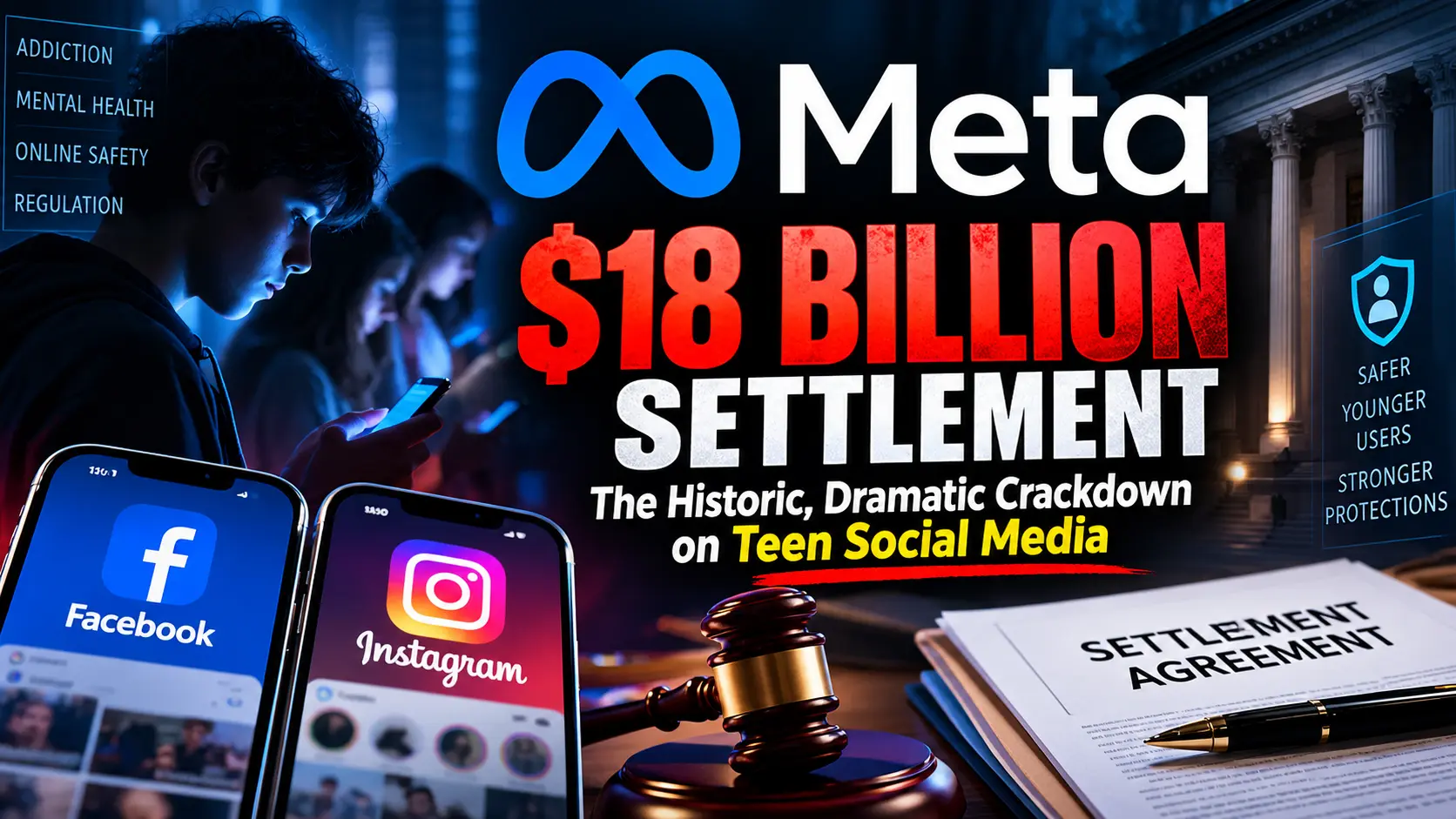
What Is the Meta $18 Billion Settlement?
The Meta $18 billion settlement resolves a federal trial that began August 18, 2026, in Oakland, California, where a coalition of state attorneys general accused Meta of designing Facebook and Instagram to be addictive to children and teenagers while misleading the public about the risks. The deal, announced August 26 and approved the next day by U.S. District Judge Yvonne Gonzalez Rogers, came one day after Instagram head Adam Mosseri testified, and just before Zuckerberg himself was due to take the stand. Meta denied any wrongdoing as part of the agreement, according to Channel 4 News.
How the $18 Billion Breaks Down
The headline figure is less straightforward than it looks, and the fine print matters:
- $12.7 billion guaranteed in payments to states over the next 10 years.
- Up to $5 billion more that Meta will pay only if rival platforms such as TikTok and YouTube adopt similar teen-safety protections.
- California stands to receive the largest share, between $1.5 billion and $2.2 billion depending on the source; New York and Texas are each in line for more than $1 billion.
- A separate $459 million settles unrelated privacy claims tied to the Cambridge Analytica scandal.
- New Mexico opted out of the settlement entirely and instead won its own case against Meta, with a jury finding thousands of violations and awarding a $375 million penalty.
The Meta $18 billion settlement covers 47 to 48 US states, Washington D.C., Puerto Rico, American Samoa, and the Northern Mariana Islands. Texas had already reached its own agreement with Meta worth more than $1 billion before the broader deal closed.
What Actually Changes for Teens on Instagram and Facebook
Beyond the money, the settlement requires Meta to roll out specific product changes for users under 18, according to California Attorney General Rob Bonta, who said the terms would take effect within months:
- A default 2-hour daily time limit on Facebook and Instagram for teen accounts.
- An overnight blackout blocking access between midnight and 6 a.m., unless a parent gives explicit consent.
- Notifications blocked during school hours.
- A break prompt delivered every 15 minutes of consecutive use.
- Like counts hidden from teenage users on their own and others’ posts.
- Cosmetic surgery and heavy beauty filters disabled for teen accounts.
Notably absent from the list: Meta is not required to remove personalized recommendation algorithms or targeted advertising for teens, which were central to the states’ original complaint.
Do Parents or Users Get Paid Directly?
No. This is the detail easiest to miss if you skim a headline. Unlike a class-action settlement or Apple’s Siri settlement, where individual users can file a claim for a personal payout, the Meta $18 billion settlement money goes to state governments, not to parents or teenagers. States say they plan to use the funds for youth online-safety initiatives and other state priorities. As of this writing, no individual claims process has been announced tied to this settlement, so be skeptical of anything online claiming otherwise.
How to Check If the New Safeguards Are Active on Your Teen’s Account
Because the rollout is staggered over the coming months, not instant, here is how to check progress and tighten things yourself in the meantime:
- Confirm the account’s age is accurate. Every one of these protections is tied to Meta’s system correctly identifying a user as a teen, so an account with an adult birthdate entered will not get them.
- Check Instagram’s built-in Teen Accounts settings, under Settings, then Account, then Supervision, which already include daily time limits and default private accounts, ahead of the broader settlement rollout.
- Use the Family Center (available on both Facebook and Instagram) to see activity, set additional time limits, and schedule your own overnight restrictions in the meantime.
- Don’t assume one setting covers both apps. Facebook and Instagram have separate supervision tools, so each needs to be checked individually.
The Debate: Does This Go Far Enough?
Child-safety advocates point to the settlement as proof that sustained legal pressure works: a decade of guaranteed, enforceable product changes is more than years of public criticism ever produced. Bonta said the deal would make social media less dangerous for kids.
Critics counter that the core business model survives untouched. Recommendation algorithms and targeted ads, the features researchers say are most linked to compulsive use, remain in place. Enforcement still depends on Meta’s own age detection, which a teenager can defeat by entering a false birthdate. And New Mexico’s separate $375 million jury verdict, which found thousands of specific violations, suggests other states or plaintiffs could pursue harder-edged cases even after this settlement closes the book on this particular lawsuit.
Frequently Asked Questions
How much is the Meta $18 billion settlement actually worth?
Meta has guaranteed about $12.7 billion in payments over 10 years. The remaining roughly $5 billion is conditional on other platforms like TikTok and YouTube adopting similar teen-safety measures, so the true final total could be lower than $18 billion.
Can I file a claim to get money from the Meta $18 billion settlement?
No individual claims process exists. The settlement money goes to state governments for youth online-safety programs, not to individual parents or teen users.
When do the new teen safety features take effect?
California’s attorney general said changes would roll out within months of the August 2026 approval. Some protections, like default private accounts for teens, were already in place on Instagram before this settlement.
Does the Meta $18 billion settlement cover all US states?
It covers 47 to 48 states plus Washington D.C., Puerto Rico, American Samoa, and the Northern Mariana Islands. New Mexico did not join and pursued its own separate case, winning a $375 million jury verdict.
The Bottom Line on Meta $18 billion Settlement
The Meta $18 billion settlement is real, historic, and will change how teenagers experience Facebook and Instagram over the next decade, through a 2-hour daily limit, an overnight blackout, and hidden like counts. What it will not do is put a check in any parent’s mailbox, or touch the recommendation systems and ad targeting at the center of the original complaint. If you have a teenager on either platform, the Family Center and Teen Accounts settings are worth checking today, rather than waiting for Meta’s rollout timeline. For a broader look at protecting your family online, see our guide to spotting AI voice cloning scams.