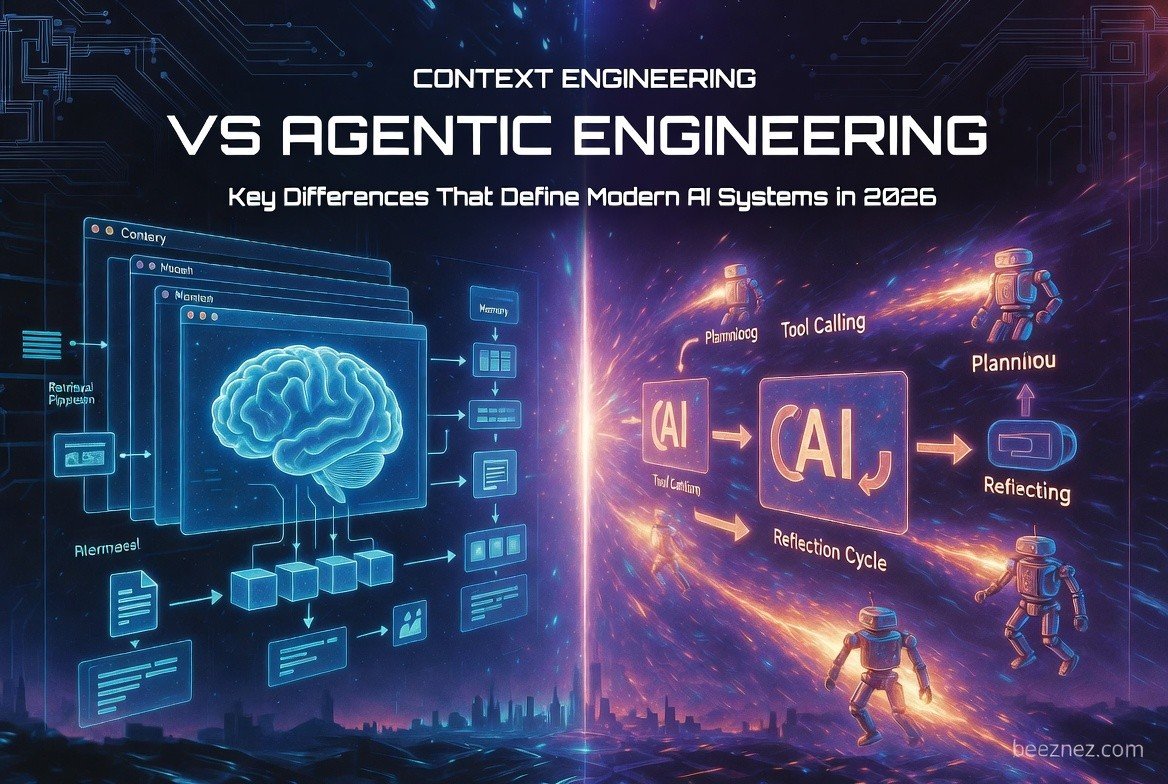
In 2026, two disciplines are shaping how reliable, autonomous AI systems get built: context engineering and agentic engineering. They sound similar and often get confused, but they solve different problems. Context engineering is about what an AI system knows before it responds. Agentic engineering is about how it plans and acts once it has that knowledge.
In this guide, we’ll break down what each discipline actually means, where they differ, and how the strongest AI systems in production today combine both.
What Is Context Engineering?

Context engineering is the practice of designing, structuring, and curating exactly what a language model sees before it responds. It goes beyond simple prompt wording — think of it as building the operating system the model runs on.
Instead of tweaking phrasing, context engineering focuses on:
- Retrieval (RAG pipelines)
- Memory management
- Tool schemas
- Hierarchical structuring
- Compression techniques
Done well, it ensures the model has the right knowledge, history, and constraints at the right moment — reducing hallucinations and improving reliability in production. In the context-vs-agentic conversation, context engineering is usually the foundational layer: without it, even the strongest models start to drift.
What Is Agentic Engineering?
Agentic engineering — a term popularized by Andrej Karpathy — is the discipline of designing autonomous AI agents that can plan, reason, use tools, reflect, and pursue multi-step goals with minimal human oversight.
These aren’t chatbots. They’re systems that:
- Break goals down into subtasks
- Call tools and APIs in loops
- Adapt based on results
- Coordinate multi-agent teams
In 2026, agentic engineering is reshaping coding workflows, customer support, and enterprise automation. But agentic systems still depend on strong context to stay grounded while they act — an agent making decisions on stale or incomplete information will fail regardless of how well it plans.
Key Differences at a Glance
Context engineering is about what the AI sees and knows. Agentic engineering is about how it decides and acts.
| Aspect | Context Engineering | Agentic Engineering |
|---|---|---|
| Primary Focus | Curating the information environment | Building autonomous reasoning and action loops |
| Scope | Single or multi-turn context window | Multi-step goal pursuit and tool orchestration |
| Key Techniques | RAG, memory blocks, compression, structuring | Planning, reflection, tool calling, ReAct |
| Output Style | More accurate, grounded responses | Executable actions and adaptive workflows |
| 2026 Relevance | Solves the “context bottleneck” in production | Powers fully autonomous AI teams |
When to Choose Each Approach
Context engineering shines when:
- You need reliability and low hallucination rates
- You’re building RAG-heavy apps or long-context chatbots
- You’re managing enterprise knowledge at scale
Pros: scalable, interpretable, cost-efficient. Cons: still fundamentally reactive — it doesn’t act on its own.
Agentic engineering excels when:
- Tasks require planning, iteration, and tool use
- You want autonomous workflows (coding agents, research bots)
- Some human-in-the-loop oversight is acceptable
Pros: genuinely autonomous, adaptive, high-leverage. Cons: can be brittle without solid context underneath it, and adds real complexity.
In practice, the strongest systems don’t pick one over the other. Hybrid “agentic context engineering” (ACE) approaches — where context is treated as a living, self-improving playbook rather than a static prompt — are emerging as a standard pattern, including in Microsoft Research’s ACE framework.
How They Work Together in Practice
The real value shows up when the two disciplines combine. Strong context engineering gives agents persistent memory, fresh retrieval, and structured playbooks — turning them from unreliable experiments into dependable production systems. A couple of real-world patterns:
- DevOps agents that remember past deployments (context) while autonomously troubleshooting new incidents (agentic behavior)
- Customer service systems that pull live account data while planning multi-step resolutions
The Bottom Line
Context engineering vs. agentic engineering isn’t really a rivalry — it’s two halves of what makes a modern AI system dependable. Context engineering provides the reliable foundation; agentic engineering provides the autonomous execution. Build both well, and you get AI that doesn’t just answer questions — it gets things done.
Further reading: Anthropic on effective context engineering, Neo4j’s comparison of context vs. prompt engineering, and Microsoft Research’s work on agentic context engineering.
Related Reading
- Multi-Agent Orchestration for Small Teams: CrewAI vs. LangGraph vs. AutoGen
- AI Agent Governance 101: How Small Businesses Can Deploy Agentic AI Without Losing Control
- How AI is Transforming Small Business Operations in 2026
- Stop Wasting Budget on Generic AI: Implement These 3 Custom AI Solutions for 10x ROI