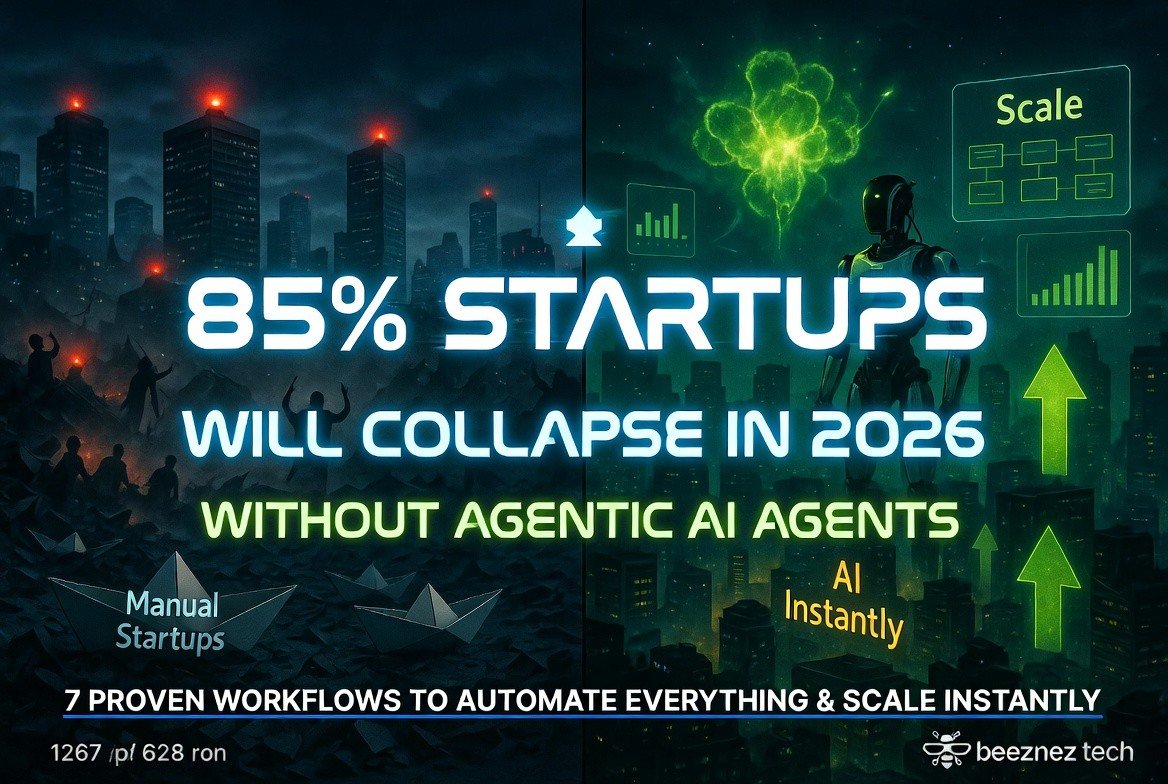
The numbers are brutal: roughly 90% of startups still fail. But there’s a shift happening in 2026 that isn’t getting talked about enough — the gap between startups that use agentic AI and those that don’t is widening fast, and it’s starting to show up directly in survival rates.
Traditional founders are burning cash on hires, endless meetings, and manual busywork. Meanwhile, the startups that survive and scale have already replaced large chunks of their operations with autonomous agentic AI systems that plan, execute, and iterate around the clock at near-zero marginal cost.
This isn’t hype — it’s agentic engineering in action, the same shift that’s been building since the first multi-agent orchestration frameworks went into production. Below are 7 practical agentic AI workflows, plus a rough 30-day plan for putting them to work.
Why Manual Operations Are Falling Behind
CB Insights’ most recent postmortem analysis of failed startups keeps landing on the same causes: no market need (42%), running out of cash (29–38%), getting outcompeted, and team, pricing, or timing problems. What’s changed in 2026 is that these failure modes are now amplified by the agentic AI gap.
A traditional startup might spend $50K/month on manual market research, design sprints, lead qualification, support, and finance spreadsheets. A startup running agentic workflows handles the same tasks for pennies per hour, 24/7, with no fatigue and instant replication. Competitors using multi-agent systems ship features faster, iterate at scale, and adapt in real time.
| Aspect | Traditional Generative AI | Agentic AI |
|---|---|---|
| Primary Function | One-off outputs from prompts | Goal-driven autonomy, tool use, self-correction |
| Human Dependency | High (constant prompting) | Low (multi-step execution with feedback loops) |
| Workflow Capability | Single tasks | Full end-to-end orchestration |
| Cost Model | Pay-per-token plus human oversight | Near-zero marginal cost after setup |
What Agentic AI Agents Actually Are
Agentic AI agents aren’t chatbots. They’re autonomous systems that:
- Break high-level goals into multi-step plans
- Use tools, APIs, databases, and external services
- Self-correct through reflection loops
- Collaborate in multi-agent teams (an orchestrator plus specialist agents)
This is agentic engineering: building reliable, observable, production-grade agent systems. Frameworks like LangGraph, CrewAI, and AutoGen have matured into genuinely enterprise-ready orchestration layers. One agent behaves like a tireless junior employee. A full multi-agent team can approximate an entire department at a fraction of the cost.
7 Agentic AI Workflows Worth Implementing
1. Market Intelligence & Product Validation
Addresses the #1 failure reason (no market need). A research agent scrapes trends and competitor data; a validation agent runs synthetic interviews and sentiment analysis; a synthesis agent turns findings into a daily product roadmap. Implementation: CrewAI with web search tools, feeding into Notion or Airtable. Impact: cuts validation time from weeks to days.
2. Agentic Coding Pipeline
A planning agent breaks tickets into subtasks; a coding agent generates the implementation and tests; a review agent runs security and quality checks; a deploy agent pushes to production, with human approval required only for high-risk changes. Implementation: LangGraph with GitHub CI/CD integration.
3. Lead Generation & Sales Orchestration
A research agent enriches leads; a personalization agent crafts targeted outreach; an outreach agent sends and follows up; a qualifier agent books demos. Implementation: CrewAI with LinkedIn/Gmail tools and CRM sync.
4. 24/7 Customer Support & Success
A triage agent routes tickets; a resolver agent handles routine cases autonomously; a success agent watches for churn and upsell signals and acts on them. Implementation: AutoGen with Zendesk/Slack integration.
5. Cash Flow & Financial Operations
A forecasting agent models burn rate; a collections agent chases outstanding invoices; a fundraising-prep agent generates pitch materials from live metrics. Implementation: LangGraph connected to accounting APIs and spreadsheet tools.
6. Hiring, Screening & Onboarding
A sourcing agent reviews resumes and GitHub profiles; a scheduling agent books and coordinates interviews; an onboarding agent builds a tailored 30-day plan for new hires. Implementation: multi-agent setup with LinkedIn, calendar, and HRIS tools.
7. Business Orchestrator (“CEO Agent”)
A master agent that coordinates all six workflows above, produces daily summaries, flags problems, and surfaces strategic recommendations. Implementation: a hierarchical LangGraph setup with human-in-the-loop guardrails at every major decision point.
A Rough 30-Day Launch Plan
- Pick one workflow to start — workflow 1 or 2 is usually the easiest entry point
- Prototype it in LangGraph or CrewAI (both have free tiers)
- Add observability (LangSmith or Langfuse)
- Implement guardrails and human approval gates before anything touches production
- Scale gradually with proper cost monitoring
Security, data privacy, and human oversight aren’t optional here — use established protocols for safe inter-agent communication, and keep a human in the loop for anything consequential.
Five Mistakes to Avoid
- No guardrails, leading to hallucinated actions taken autonomously
- Poor data quality feeding the agents (garbage in, garbage out)
- Vendor lock-in — favor open frameworks where possible
- Skipping human oversight entirely
- Treating agents as “set and forget” rather than systems that need ongoing governance
The Bottom Line
The gap is closing fast. Agentic AI isn’t a nice-to-have for startups in 2026 — it’s increasingly the difference between joining the majority that fail and the minority that scale. The founders acting on this now will look back at 2026 as the year the operating model changed.
Related Reading
- Is AI Actually Taking Jobs in 2026? What the Data Really Shows
- AI Agent Governance 101: How Small Businesses Can Deploy Agentic AI Without Losing Control
- Context Engineering vs Agentic Engineering: The Ultimate Key Differences That Define Modern AI Systems in 2026
- 8 Best No-Code Agentic AI Builders in 2026: Which One Actually Delivers Autonomous Workflows?