Introduction
Tired of spending hours digging for keywords, only to watch your search rankings barely budge? It’s frustrating. The digital world moves fast, and every minute lost on outdated methods is money you’ll never see. Here’s the good news: AI keyword research tools are here, and they’re changing the game. They help you work smarter, spot hidden opportunities, and—if you use them right—can send your site traffic soaring, sometimes by 300% or more. With AI keyword research tools on your side, you stop guessing and start making moves based on real data.
These AI keyword research tools use machine learning to churn through massive piles of data, spot trends, and toss you high-value keywords faster than you ever could on your own. Forget the old way of doing things. This is your shot at serious growth. Let’s jump in and see how these tools can shake up your SEO approach—starting right now.
AI keyword researchTools: The Foundation of Keyword Strategy
Before you let AI do the heavy lifting, you need a solid foundation. You have to know which types of keywords actually matter for your goals.
So, what are the four main types of keywords? Here’s the rundown: Informational (people searching for knowledge—think “how to bake cookies”), Navigational (looking for a specific site, like “YouTube login”), Transactional (ready to buy—“buy running shoes online”), and Commercial (research before buying, like “best laptops 2026”). Nail these basics, and you’ll use AI keyword tools to find the exact terms that match what people are really searching for.
The 7 AI keyword researchTools for High-ROI Keywords
Ready to take your SEO up a notch? Here are seven of the top AI keyword research tools making waves in 2026. Each one brings something different to the table. Just remember, always double-check your results using a Google Keyword search volume tool or a keyword volume checker extension to make sure the numbers add up. If you want to keep costs down, there are some free tools out there—but keep in mind, the paid versions usually give you deeper insights.
- SEMrush: This is the heavy hitter. It uses AI to give you a full picture of your keyword landscape—competitive analysis, trend predictions, all of it. Perfect for big teams or anyone serious about growth. Expect to pay around $129 a month.
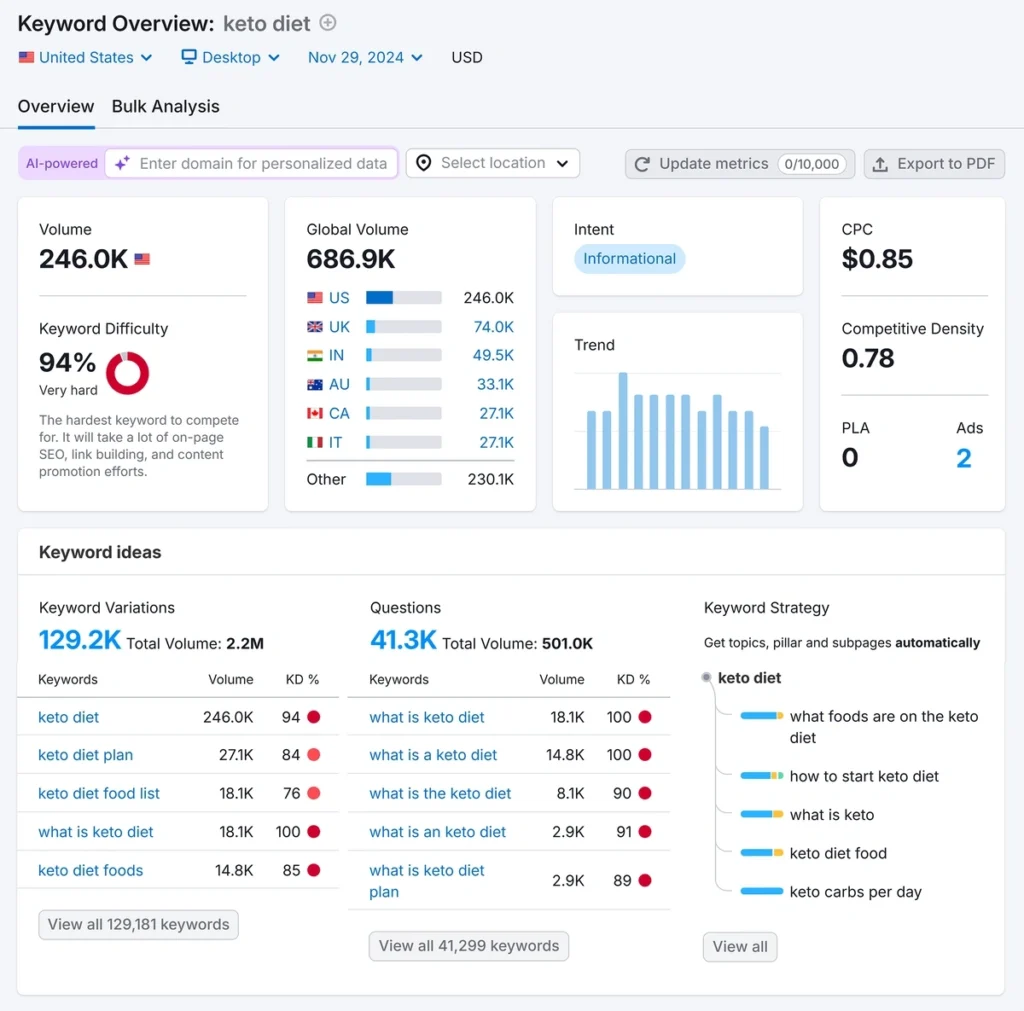
SEMrush really is one of the most powerful options out there. If I just want a quick burst of inspiration, I’ll check out the free keyword research tool on Exploding Topics. But SEMrush goes way beyond that. Inside SEMrush, you get several different keyword research tools, each with its own strengths. Let’s break down what each one does best.
Keyword Overview
The Keyword Overview tool hands you all the key info for any given keyword—search volume, difficulty, CPC, and more. It’s your starting point for figuring out if a keyword’s worth the effort.
- Ahrefs: Known for its huge backlink database, Ahrefs’ AI-powered keyword explorer digs up insights across different platforms. If you want to get into the nitty-gritty of search volume and keyword difficulty, this tool’s got you covered. Plans start at $99 a month.
- Surfer SEO: This one zeros in on content optimization and keyword research. This Among most of the AI keyword research tools, Surfer SEO uses AI to break down what makes top-ranking pages tick, so you can tweak your content and climb the rankings. Prices kick off at $59 a month..
- Clearscope: Clearscope: Here’s a tool that shines with its AI-driven content scoring and keyword clustering. This AI keyword research tool gives you smart recommendations to help your content nail user intent and rank higher. Pricing starts at $170 a month.
- Moz Pro: A classic in the SEO world, now with AI-powered keyword suggestions and SERP analysis. It’s easy to use, even if you’re just getting started, and helps you keep tabs on your performance over time. Plans start at $99 a month.
- Ubersuggest: Developed by Neil Patel, Ubersuggest stands out with a solid free version for basic SEO research. It’s a great starting point if you want something that won’t cost you right away. For more advanced features, paid plans start at $29 a month.
- WordStream: Specializes in PPC but shines in free keyword discovery. Its AI pulls from Google data for quick, actionable lists – a solid free AI keyword research tool result to start with.
Quick Comparison Table of AI Keyword Research Tools
| Tool | Best For | Key AI Feature | Starting Price | Free Tier? |
|---|---|---|---|---|
| SEMrush | Comprehensive Analysis | Trend Forecasting | $129/month | No |
| Ahrefs | Backlink Integration | Multi-Platform Insights | $99/month | No |
| Surfer SEO | Content Optimization | SERP Analysis | $59/month | Limited |
| Clearscope | Keyword Clustering | Content Scoring | $170/month | No |
| Moz Pro | Beginner-Friendly | Performance Tracking | $99/month | Limited |
| Ubersuggest | Budget Options | Free Keyword Suggestions | $29/month | Yes |
| WordStream | PPC-Focused Keywords | Google Data Integration | $49/month | Yes |
AI keyword research tools take the hassle out of finding high-ROI keywords. Pair them with a keyword volume checker extension, and you can instantly see if those keywords are worth chasing.
Digging Into User Intent
If you want to win at SEO, you need to understand what people really want. That’s where user intent comes in—it’s the key ingredient. AI keyword tools are great at uncovering the exact questions people type into Google. Instead of just “faucet,” you’ll find gems like “how to fix a leaky faucet.”
These AI keyword research tools pick up on search patterns and pull out those natural, conversational queries. They’re perfect for landing featured snippets and showing up in voice search. Target these, and you’ll pull in more organic traffic—and probably start climbing the rankings.
How to Get That “300% Traffic Boost”
Once you’re using AI keyword research tools, here’s how to make them work even harder for you:
Build Content Clusters: Take related keywords and organize them into pillar pages and supporting articles. This shows search engines you know your stuff and helps build your site’s authority.
Optimize On-Page SEO: Work your keywords into titles, headers, and meta descriptions so they feel natural. Use your AI tools to check keyword density and sidestep keyword stuffing.
Monitor and Tweak: Keep an eye on your performance with analytics. Use new data from your AI tools to make improvements. Stick with this cycle, and you can see your traffic skyrocket.
FAQs
Which of the AI keyword research tools is best for keyword research?
It really depends on what you need. SEMrush is packed with features, Ahrefs goes deep, and Ubersuggest is easy on the wallet. Try a few and see what clicks.
How do AI keyword research tools help you find real questions people are asking?
They’re built to spot question-based searches by looking at trends and user habits. Tools like SEMrush and Ahrefs scan for “how,” “what,” “who,” and other question words so you can target featured snippets and voice search. Just drop in a seed keyword, and they’ll spit out a list of actual questions people ask—perfect for content that gets clicks.
What is a Google Keyword search volume tool, and how does it work with AI?
A Google Keyword search volume tool—think Google Keyword Planner—gives you real search volume straight from the source. When you pair it with AI tools like Ubersuggest, you get both ideas and proof those keywords can bring in real traffic. It’s a solid way to double-check your choices.
Is there a reliable keyword volume checker extension for quick checks?
Totally. Tools like Keywords Everywhere plug right into your browser and show you search volumes as you browse. Pair this with your favorite AI research tool, and you can validate keywords on the fly, right in your workflow. It’s a huge time saver.
How should I evaluate free AI keyword research tools results?
Free tools like WordStream or Ubersuggest are good for getting started, but always double-check their data against paid tools if you can. Free versions sometimes limit what you can export or don’t show trends over time. Cross-reference with something like Google Keyword Planner to make sure the numbers add up.
Are there good free SEO research tools for beginners?
Yes—look at Moz’s Keyword Explorer free tier or Ubersuggest’s basic version. They give you a taste of search volume and competition without costing a dime. As your needs grow, you can upgrade for more features and bigger results.
Is WordStream really free?
WordStream’s keyword tool is free for basic research and uses Google data. If you want their full Advisor suite, though, that starts at $49 a month and gets you more advanced features.
Wrapping Up
AI keyword research tools make tough SEO work simple. They open up high-ROI opportunities and can seriously boost your traffic. Whether you’re just starting out or ready to go big, these AI keyword research tools give you the edge.
So why wait? Pick a tool, give it a try, and start seeing real results. Your next traffic surge could be just a few keywords away.
──────────────────────────────
Disclosure: Some links in this article are affiliate links. If you purchase through them, I may earn a small commission at no extra cost to you. I only recommend tools I’ve tested or genuinely believe will help your business grow.
──────────────────────────────
Thanks for reading! If you found this helpful, share it with a founder who needs smarter automation.