McKinsey finally put hard numbers to a question founders and SaaS vendors have argued about for the last couple of years: should you build vs buy AI? Their State of AI 2026 survey, which came out on August 25, 2026, shows that AI coding tools are starting to tip the scales toward building software in-house instead of buying it.
They surveyed 1,719 organizations and found that 32% had canceled at least one software purchase or skipped buying a feature because they used agentic coding tools to build what they needed themselves. That’s a pretty clear warning sign for SaaS vendors. For buyers, the build vs buy AI debate is set to play a much bigger role in future software deals and contract renewals.
What McKinsey’s Survey Actually Found
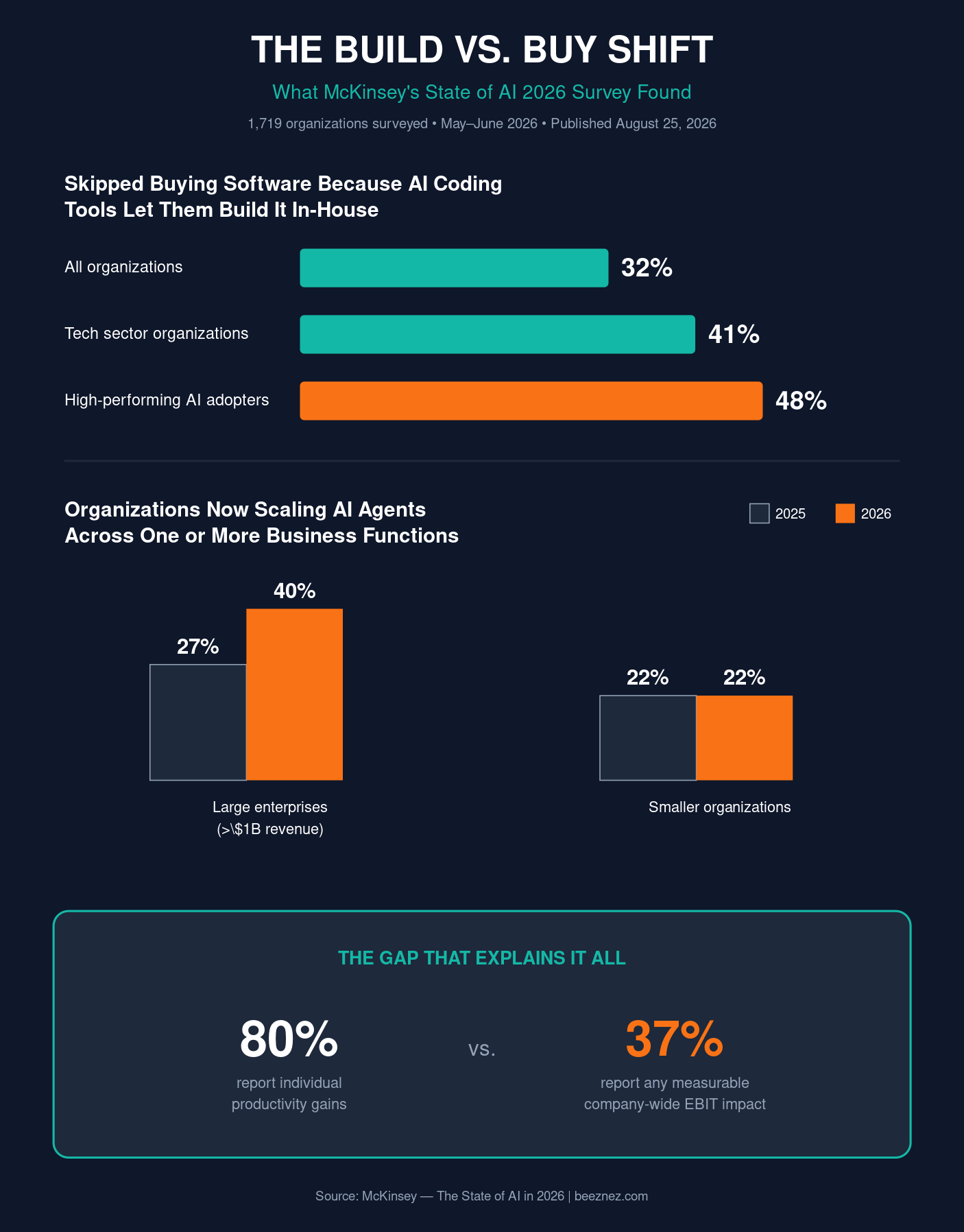
McKinsey fielded its State of AI 2026 survey between May 4 and June 8, gathering responses from 1,719 participants across 97 countries. The build vs buy AI finding was one of the standout results: 32 percent of organizations overall have skipped a software purchase in favor of building it themselves with agentic coding tools, and the number climbs to 41 percent among technology-sector organizations specifically.
The effect is sharpest among what McKinsey calls high performers, the 6 percent of respondents whose organizations attribute at least 5 percent of their EBIT directly to AI. Within that group, nearly half report skipping a software purchase, compared to 31 percent of everyone else. These are the companies furthest along in redesigning their workflows around AI, and they are also the ones most willing to ask whether a SaaS contract is still worth signing.
It’s Not Just Small Tools: Large Enterprises Are Scaling Fast
The build vs buy AI shift is happening alongside a broader jump in AI agent adoption. Large enterprises, those with more than $1 billion in annual revenue, reported that 40 percent are now scaling AI agents across one or more business functions, up sharply from 27 percent the year before. Smaller organizations have not kept pace, holding flat at 22 percent both years.
That gap matters for how you read the build vs buy AI number. It is being driven disproportionately by organizations with the engineering headcount and AI maturity to actually pull off an in-house build. A five-person startup skipping a $30-a-month tool is a different story than an enterprise IT department redirecting a multi-year SaaS budget into internal tooling.
The Build vs Buy AI Gap That Should Worry Everyone
Here is the detail that puts the whole build vs buy trend in perspective. In the same survey, 80 percent of respondents reported individual productivity gains from AI. Only 37 percent reported any measurable, enterprise-wide EBIT impact, a figure that stayed essentially flat compared to the previous year’s survey.
That gap is the real story underneath the headline. Individuals feel faster. Finance departments mostly can’t point to the number yet. A company that replaces a SaaS subscription with an internal build has swapped a predictable monthly cost for an unmeasured one: engineering time, maintenance, security patching, and the risk that the tool quietly breaks the next time an API changes. McKinsey’s own data suggests plenty of organizations are making that trade before they can actually prove it pays off.
What This Means If You Sell Software
- Assume your buyer has priced out building it themselves. Even if they don’t build it, the fact that they could changes what they’re willing to pay and how long they’ll tolerate friction in your product.
- Workflow-automation and internal-admin tools are most exposed. These are consistently the categories builders replace first, since the logic is often simple enough for an agentic coding tool to reproduce.
- Your defensibility has to be more than the interface. Data you’ve accumulated, integrations you maintain, and compliance work you’ve already done are much harder to replicate in a weekend build than a CRUD dashboard is.
What This Means If You Buy Software
- Price the real cost of building it yourself before you do, including the maintenance and security work that doesn’t show up in a weekend prototype’s demo.
- Use the option as leverage, not just an exit. A credible build-it-yourself alternative is one of the strongest renewal negotiating positions you’ve had in years.
- Watch for the EBIT gap in your own numbers. If a tool you built in-house is saving individual hours but you can’t point to a company-level number after a quarter or two, that’s the exact pattern McKinsey’s survey is describing.
If your team is evaluating whether to build a feature internally with AI, our piece on vibe coding and what non-developers can realistically build is a useful next read, and our breakdown of outcome-based AI agent pricing covers what vendors often leave out of the buy side of this decision. For the full survey results, McKinsey’s State of AI 2026 report is the primary source.
Key Takeaways: Build vs Buy AI
The build vs buy AI shift is real and it is measurable, but McKinsey’s own numbers show it is running ahead of proof. Thirty-two percent of companies are skipping a software purchase because they can build it themselves. Only 37 percent can point to a company-wide financial return from AI at all. Somewhere in that gap sits a lot of internal tools that will look like a bargain in the demo and a burden a year from now.